McLaren

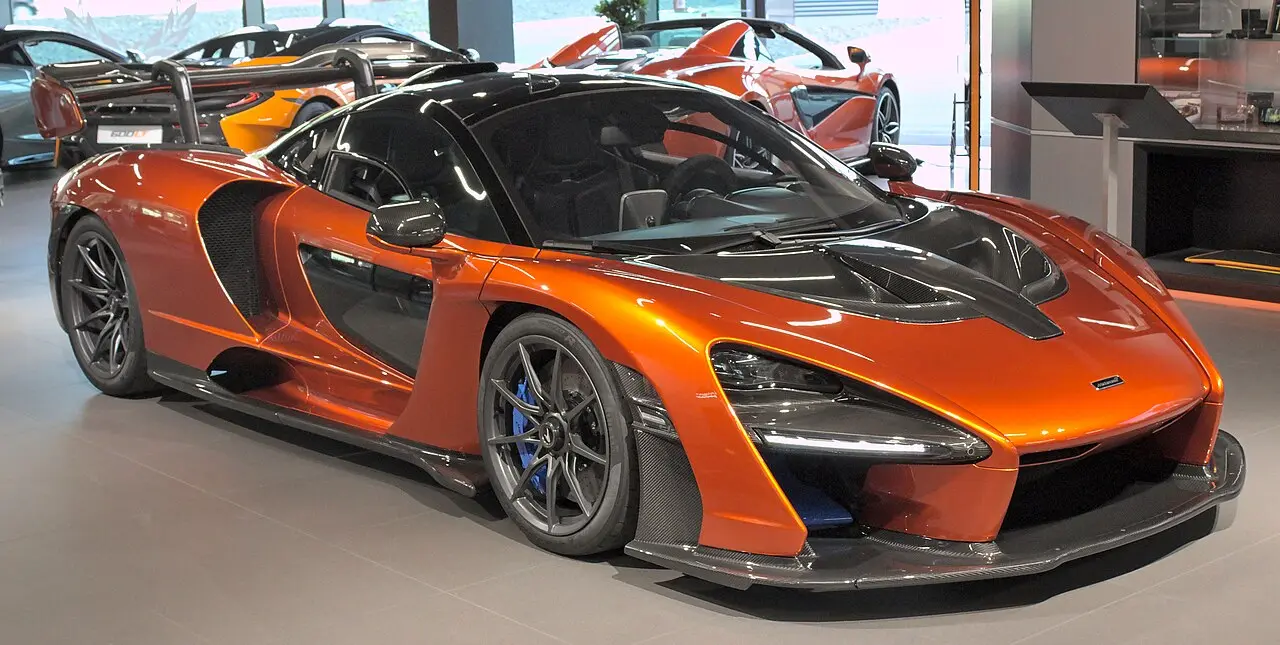
McLaren Senna

McLaren Senna
Photo: Alexander Migl / Wikimedia Commons · CC BY-SA 4.0

The official data lists 6 versions of the McLaren Senna (2018–2023), in the European Union, the United Kingdom, and the United States. Each market publishes its own figures, measured on its own test procedure.

At a glance

Years in the data
2018–2023
Markets
European Union, United Kingdom, United States
Engines
4.0 L to 4.0 L
Power
588 kW (799 PS)
Fuels
Petrol
Lowest consumption (United Kingdom)
12.4 L/100 km (WLTP)
Lowest consumption (United States)
14.7 L/100 km (EPA)
New registrations in the EU
240

What is the McLaren Senna?

The Senna is a two-seat, mid-engined supercar built with track driving in mind. It is part of McLaren’s Ultimate Series, the range for its most focused, limited-production cars. Named after Formula One driver Ayrton Senna, it has active aerodynamic features, including front aero blades and a rear wing, to generate downforce. Its road-legal design puts the emphasis on the driving experience.

Generation and engines

The Senna’s P15 generation is listed for 2018–2019. It uses a 4.0-litre petrol engine producing 588 kW (799 PS).

Fuel consumption

The UK VCA figure is 12.4 L/100 km on the WLTP test. In the US, the EPA gives a combined rating of 16 MPG, equivalent to 14.7 L/100 km. These results use different test procedures, so they are not directly comparable.

Where was it sold?

European Economic Area registrations run from 2018 to 2020 and total 240. The largest annual count was 146 in 2019, followed by 70 in 2018 and 24 in 2020. UK VCA figures cover 2019–2023, while the US EPA entry covers 2019.

Questions and answers

How much power does the McLaren Senna have?

Its 4.0-litre petrol engine produces 588 kW (799 PS).

What is the Senna’s official fuel consumption?

The UK WLTP figure is 12.4 L/100 km. The US EPA combined rating is 16 MPG, or 14.7 L/100 km. The tests use different procedures.

When was the Senna generation sold?

The P15 generation is listed for 2018–2019. European Economic Area registrations run through 2020, and UK VCA figures through 2023.

Senna Senna (2018–2019)

McLaren Senna Senna
Photo: Alexander Migl / Wikimedia Commons · CC BY-SA 4.0

Model codes: P15 · References: en.wikipedia.org, senna.com

European Union 2 versions

New cars registered in the EU (plus Norway and Iceland), from the European Environment Agency. Figures on the NEDC procedure until 2020 and on WLTP from 2021; versions are grouped by engine and power, with their number of registrations.

Years and versionEnginePowerFuelCO₂EU registrations
20194.0 L588 kW (799 PS)Petrol268 g/km146
20184.0 L588 kW (799 PS)Petrol268 g/km70

United Kingdom 1 version

New cars on sale in the UK, from the Vehicle Certification Agency. NEDC figures until 2018 and WLTP figures after; years are the editions a version appeared in.

Years and versionEnginePowerFuelConsumption (combined)
2019Coupé (800 Ps)4.0 L588 kW (799 PS)Petrol12.4 L/100 km WLTP

United States 1 version

Model years sold in the USA, from the EPA and the Department of Energy (fueleconomy.gov). MPG on the EPA test; litres per 100 km = 235.215 ÷ MPG.

Years and versionEngineFuelGearboxDriveConsumption (combined)CO₂
20194.0 LPetrol7-speed automaticRear-wheel drive16 MPG (14.7 L/100 km) EPA354 g/km

Versions outside these generations

European Union 1 version

New cars registered in the EU (plus Norway and Iceland), from the European Environment Agency. Figures on the NEDC procedure until 2020 and on WLTP from 2021; versions are grouped by engine and power, with their number of registrations.

Years and versionEnginePowerFuelCO₂EU registrations
20204.0 L588 kW (799 PS)Petrol268 g/km24

United Kingdom 1 version

New cars on sale in the UK, from the Vehicle Certification Agency. NEDC figures until 2018 and WLTP figures after; years are the editions a version appeared in.

Years and versionEnginePowerFuelConsumption (combined)CO₂
2020–2023Coupé (800 Ps)4.0 L588 kW (799 PS)Petrol12.4 L/100 km WLTP280 g/km

Official figures are measured on standard test procedures and differ between markets. Your consumption depends on how, where and in what conditions you drive.