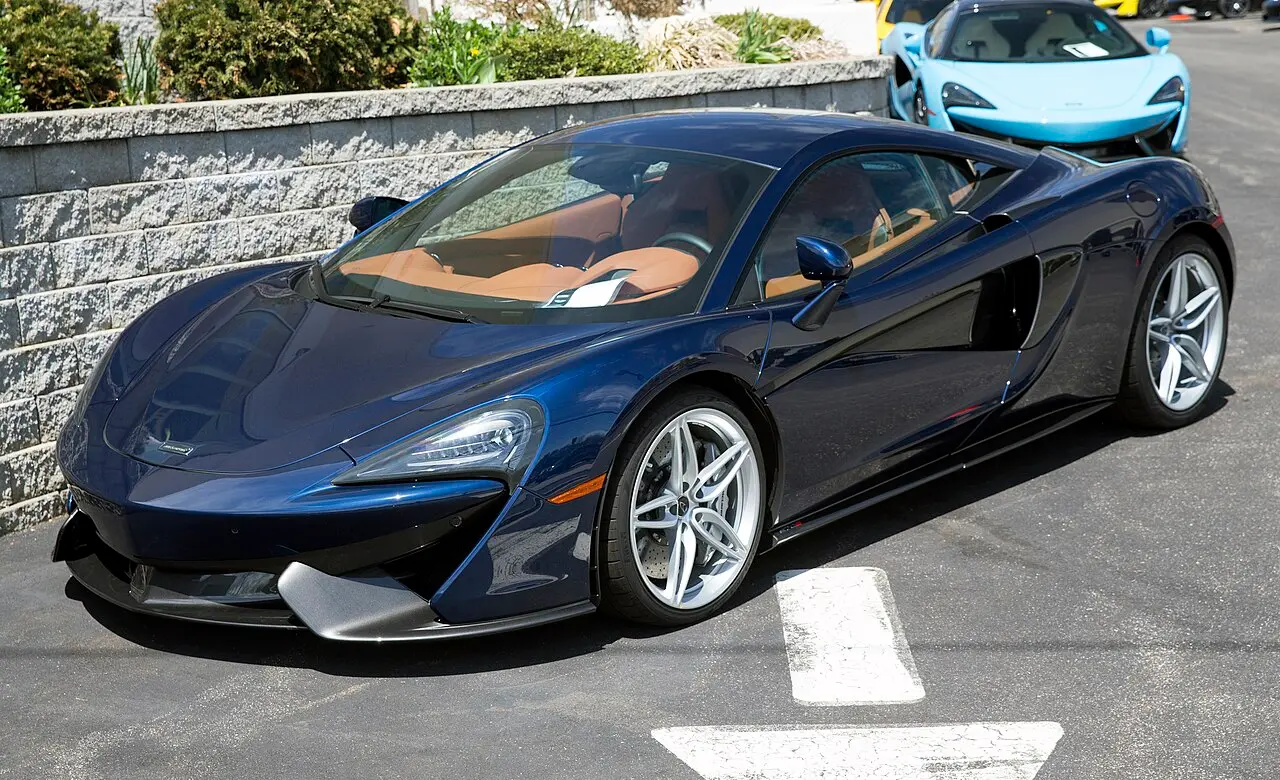
The official data lists 12 versions of the McLaren 570S (2015–2023), in the European Union, the United Kingdom, and the United States. Each market publishes its own figures, measured on its own test procedure.
At a glance
Years in the data
2015–2023
Markets
European Union, United Kingdom, United States
Engines
3.8 L to 3.8 L
Power
419 kW (570 PS) to 419 kW (570 PS)
Fuels
Petrol
Lowest consumption (United Kingdom)
10.7 L/100 km (NEDC)
Lowest consumption (United States)
12.4 L/100 km (EPA)
New registrations in the EU
2,166
What is the McLaren 570S?
The 570S is a two-seat sports car and a member of McLaren’s Sports Series. It arrived in 2015 as a coupe, bringing the marque’s mid-engined layout and carbon-fibre MonoCell construction to a more road-focused part of its range. McLaren’s racing background is reflected in the car’s lightweight structure and driver-focused design.
The 570S generation ran from 2015 to 2021. The Sports Series broadened McLaren’s road-car range while retaining the company’s emphasis on lightweight construction and performance.
Engines and power
The 570S used a 3.8-litre petrol engine. EU and UK figures list 419 kW (570 PS).
How economical is the McLaren 570S?
The UK figure is 10.7 L/100 km on the NEDC test. In the United States, the EPA rating is 12.4 L/100 km, or 19 MPG combined. NEDC and EPA use different procedures, so the results are best understood within their own markets.
Official EU registration figures total 2,166 cars from 2015 to 2020. The largest annual totals shown are 682 in 2018, 544 in 2017 and 426 in 2019.
Where was the 570S sold?
The 570S was listed in official figures for the European Union, the United Kingdom and the United States. As a Sports Series coupe, it brought McLaren’s mid-engined layout and carbon-fibre construction to a road-focused model in the range.
Questions and answers
What engine is in the McLaren 570S?
A 3.8-litre petrol engine producing 419 kW (570 PS) in EU and UK listings.
What is the 570S’s official fuel consumption?
The UK NEDC figure is 10.7 L/100 km; the US EPA rating is 12.4 L/100 km, or 19 MPG combined.
New cars registered in the EU (plus Norway and Iceland), from the European Environment Agency. Figures on the NEDC procedure until 2020 and on WLTP from 2021; versions are grouped by engine and power, with their number of registrations.
Years and version
Engine
Power
Fuel
CO₂
EU registrations
2020
3.8 L
419 kW (570 PS)
Petrol
249 g/km
72
2019
3.8 L
419 kW (570 PS)
Petrol
249 g/km
426
2018
3.8 L
419 kW (570 PS)
Petrol
249 g/km
682
2017
3.8 L
419 kW (570 PS)
Petrol
249 g/km
544
2016
3.8 L
419 kW (570 PS)
Petrol
249 g/km
414
2015
3.8 L
419 kW (570 PS)
Petrol
249 g/km
28
United Kingdom 3 versions
New cars on sale in the UK, from the Vehicle Certification Agency. NEDC figures until 2018 and WLTP figures after; years are the editions a version appeared in.
Years and version
Engine
Power
Fuel
Consumption (combined)
CO₂
2020–2023Coupé (570 Ps) · Spider (570 Ps)
3.8 L
419 kW (570 PS)
Petrol
12.2 L/100 km WLTP
276 g/km
2019Coupé (570 Ps) · Spider (570 Ps)
3.8 L
419 kW (570 PS)
Petrol
12.2 L/100 km WLTP
–
2016–2018Coupé (570 Ps) sports muffler · Coupé (570 Ps) standard muffler · Spider (570 Ps) sports muffler and 1 more trim
3.8 L
419 kW (570 PS)
Petrol
10.7 L/100 km NEDC
249 g/km
United States 3 versions
Model years sold in the USA, from the EPA and the Department of Energy (fueleconomy.gov). MPG on the EPA test; litres per 100 km = 235.215 ÷ MPG.
Years and version
Engine
Fuel
Gearbox
Drive
Consumption (combined)
CO₂
2020
3.8 L
Petrol
7-speed automated manual
Rear-wheel drive
18 MPG (13.1 L/100 km) EPA
313 g/km
2019
3.8 L
Petrol
7-speed automatic
Rear-wheel drive
18 MPG (13.1 L/100 km) EPA
313 g/km
2016–2018
3.8 L
Petrol
7-speed automatic
Rear-wheel drive
19 MPG (12.4 L/100 km) EPA
299 g/km
Official figures are measured on standard test procedures and differ between markets. Your consumption depends on how, where and in what conditions you drive.