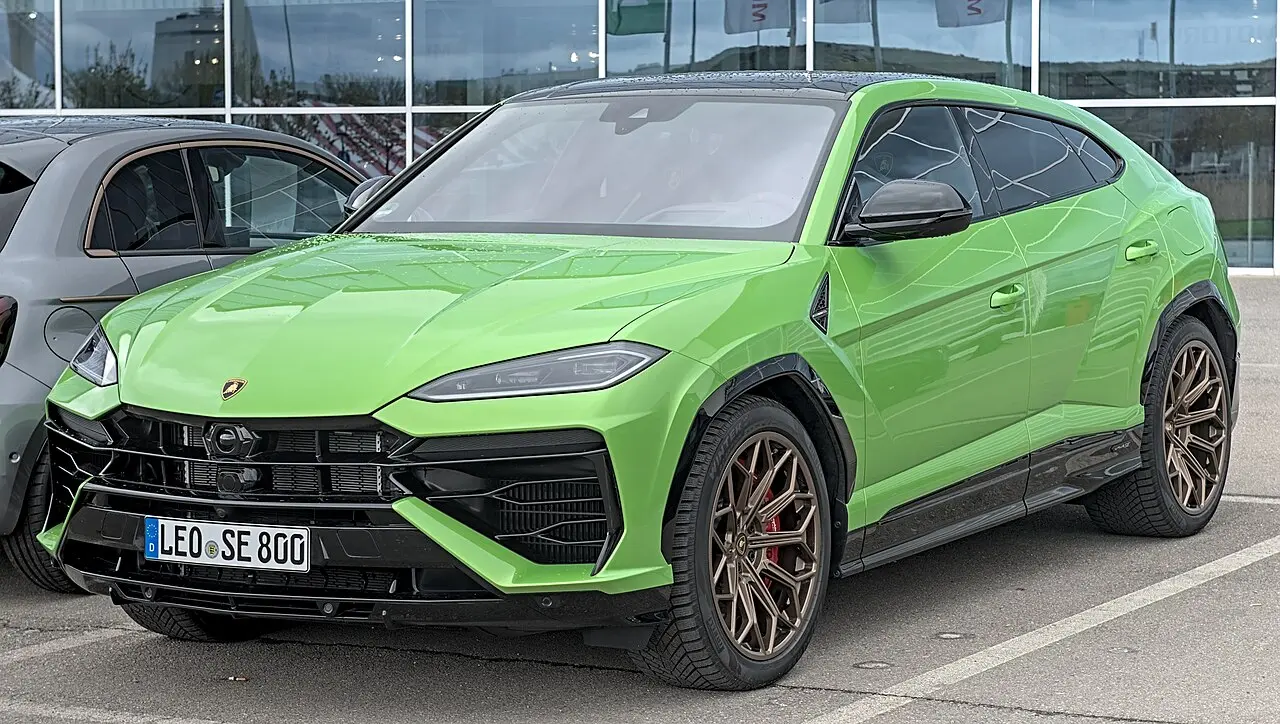
The official data lists 26 versions of the Lamborghini Urus (2018–2026), in the European Union, France, the United States, and Canada. Each market publishes its own figures, measured on its own test procedure.
At a glance
Years in the data
2018–2026
Markets
European Union, France, United States, Canada
Engines
4.0 L to 4.0 L
Power
456 kW (620 PS) to 490 kW (666 PS)
Fuels
Petrol, Plug-in hybrid, Hybrid
Lowest consumption (European Union)
12.7 L/100 km (WLTP)
Lowest consumption (United States)
14.7 L/100 km (EPA)
Lowest consumption (Canada)
14.8 L/100 km (5-cycle)
Plug-in hybrid, weighted (European Union)
2.7 L/100 km (WLTP)
Plug-in hybrid, weighted (United States)
11.8 L/100 km (EPA)
New registrations in the EU
10,476
What is the Lamborghini Urus?
The Urus is Lamborghini’s SUV, combining the brand’s sporting character with a taller, more versatile shape. Lamborghini calls it a Super Sport Utility Vehicle, and describes it as bringing together the soul of a super sports car and the functionality of an SUV.
Presented in 2018, the Urus opened a new model line for Lamborghini. Its angular body and distinctive design details bring the marque’s styling into an SUV. The Urus SE, a plug-in hybrid version, joined the range in 2024.
Generations and engines
The Urus has one generation, listed from 2018 to today. Across EU registration figures from 2018 to 2025, listed engines are 4.0 litres and power ranges from 456 kW (620 PS) to 490 kW (666 PS). The EU’s most registered specification was the 4.0-litre petrol version with 478 kW (650 PS), which led the figures in 2019, 2020 and 2021.
Lamborghini is known for its high-performance sports cars. The Urus brings that sporting identity to an SUV, with selectable driving modes and systems designed to support traction on different surfaces.
How economical is the Lamborghini Urus?
On the EU WLTP test, the lowest listed consumption for petrol, diesel or hybrid versions is 12.7 L/100 km. The plug-in hybrid’s official weighted figure is 2.7 L/100 km; it assumes that some driving is electric, so it is not directly comparable with the petrol figure.
In the United States, the EPA’s lowest listed figure for petrol, diesel or hybrid versions is 14.7 L/100 km, or 16 MPG combined. Its weighted plug-in hybrid figure is 11.8 L/100 km. Canada’s NRCan 5-cycle figures are 14.8 L/100 km for petrol, diesel or hybrid versions and 11.9 L/100 km for the plug-in hybrid. Test procedures differ: Europe uses WLTP, the USA uses EPA, and Canada uses a 5-cycle procedure.
Where was the Urus sold?
The Urus appears in EU registration figures from 2018 to 2025, France’s ADEME figures for 2026, US EPA figures from 2019 to 2026, and Canadian NRCan figures from 2019 to 2026. EU registration figures list 10,476 registrations over that period.
Questions and answers
When did the Lamborghini Urus first appear?
The Urus was presented in 2018. Its single generation is listed from 2018 to today.
What engines does the Urus use?
EU registration figures list 4.0-litre engines, with power from 456 kW (620 PS) to 490 kW (666 PS). The range includes petrol and plug-in hybrid versions.
What is the Urus’s official fuel consumption?
The lowest listed petrol, diesel or hybrid figure is 12.7 L/100 km on the EU WLTP test. The weighted plug-in hybrid figure is 2.7 L/100 km on WLTP and assumes some driving is electric.
How many Urus registrations are recorded in the EU?
EU registration figures list 10,476 from 2018 to 2025.
New cars registered in the EU (plus Norway and Iceland), from the European Environment Agency. Figures on the NEDC procedure until 2020 and on WLTP from 2021; versions are grouped by engine and power, with their number of registrations.
Years and version
Engine
Power
Fuel
Consumption (combined)
CO₂
Electric range
EU registrations
2025
4.0 L
456 kW (620 PS)
Plug-in hybrid
2.7 L/100 km WLTP33.4 kWh/100 km WLTP
66 g/km
68 km
1,365
2025
4.0 L
490 kW (666 PS)
Petrol
14.1 L/100 km WLTP
320 g/km
–
628
2025
4.0 L
456 kW (620 PS)
Hybrid
12.9 L/100 km WLTP
259 g/km
–
44
2025
4.0 L
441 kW (600 PS)
Plug-in hybrid
–
242 g/km
–
18
2024
4.0 L
490 kW (666 PS)
Petrol
14.1 L/100 km WLTP
320 g/km
–
1,099
2024
4.0 L
456 kW (620 PS)
Plug-in hybrid
2.1 L/100 km WLTP33.1 kWh/100 km WLTP
51 g/km
66 km
47
2024
4.0 L
441 kW (600 PS)
Plug-in hybrid
–
–
–
19
2023
4.0 L
490 kW (666 PS)
Petrol
14.1 L/100 km WLTP
311 g/km
–
614
2023
4.0 L
478 kW (650 PS)
Petrol
12.7 L/100 km WLTP
299 g/km
–
22
2022
4.0 L
478 kW (650 PS)
Petrol
12.7 L/100 km WLTP
324 g/km
–
437
2022
4.0 L
490 kW (666 PS)
Petrol
–
320 g/km
–
43
2021
4.0 L
478 kW (650 PS)
Petrol
12.7 L/100 km WLTP
325 g/km
–
1,862
2021
4.0 L
478 kW (650 PS)
Petrol
–
–
–
12
2020
4.0 L
478 kW (650 PS)
Petrol
–
292 g/km
–
1,772
2020
4.0 L
478 kW (650 PS)
Petrol
–
415 g/km
–
44
2019
4.0 L
478 kW (650 PS)
Petrol
–
293 g/km
–
1,988
2018
4.0 L
478 kW (650 PS)
Petrol
–
287 g/km
–
384
2018
4.0 L
–
Petrol
–
325 g/km
–
78
France 1 version
New cars on sale in France, from ADEME Car Labelling. NEDC figures until 2015, WLTP figures in the current catalogue.
Years and version
Engine
Power
Fuel
Gearbox
2026URUS
4.0 L
478 kW (650 PS)
Petrol
8-speed automatic
United States 4 versions
Model years sold in the USA, from the EPA and the Department of Energy (fueleconomy.gov). MPG on the EPA test; litres per 100 km = 235.215 ÷ MPG.
Years and version
Engine
Fuel
Gearbox
Drive
Consumption (combined)
CO₂
2026SIDI; PHEV
4.0 L
Plug-in hybrid
8-speed automatic
Four-wheel drive
20 MPG (11.8 L/100 km) EPA
156 g/km
2025SIDI; PHEV
4.0 L
Plug-in hybrid
8-speed automatic
Four-wheel drive
20 MPG (11.8 L/100 km) EPA
103 g/km
2023–2024SIDI
4.0 L
Petrol
8-speed automatic
All-wheel drive
16 MPG (14.7 L/100 km) EPA
344 g/km
2019–2022SIDI & PFI · SIDI
4.0 L
Petrol
8-speed automatic
All-wheel drive
14 MPG (16.8 L/100 km) EPA
383 g/km
Canada 3 versions
Model years sold in Canada, from Natural Resources Canada fuel consumption ratings (5-cycle test).
Years and version
Engine
Fuel
Gearbox
Consumption (combined)
CO₂
Electric range
2025–2026Sport utility vehicle: Standard
4.0 L
Plug-in hybrid
8-speed automatic
11.9 L/100 km 5-cycle
103 g/km
56 km
2023–2024Sport utility vehicle: Standard · Mid-size
4.0 L
Petrol
8-speed automatic
14.8 L/100 km 5-cycle
345 g/km
–
2019–2022Sport utility vehicle: Standard
4.0 L
Petrol
8-speed automatic
16.9 L/100 km 5-cycle
384 g/km
–
Official figures are measured on standard test procedures and differ between markets. Your consumption depends on how, where and in what conditions you drive.