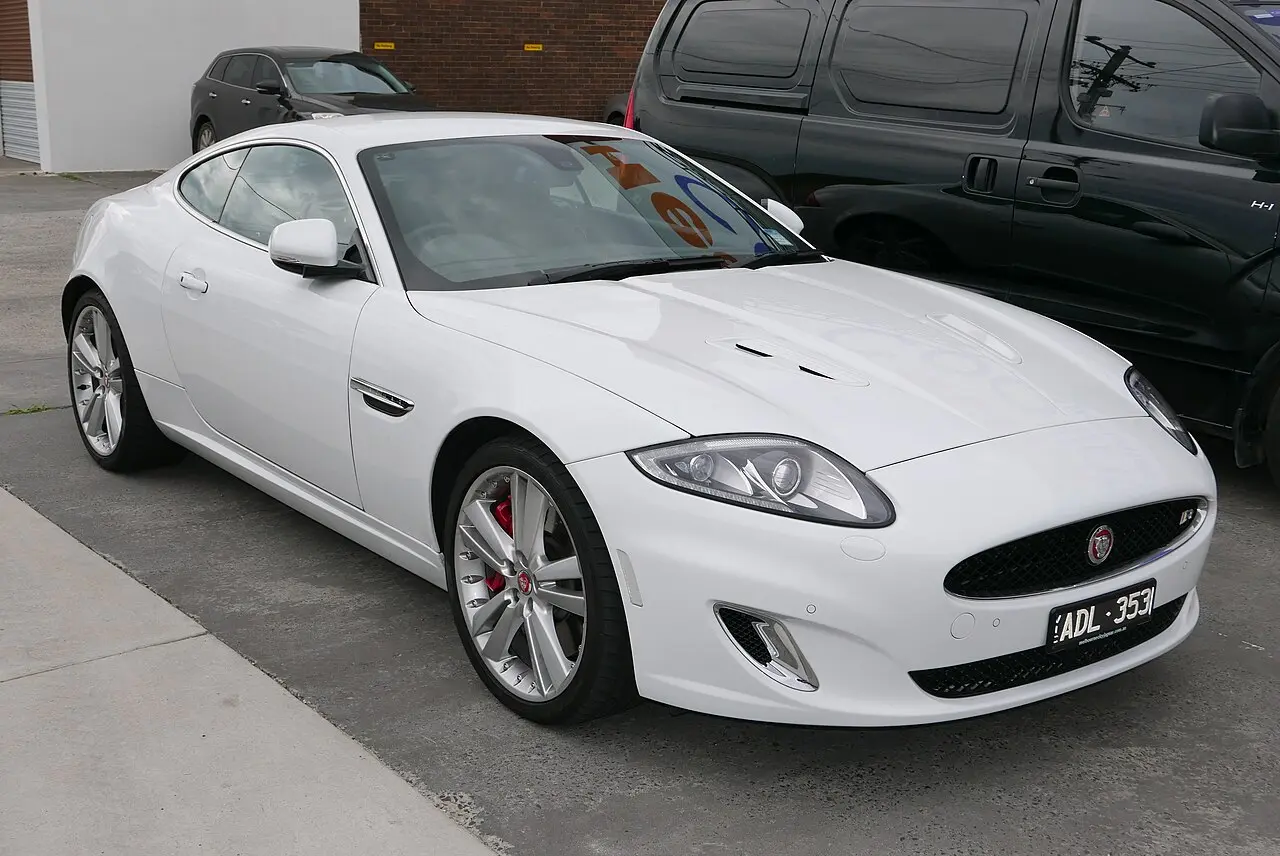
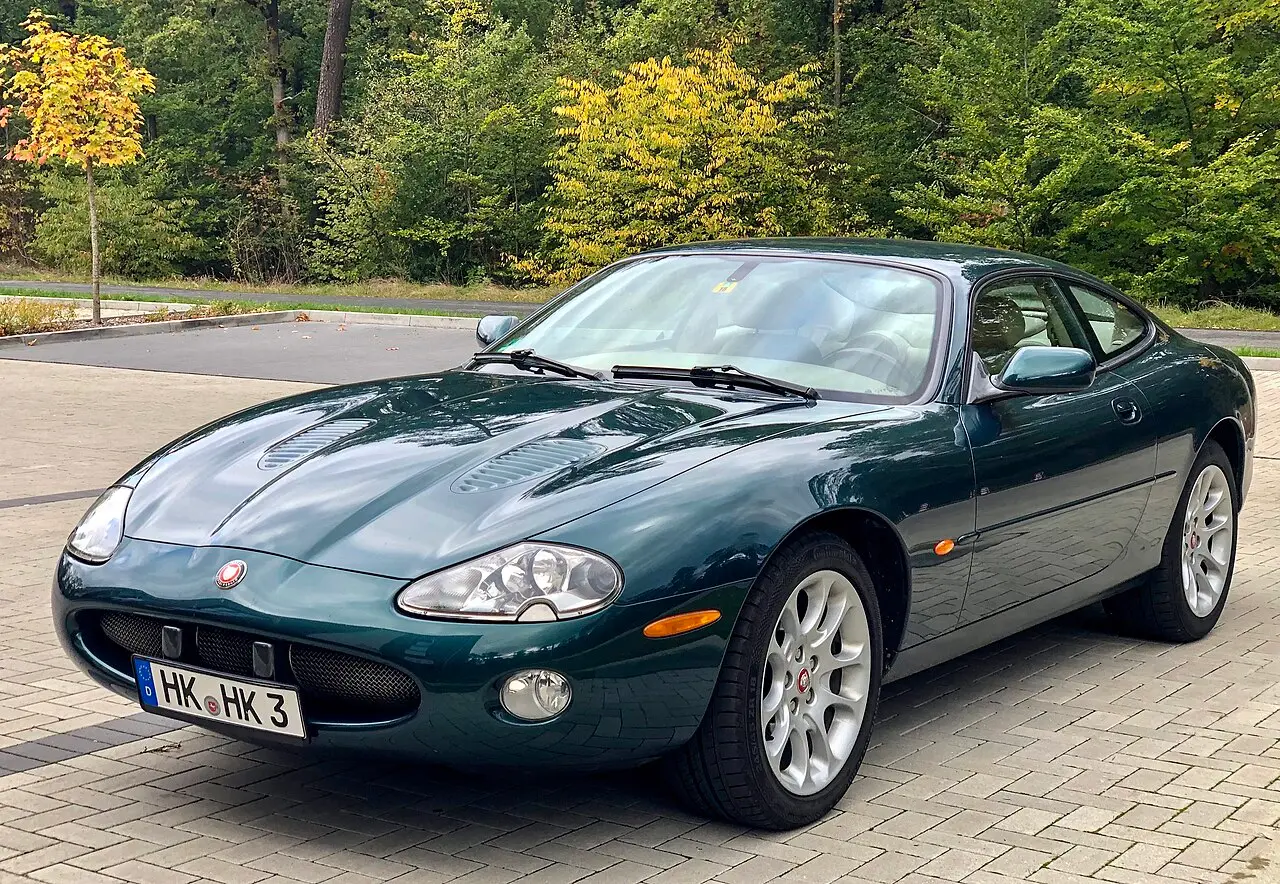
The official data lists 97 versions of the Jaguar XK (1997–2015), in the European Union, the United Kingdom, France, the United States, and Canada. Each market publishes its own figures, measured on its own test procedure.
At a glance
Years in the data
1997–2015
Markets
European Union, United Kingdom, France, United States, Canada
Engines
3.6 L to 5.0 L
Power
283 kW (385 PS) to 405 kW (551 PS)
Fuels
Petrol
Lowest consumption (France)
11.2 L/100 km (NEDC)
Lowest consumption (Canada)
11.2 L/100 km (5-cycle)
Lowest consumption (United Kingdom)
11.2 L/100 km (NEDC)
New registrations in the EU
18,855
What is the Jaguar XK?
The XK is a two-door grand touring sports car, offered as a coupé and convertible. Its blend of a sleek shape and long-distance comfort gave Jaguar’s sporting range a distinctive grand tourer. The X100 arrived as the XK8; its successor, the X150, used the simpler XK name.
XK generations
The generations were X100 (1996–2006) and X150 (2007–2015). The X100 XK8 brought a V8-powered grand tourer to Jaguar’s range. The X150 followed with an aluminium body and chassis, and introduced a new design direction under Ian Callum. Both generations came as coupés and convertibles.
Engines and power
The EU figures list petrol and other fuel classifications, with engines from 3.6 to 5.0 litres and power from 283 kW (385 PS) to 405 kW (551 PS). The 5.0-litre petrol version rated at 283 kW (385 PS) was a leading choice in the listed EU registrations. US and Canadian engine sizes ranged from 4.0 to 5.0 litres. The XK is listed with petrol engines in the UK, France, US and Canada.
How economical is the Jaguar XK?
The lowest listed UK and French figure is 11.2 L/100 km on NEDC. The US EPA low is 12.4 L/100 km, with a best listed combined rating of 19 MPG. Canada’s NRCan 5-cycle low is 11.2 L/100 km. The results use different procedures: NEDC in Europe, EPA in the US and 5-cycle in Canada. EU registrations totalled 18,855 between 2010 and 2015.
Where was the XK sold?
Official figures cover the EU, UK, France, US and Canada. The EU registration period is 2010–2015, while the national consumption figures span different years. The XK line began with the X100 XK8 and continued with the X150, which adopted aluminium construction.
Questions and answers
Was the Jaguar XK a coupé or convertible?
It was offered in both coupé and convertible body styles.
What are the XK generation names?
The two generations are X100 (1996–2006) and X150 (2007–2015).
What is the lowest listed fuel consumption?
The UK and France show 11.2 L/100 km on NEDC; the EPA low is 12.4 L/100 km and the Canadian 5-cycle low is 11.2 L/100 km.
What was the XK’s EU power range?
The listed EU range is 283 kW (385 PS) to 405 kW (551 PS).
New cars registered in the EU (plus Norway and Iceland), from the European Environment Agency. Figures on the NEDC procedure until 2020 and on WLTP from 2021; versions are grouped by engine and power, with their number of registrations.
Years and version
Engine
Power
Fuel
CO₂
EU registrations
2013–2015
5.0 L
283 kW (385 PS)
Petrol
264 g/km
5,480
2015
5.0 L
375 kW (510 PS)
Petrol
292 g/km
12
2014
5.0 L
375 kW (510 PS)
Petrol
292 g/km
176
2014
5.0 L
405 kW (551 PS)
Petrol
292 g/km
64
2011–2013
5.0 L
375 kW (510 PS)
Petrol
292 g/km
1,280
2012–2013
5.0 L
405 kW (551 PS)
Petrol
292 g/km
400
2013
5.0 L
–
Other fuel
267 g/km
18
2012
5.0 L
283 kW (385 PS)
Petrol
264 g/km
2,373
2011
5.0 L
283 kW (385 PS)
Petrol
264 g/km
3,668
2011
5.0 L
405 kW (551 PS)
Petrol
292 g/km
136
2011
5.0 L
390 kW (530 PS)
Petrol
292 g/km
48
2011
4.2 L
306 kW (416 PS)
Petrol
294 g/km
20
2010
5.0 L
–
Petrol
279 g/km
5,026
2010
4.2 L
–
Petrol
284 g/km
100
2010
3.6 L
–
Petrol
269 g/km
54
United Kingdom 10 versions
New cars on sale in the UK, from the Vehicle Certification Agency. NEDC figures until 2018 and WLTP figures after; years are the editions a version appeared in.
Model years sold in the USA, from the EPA and the Department of Energy (fueleconomy.gov). MPG on the EPA test; litres per 100 km = 235.215 ÷ MPG.
Years and version
Engine
Fuel
Gearbox
Drive
Consumption (combined)
CO₂
2013–2015SIDI
5.0 L
Petrol
6-speed automatic
Rear-wheel drive
17 MPG (13.8 L/100 km) EPA
320 g/km
2013–2015SIDI
5.0 L
Petrol
6-speed automatic
Rear-wheel drive
18 MPG (13.1 L/100 km) EPA
304 g/km
2013–2015SIDI
5.0 L
Petrol
6-speed automatic
Rear-wheel drive
19 MPG (12.4 L/100 km) EPA
294 g/km
2013–2015SIDI
5.0 L
Petrol
6-speed automatic
Rear-wheel drive
18 MPG (13.1 L/100 km) EPA
316 g/km
2010–2012SIDI
5.0 L
Petrol
6-speed automatic
Rear-wheel drive
19 MPG (12.4 L/100 km) EPA
291 g/km
2010–2012SIDI
5.0 L
Petrol
6-speed automatic
Rear-wheel drive
17 MPG (13.8 L/100 km) EPA
325 g/km
2010–2012SIDI
5.0 L
Petrol
6-speed automatic
Rear-wheel drive
18 MPG (13.1 L/100 km) EPA
307 g/km
2007–20093MODE CLKUP
4.2 L
Petrol
6-speed automatic
Rear-wheel drive
19 MPG (12.4 L/100 km) EPA
291 g/km
2007–20093MODE CLKUP
4.2 L
Petrol
6-speed automatic
Rear-wheel drive
18 MPG (13.1 L/100 km) EPA
307 g/km
Canada 12 versions
Model years sold in Canada, from Natural Resources Canada fuel consumption ratings (5-cycle test).
Years and version
Engine
Fuel
Gearbox
Consumption (combined)
CO₂
2015Minicompact
5.0 L
Petrol
6-speed automatic
13.6 L/100 km 5-cycle
313 g/km
2015Minicompact
5.0 L
Petrol
6-speed automatic
13.4 L/100 km 5-cycle
308 g/km
2010–2014Two-seater · Minicompact
5.0 L
Petrol
6-speed automatic
13.1 L/100 km 5-cycle
301 g/km
2013–2014Minicompact
5.0 L
Petrol
6-speed automatic
12.6 L/100 km 5-cycle
290 g/km
2014Minicompact
5.0 L
Petrol
6-speed automatic
13.7 L/100 km 5-cycle
315 g/km
2014Minicompact
5.0 L
Petrol
6-speed automatic
13.5 L/100 km 5-cycle
310 g/km
2013Minicompact
5.0 L
Petrol
6-speed automatic
13.6 L/100 km 5-cycle
313 g/km
2013Minicompact
5.0 L
Petrol
6-speed automatic
13.4 L/100 km 5-cycle
308 g/km
2010–2012Minicompact
5.0 L
Petrol
6-speed automatic
12.7 L/100 km 5-cycle
292 g/km
2010–2012Two-seater · Minicompact
5.0 L
Petrol
6-speed automatic
13.5 L/100 km 5-cycle
311 g/km
2007–2009Minicompact
4.2 L
Petrol
6-speed automatic
12.3 L/100 km 5-cycle
283 g/km
2007–2009Minicompact
4.2 L
Petrol
6-speed automatic
13.1 L/100 km 5-cycle
301 g/km
Official figures are measured on standard test procedures and differ between markets. Your consumption depends on how, where and in what conditions you drive.