Isuzu

Isuzu Rodeo

Isuzu Rodeo
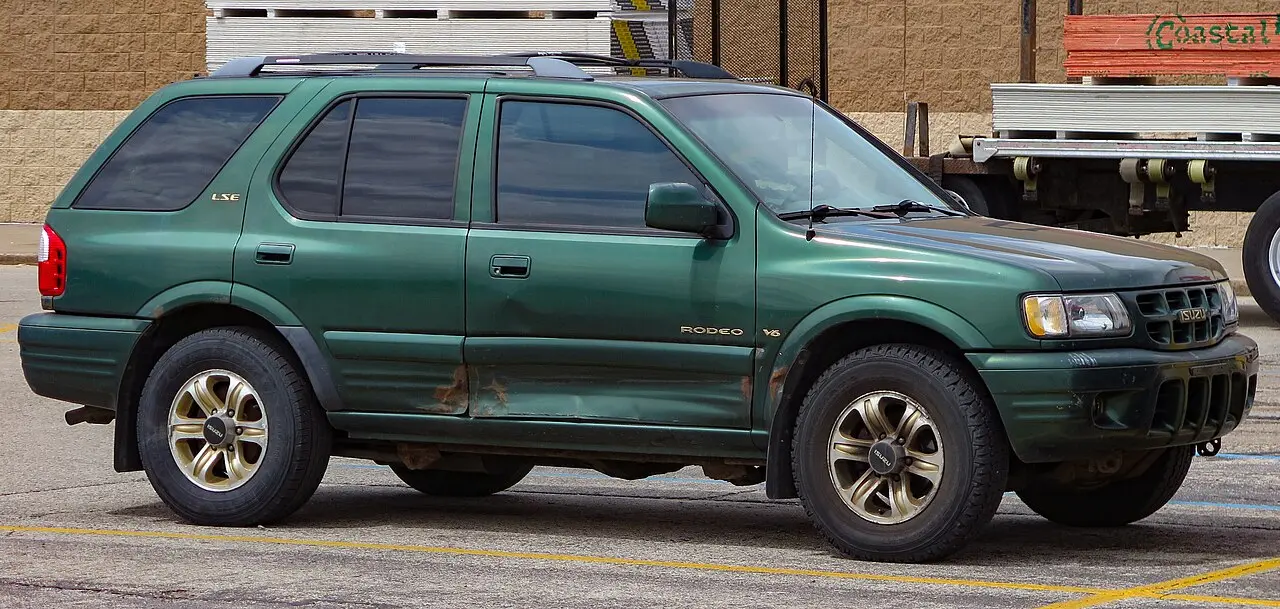
Photo: Elise240SX / Wikimedia Commons · CC BY-SA 4.0

The official data lists 58 versions of the Isuzu Rodeo (1991–2004), in the United States and Canada. Each market publishes its own figures, measured on its own test procedure.

At a glance

Years in the data
1991–2004
Markets
United States, Canada
Engines
2.2 L to 3.5 L
Fuels
Petrol
Lowest consumption (United States)
11.8 L/100 km (EPA)
Lowest consumption (Canada)
14.2 L/100 km (5-cycle)

What is the Isuzu Rodeo?

The Rodeo is a mid-size SUV that brought Isuzu’s light-truck experience to a practical family wagon. It sat below the larger Trooper in Isuzu’s range, offering a more compact option for everyday driving and rougher roads. The Rodeo name was also used for pickups in other markets; here it refers to the North American SUV.

Rodeo generations

The first generation ran from 1991 to 1997, followed by a redesigned second generation from 1998 to 2004. The later model kept the Rodeo’s practical, truck-based character while adopting a newer design. In the United States, it was also sold as the Honda Passport.

Engines, fuel use and where it was sold

In the United States, petrol engines ranged from 2.2 L to 3.5 L. The best combined EPA rating is 20 MPG, and the lowest listed consumption is 11.8 L/100 km on the EPA test. Canadian listings cover a 3.2 L petrol engine, with a lowest figure of 14.2 L/100 km on NRCan’s 5-cycle test. These results use different procedures and are not directly comparable. US EPA listings cover 1991–2004, while Canadian NRCan listings cover 1995–2002.

Questions and answers

Was the Isuzu Rodeo an SUV or a pickup?

The Rodeo discussed here is Isuzu’s North American mid-size SUV. Isuzu also used the Rodeo name for pickups in other markets.

What years did the Rodeo generations run?

The first generation ran from 1991 to 1997, followed by the second generation from 1998 to 2004.

What engines were available in the United States?

US listings include petrol engines from 2.2 L to 3.5 L.

How does the Canadian fuel figure compare with the US figure?

The lowest listed Canadian figure is 14.2 L/100 km on NRCan’s 5-cycle test; the lowest US figure is 11.8 L/100 km on the EPA test. The procedures differ, so the results are not directly comparable.
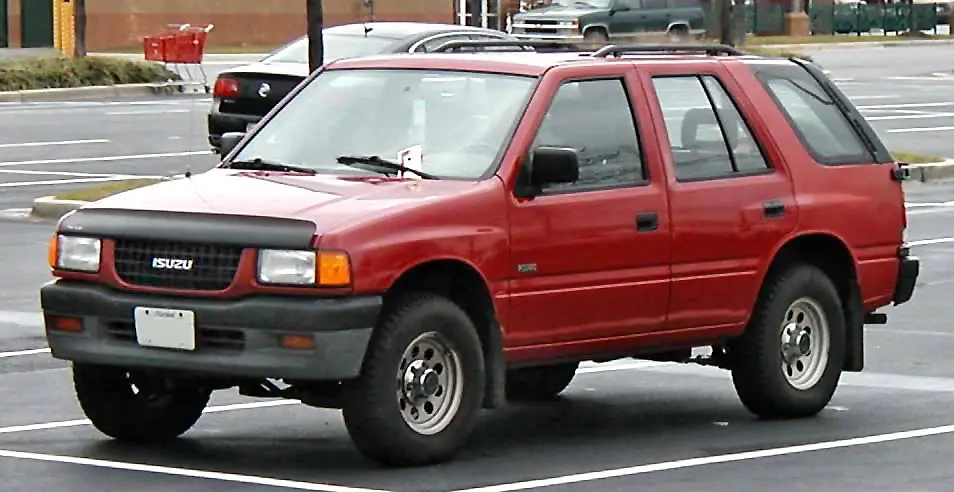
Rodeo first generation (1991–1997)

Isuzu Rodeo first generation
Photo: IFCAR / Wikimedia Commons · Public domain

Model codes: UCS · Sold in: United States and Canada · References: en.wikipedia.org, en.wikipedia.org

Show all 28 versions

Rodeo second generation (1998–2004)

Isuzu Rodeo second generation
Photo: Elise240SX / Wikimedia Commons · CC BY-SA 4.0

Model codes: UE · Sold in: United States and Canada · References: en.wikipedia.org

United States 24 versions

Model years sold in the USA, from the EPA and the Department of Energy (fueleconomy.gov). MPG on the EPA test; litres per 100 km = 235.215 ÷ MPG.

Years and versionEngineFuelGearboxDriveConsumption (combined)CO₂
2003–2004V-6, 2MODE CLKUP · V-6, CLKUP3.2 LPetrol4-speed automaticFour- or all-wheel drive17 MPG (13.8 L/100 km) EPA325 g/km
2003–2004V-6, SIL3.2 LPetrol5-speed manualFour- or all-wheel drive17 MPG (13.8 L/100 km) EPA325 g/km
2004V-6, CLKUP3.2 LPetrol4-speed automaticRear-wheel drive18 MPG (13.1 L/100 km) EPA307 g/km
2004V-6, SIL3.2 LPetrol5-speed manualRear-wheel drive17 MPG (13.8 L/100 km) EPA325 g/km
2004V-6, CLKUP3.5 LPetrol4-speed automaticRear-wheel drive18 MPG (13.1 L/100 km) EPA307 g/km
2004V-6, CLKUP3.5 LPetrol4-speed automaticFour- or all-wheel drive17 MPG (13.8 L/100 km) EPA325 g/km
2003L-4, 2MODE CLKUP2.2 LPetrol4-speed automaticRear-wheel drive18 MPG (13.1 L/100 km) EPA307 g/km
2003L-4, SIL2.2 LPetrol5-speed manualRear-wheel drive19 MPG (12.4 L/100 km) EPA291 g/km
2003V-6, 2MODE CLKUP3.2 LPetrol4-speed automaticRear-wheel drive17 MPG (13.8 L/100 km) EPA325 g/km
2001–20022MODE CLKUP · L-4, 2MODE CLKUP2.2 LPetrol4-speed automaticRear-wheel drive17 MPG (13.8 L/100 km) EPA325 g/km
2001–2002SIL · L-4, SIL2.2 LPetrol5-speed manualRear-wheel drive18 MPG (13.1 L/100 km) EPA307 g/km
2001–20022MODE CLKUP · V-6, 2MODE CLKUP3.2 LPetrol4-speed automaticFour- or all-wheel drive16 MPG (14.7 L/100 km) EPA345 g/km
2001–20022MODE CLKUP · V-6, 2MODE CLKUP3.2 LPetrol4-speed automaticRear-wheel drive17 MPG (13.8 L/100 km) EPA325 g/km
2001–2002SIL · V-6, SIL3.2 LPetrol5-speed manualRear-wheel drive17 MPG (13.8 L/100 km) EPA325 g/km
2001–2002SIL · V-6, SIL3.2 LPetrol5-speed manualFour- or all-wheel drive17 MPG (13.8 L/100 km) EPA325 g/km
2000L-4, SIL2.2 LPetrol5-speed manualRear-wheel drive19 MPG (12.4 L/100 km) EPA291 g/km
1998–2000V-6, 2MODE CLKUP3.2 LPetrol4-speed automaticRear-wheel drive16 MPG (14.7 L/100 km) EPA345 g/km
2000V-6, SIL3.2 LPetrol5-speed manualRear-wheel drive16 MPG (14.7 L/100 km) EPA345 g/km
2000V-6, 2MODE CLKUP3.2 LPetrol4-speed automaticFour- or all-wheel drive16 MPG (14.7 L/100 km) EPA345 g/km
2000V-6, SIL3.2 LPetrol5-speed manualFour- or all-wheel drive16 MPG (14.7 L/100 km) EPA345 g/km
1998–1999L-4, SIL2.2 LPetrol5-speed manualRear-wheel drive20 MPG (11.8 L/100 km) EPA276 g/km
1998–1999V-6, SIL3.2 LPetrol5-speed manualRear-wheel drive17 MPG (13.8 L/100 km) EPA325 g/km
1998–1999V-6, 2MODE CLKUP3.2 LPetrol4-speed automaticFour- or all-wheel drive16 MPG (14.7 L/100 km) EPA345 g/km
1998–1999V-6, SIL3.2 LPetrol5-speed manualFour- or all-wheel drive17 MPG (13.8 L/100 km) EPA325 g/km

Canada 6 versions

Model years sold in Canada, from Natural Resources Canada fuel consumption ratings (5-cycle test).

Years and versionEngineFuelGearboxConsumption (combined)CO₂
2001–2002Sport utility vehicle3.2 LPetrol4-speed automatic14.5 L/100 km 5-cycle334 g/km
2001–2002Sport utility vehicle3.2 LPetrol5-speed manual14.6 L/100 km 5-cycle336 g/km
2000Sport utility vehicle3.2 LPetrol4-speed automatic14.8 L/100 km 5-cycle340 g/km
2000Sport utility vehicle3.2 LPetrol5-speed manual15.1 L/100 km 5-cycle347 g/km
1998–1999Sport utility vehicle3.2 LPetrol4-speed automatic14.2 L/100 km 5-cycle327 g/km
1998–1999Sport utility vehicle3.2 LPetrol5-speed manual14.4 L/100 km 5-cycle331 g/km

Official figures are measured on standard test procedures and differ between markets. Your consumption depends on how, where and in what conditions you drive.