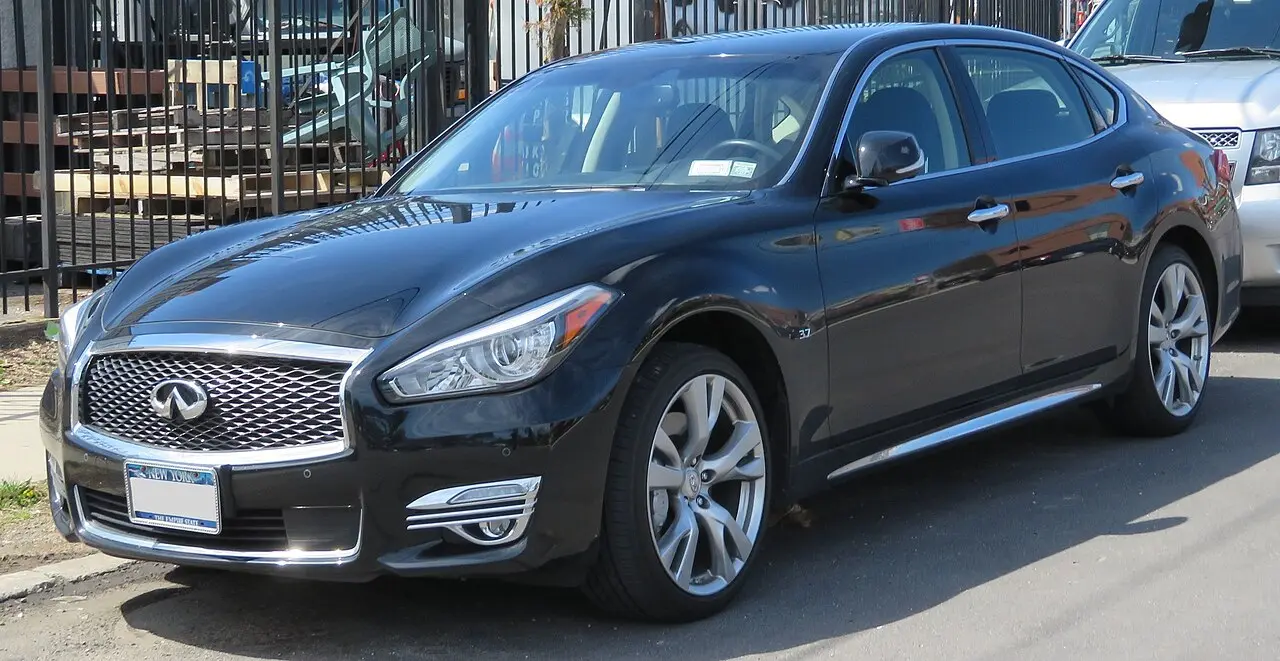
The official data lists 70 versions of the Infiniti Q70 (2014–2019), in the European Union, the United Kingdom, France, the United States, and Canada. Each market publishes its own figures, measured on its own test procedure.
At a glance
Years in the data
2014–2019
Markets
European Union, United Kingdom, France, United States, Canada
Engines
2.1 L to 5.6 L
Power
125 kW (170 PS) to 235 kW (320 PS)
Fuels
Diesel, Hybrid, Petrol
Lowest consumption (United Kingdom)
4.8 L/100 km (NEDC)
Lowest consumption (France)
4.9 L/100 km (NEDC)
Lowest consumption (Canada)
7.5 L/100 km (5-cycle)
New registrations in the EU
3,004
What is the Infiniti Q70?
The Q70 is a large luxury sedan with a roomy cabin and a comfort-focused character. It sat near the top of Infiniti’s passenger-car range, with petrol, diesel and hybrid versions offered in different markets. Its long bonnet and distinctive grille give it a recognisable presence.
Infiniti introduced the Q70 name when it renamed its M sedan range. The Y51 was the model’s first generation, sold from 2014 to 2019 in the EU. Infiniti is Nissan’s luxury marque.
Engines and power
Engine choice varied by market. In the EU, engines ranged from 2.1 L to 3.5 L, with power from 125 kW (170 PS) to 225 kW (306 PS). EU registrations include diesel, petrol and other fuel types. The 2.1 L diesel rated at 125 kW (170 PS) was the leading version among those registered in 2015, 2016 and 2017.
The UK and France also had diesel, petrol and hybrid versions. In the United States, the Q70 had petrol and hybrid versions with engines from 3.5 L to 5.6 L. Canadian versions had petrol engines from 3.5 L to 5.6 L.
How economical is the Infiniti Q70?
The lowest UK figure is 4.8 L/100 km on the NEDC test, while France’s lowest is 4.9 L/100 km, also on NEDC. In the United States, the lowest figure is 7.6 L/100 km, and the best combined rating is 31 MPG under the EPA procedure. Canada’s lowest figure is 7.5 L/100 km on the 5-cycle test.
These figures come from different test procedures. NEDC and WLTP are used in Europe, EPA in the United States, and the 5-cycle procedure in Canada, so results across markets are not directly comparable.
Where was the Q70 sold?
The Q70 appears in EU registrations from 2014 to 2019 and in UK figures from 2014 to 2018. French figures cover 2014 to 2015, while US and Canadian figures cover 2014 to 2019. The 2.1 L diesel was the leading version among EU registrations in 2015, 2016 and 2017.
Questions and answers
Was the Q70 a sedan or an SUV?
It was a four-door sedan in Infiniti’s luxury passenger-car range.
What was the Q70’s generation?
The Q70 was the Y51, its first generation, sold from 2014 to 2019 in the EU.
Was a hybrid Q70 available?
Yes. Hybrid versions were offered in the UK, France and the United States.
Which market had the lowest listed consumption?
The UK figure was lowest at 4.8 L/100 km on the NEDC test. Test procedures differ by market, so it cannot be directly compared with EPA or Canadian 5-cycle results.
New cars registered in the EU (plus Norway and Iceland), from the European Environment Agency. Figures on the NEDC procedure until 2020 and on WLTP from 2021; versions are grouped by engine and power, with their number of registrations.
Years and version
Engine
Power
Fuel
CO₂
EU registrations
2019
2.1 L
125 kW (170 PS)
Diesel
127 g/km
20
2018
2.1 L
125 kW (170 PS)
Diesel
126 g/km
60
2018
3.5 L
225 kW (306 PS)
Petrol
185 g/km
50
2017
2.1 L
125 kW (170 PS)
Diesel
124 g/km
414
2017
2.1 L
125 kW (170 PS)
Other fuel
126 g/km
140
2017
3.5 L
225 kW (306 PS)
Petrol
145 g/km
74
2017
3.5 L
338 kW (460 PS)
Petrol
145 g/km
42
2017
3.7 L
235 kW (320 PS)
Petrol
249 g/km
16
2016
2.1 L
125 kW (170 PS)
Diesel
127 g/km
794
2016
3.5 L
225 kW (306 PS)
Petrol
145 g/km
128
2016
3.7 L
235 kW (320 PS)
Petrol
258 g/km
38
2015
2.1 L
125 kW (170 PS)
Diesel
128 g/km
884
2015
3.5 L
225 kW (306 PS)
Petrol
148 g/km
130
2015
3.0 L
175 kW (238 PS)
Diesel
193 g/km
52
2015
3.7 L
235 kW (320 PS)
Petrol
241 g/km
30
2014
3.5 L
225 kW (306 PS)
Petrol
157 g/km
62
2014
3.0 L
175 kW (238 PS)
Diesel
199 g/km
56
2014
3.7 L
235 kW (320 PS)
Petrol
235 g/km
14
United Kingdom 11 versions
New cars on sale in the UK, from the Vehicle Certification Agency. NEDC figures until 2018 and WLTP figures after; years are the editions a version appeared in.
Years and version
Engine
Fuel
Gearbox
Consumption (combined)
CO₂
2016–2018Q70 2.2d 18 inch wheel · Q70 2.2d 18inch wheel
2.1 L
Diesel
7-speed automatic
4.8 L/100 km NEDC
124 g/km
2016–2018Q70 2.2d 20 inch wheel · Q70 2.2d 20inch wheel
2.1 L
Diesel
7-speed automatic
4.9 L/100 km NEDC
128 g/km
2016–2018Q70 Hybrid
3.5 L
Hybrid
7-speed automatic
6.2 L/100 km NEDC
145 g/km
2016–2018Q70 3.7
3.7 L
Petrol
7-speed automatic
10.8 L/100 km NEDC
249 g/km
20152.2 Diesel
2.1 L
Diesel
7-speed automatic
4.9 L/100 km NEDC
129 g/km
20153.0 Diesel
3.0 L
Diesel
7-speed automatic
7.5 L/100 km NEDC
199 g/km
20153.5 Hybrid
3.5 L
Hybrid
7-speed automatic
6.2 L/100 km NEDC
146 g/km
20153.7 Petrol
3.7 L
Petrol
7-speed automatic
10.2 L/100 km NEDC
235 g/km
20143.0 Diesel
3.0 L
Diesel
Automatic
7.5 L/100 km NEDC
199 g/km
20143.5 Hybrid
3.5 L
Hybrid
Automatic
6.9 L/100 km NEDC
159 g/km
20143.7 Petrol
3.7 L
Petrol
Automatic
10.2 L/100 km NEDC
235 g/km
France 10 versions
New cars on sale in France, from ADEME Car Labelling. NEDC figures until 2015, WLTP figures in the current catalogue.
Years and version
Engine
Power
Fuel
Gearbox
Consumption (combined)
CO₂
2015Q70 3.0D V6 7AT Premium
–
125 kW (170 PS)
Diesel
7-speed automatic
4.9 L/100 km NEDC
129 g/km
2015Q70 3.0D V6 7AT Sport
–
125 kW (170 PS)
Diesel
7-speed automatic
4.9 L/100 km NEDC
129 g/km
2015Q70 3.0D Premium
–
175 kW (238 PS)
Diesel
7-speed automatic
7.5 L/100 km NEDC
199 g/km
2015Q70 3.0D Sport
–
175 kW (238 PS)
Diesel
7-speed automatic
7.5 L/100 km NEDC
199 g/km
2015Q70 3.5H V6 7AT
–
225 kW (306 PS)
Hybrid
7-speed automatic
6.2 L/100 km NEDC
145 g/km
2015Q70 3.7 Premium
–
235 kW (320 PS)
Petrol
7-speed automatic
10.2 L/100 km NEDC
235 g/km
2015Q70 3.7 Sport
–
235 kW (320 PS)
Petrol
7-speed automatic
10.2 L/100 km NEDC
235 g/km
2014Q70 3.0D
–
175 kW (238 PS)
Diesel
7-speed automatic
7.5 L/100 km NEDC
199 g/km
2014Q70 Hyb
–
225 kW (306 PS)
Hybrid
7-speed automatic
6.9 L/100 km NEDC
159 g/km
2014Q70 3.7
–
235 kW (320 PS)
Petrol
7-speed automatic
10.2 L/100 km NEDC
235 g/km
United States 15 versions
Model years sold in the USA, from the EPA and the Department of Energy (fueleconomy.gov). MPG on the EPA test; litres per 100 km = 235.215 ÷ MPG.
Years and version
Engine
Fuel
Gearbox
Drive
Consumption (combined)
CO₂
2016–2019
3.7 L
Petrol
7-speed automatic
All-wheel drive
20 MPG (11.8 L/100 km) EPA
275 g/km
2017–2019
3.7 L
Petrol
7-speed automatic
Rear-wheel drive
21 MPG (11.2 L/100 km) EPA
269 g/km
2019SIDI
5.6 L
Petrol
7-speed automatic
Rear-wheel drive
19 MPG (12.4 L/100 km) EPA
291 g/km
2019SIDI
5.6 L
Petrol
7-speed automatic
All-wheel drive
18 MPG (13.1 L/100 km) EPA
305 g/km
2017–2018
3.5 L
Hybrid
7-speed automatic
Rear-wheel drive
30 MPG (7.8 L/100 km) EPA
184 g/km
2015–2018SIDI
5.6 L
Petrol
7-speed automatic
Rear-wheel drive
19 MPG (12.4 L/100 km) EPA
288 g/km
2018SIDI
5.6 L
Petrol
7-speed automatic
All-wheel drive
18 MPG (13.1 L/100 km) EPA
304 g/km
2015–2017SIDI
5.6 L
Petrol
7-speed automatic
All-wheel drive
18 MPG (13.1 L/100 km) EPA
303 g/km
2014–2016
3.5 L
Hybrid
7-speed automatic
Rear-wheel drive
31 MPG (7.6 L/100 km) EPA
180 g/km
2016
3.7 L
Petrol
7-speed automatic
Rear-wheel drive
21 MPG (11.2 L/100 km) EPA
268 g/km
2014–2015
3.7 L
Petrol
7-speed automatic
Rear-wheel drive
21 MPG (11.2 L/100 km) EPA
267 g/km
2015
3.7 L
Petrol
7-speed automatic
All-wheel drive
20 MPG (11.8 L/100 km) EPA
276 g/km
2014
3.7 L
Petrol
7-speed automatic
All-wheel drive
20 MPG (11.8 L/100 km) EPA
274 g/km
2014
5.6 L
Petrol
7-speed automatic
Rear-wheel drive
19 MPG (12.4 L/100 km) EPA
297 g/km
2014
5.6 L
Petrol
7-speed automatic
All-wheel drive
18 MPG (13.1 L/100 km) EPA
301 g/km
Canada 16 versions
Model years sold in Canada, from Natural Resources Canada fuel consumption ratings (5-cycle test).
Years and version
Engine
Fuel
Gearbox
Consumption (combined)
CO₂
2019Mid-size
3.7 L
Petrol
7-speed automatic
11.7 L/100 km 5-cycle
275 g/km
2019Mid-size
5.6 L
Petrol
7-speed automatic
12.8 L/100 km 5-cycle
301 g/km
2017–2018Mid-size
3.7 L
Petrol
7-speed automatic
11.7 L/100 km 5-cycle
274 g/km
2018Mid-size
5.6 L
Petrol
7-speed automatic
12.8 L/100 km 5-cycle
301 g/km
2017Mid-size
3.5 L
Petrol
7-speed automatic
7.8 L/100 km 5-cycle
184 g/km
2016–2017Mid-size
5.6 L
Petrol
7-speed automatic
12.8 L/100 km 5-cycle
300 g/km
2016Mid-size
3.5 L
Petrol
7-speed automatic
7.5 L/100 km 5-cycle
177 g/km
2016Mid-size
3.7 L
Petrol
7-speed automatic
11.6 L/100 km 5-cycle
274 g/km
2015Mid-size
3.5 L
Petrol
7-speed automatic
7.5 L/100 km 5-cycle
172 g/km
2014–2015Mid-size
3.7 L
Petrol
7-speed automatic
11.0 L/100 km 5-cycle
253 g/km
2014–2015Mid-size
3.7 L
Petrol
7-speed automatic
11.6 L/100 km 5-cycle
267 g/km
2015Mid-size
5.6 L
Petrol
7-speed automatic
12.4 L/100 km 5-cycle
285 g/km
2015Mid-size
5.6 L
Petrol
7-speed automatic
12.9 L/100 km 5-cycle
297 g/km
2014Mid-size
3.5 L
Petrol
7-speed automatic
7.6 L/100 km 5-cycle
175 g/km
2014Mid-size
5.6 L
Petrol
7-speed automatic
12.3 L/100 km 5-cycle
283 g/km
2014Mid-size
5.6 L
Petrol
7-speed automatic
12.8 L/100 km 5-cycle
294 g/km
Official figures are measured on standard test procedures and differ between markets. Your consumption depends on how, where and in what conditions you drive.