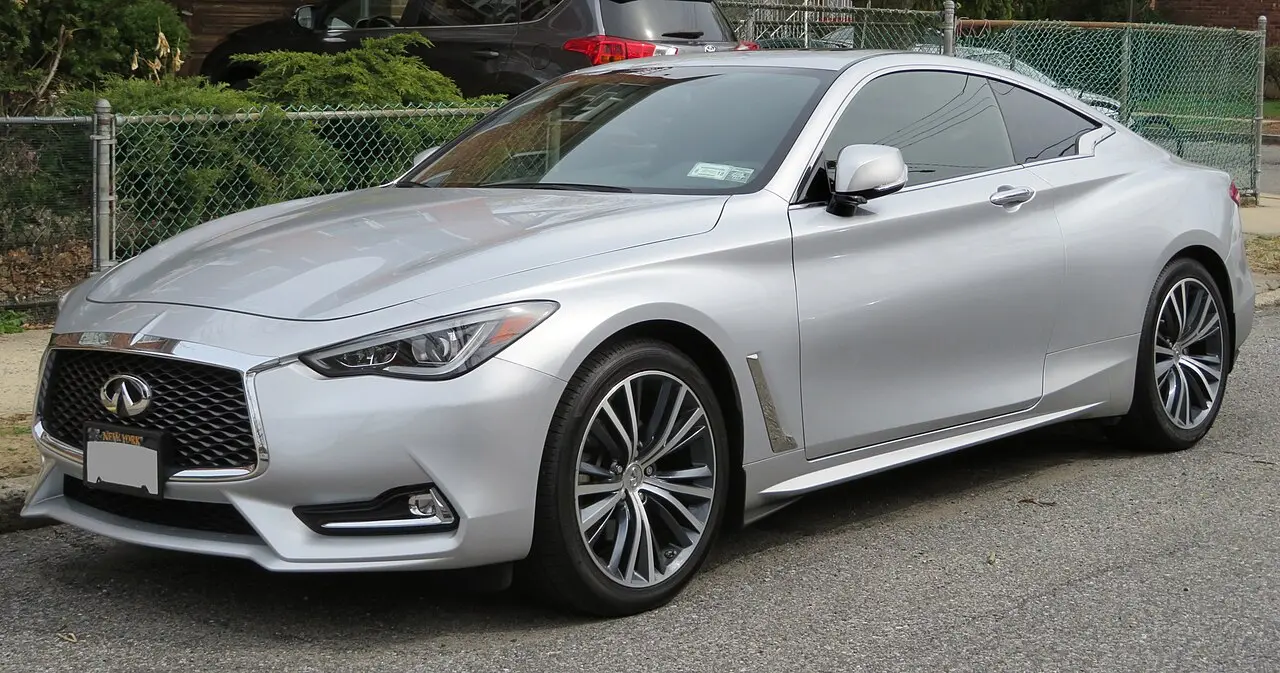
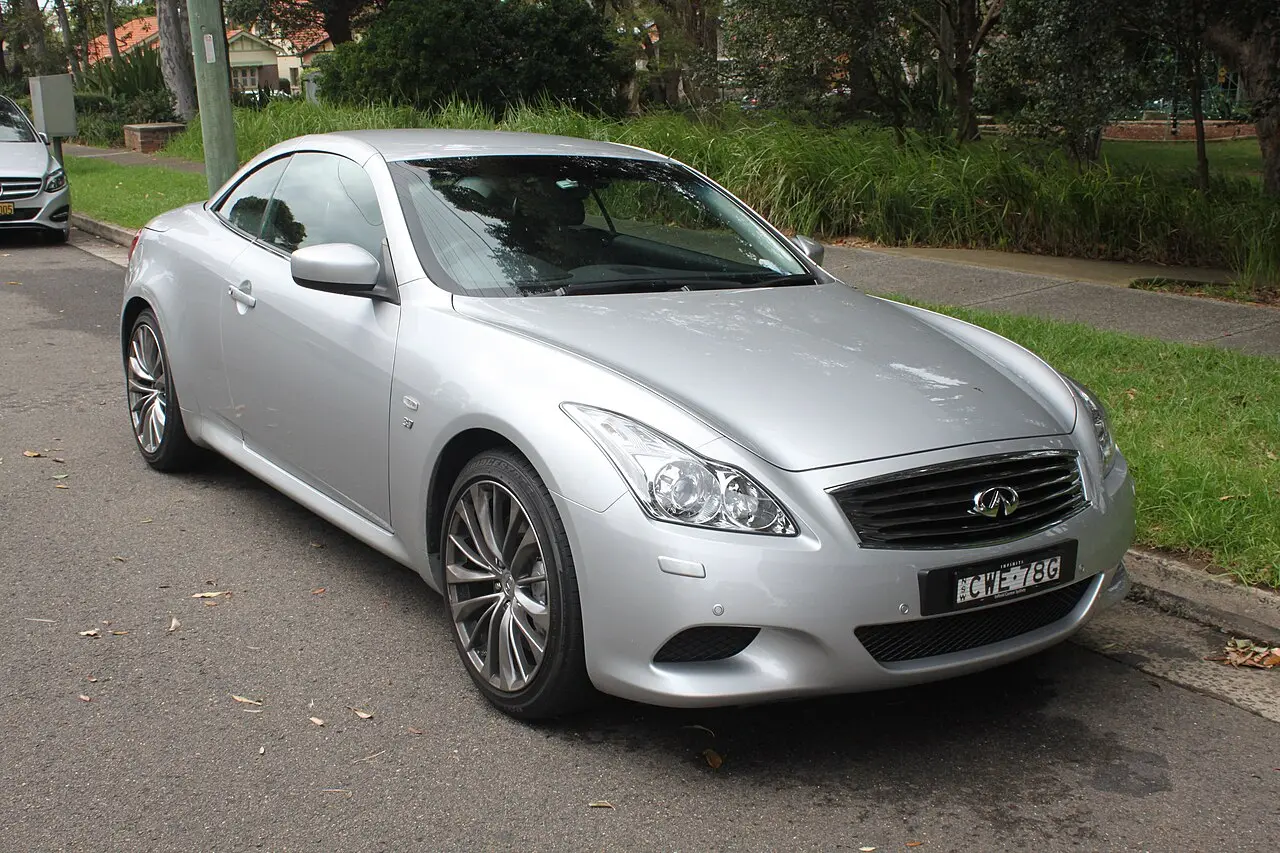
The official data lists 51 versions of the Infiniti Q60 (2014–2022), in the European Union, the United Kingdom, France, the United States, and Canada. Each market publishes its own figures, measured on its own test procedure.
At a glance
Years in the data
2014–2022
Markets
European Union, United Kingdom, France, United States, Canada
Engines
2.0 L to 3.7 L
Power
155 kW (211 PS) to 447 kW (608 PS)
Fuels
Petrol
Lowest consumption (United States)
9.4 L/100 km (EPA)
Lowest consumption (Canada)
10.0 L/100 km (5-cycle)
Lowest consumption (France)
10.5 L/100 km (NEDC)
New registrations in the EU
2,466
What is the Infiniti Q60?
The Q60 is a two-door luxury coupe with a low roof and sweeping profile. It occupied the sporty end of Infiniti’s passenger-car range. Its shape and distinctive grille reflect the brand’s sculpted design style.
The Q60 name spans two generations. The first-generation V36/CV36 appears in figures for 2014 to 2015. The second-generation V37 appears from 2017 to 2022 in US and Canadian figures, and from 2017 to 2019 in EU registrations. The later generation introduced a twin-turbo V6 in some versions.
Engines and power
EU registration figures cover petrol engines from 2.0 L to 3.7 L, with power from 155 kW (211 PS) to 447 kW (608 PS). The 2.0 L petrol rated at 155 kW (211 PS) was among the leading versions in 2017 and 2018. A 3.0 L petrol rated at 298 kW (405 PS) was also among the leading versions in 2018.
US and Canadian versions had petrol engines from 2.0 L to 3.7 L. UK figures cover a 3.7 L petrol version, and French figures list a petrol version rated at 235 kW (320 PS).
How economical is the Infiniti Q60?
The lowest UK and French figures are 10.5 L/100 km on the NEDC test. In the United States, the lowest figure is 9.4 L/100 km, with a best combined rating of 25 MPG under the EPA procedure. Canada’s lowest figure is 10 L/100 km on the 5-cycle test.
Test procedures differ by market: Europe uses WLTP and NEDC, the United States uses EPA, and Canada uses the 5-cycle procedure. Results from different procedures are not directly comparable.
Where was the Q60 sold?
The Q60 appears in EU registration figures from 2014 to 2019, UK figures for 2015, and French figures from 2014 to 2015. US and Canadian figures span 2014 to 2022. The first-generation V36/CV36 appears in earlier figures, while later EU and North American figures include the V37.
Questions and answers
Is the Q60 a coupe?
Yes. It is a two-door luxury coupe in Infiniti’s passenger-car range.
What are the Q60 generations?
The first generation is V36/CV36, appearing in figures for 2014 to 2015. The second is V37, appearing from 2017 to 2022 in US and Canadian figures.
What is the Q60’s lowest listed consumption?
The lowest figure is 9.4 L/100 km under the US EPA test. UK and French NEDC figures and Canada’s 5-cycle result use different procedures.
Did the Q60 have a 3.0 L version?
Yes. EU registrations include a 3.0 L petrol version rated at 298 kW (405 PS) among the leading versions in 2018.
Model codes: V36, CV36 · Sold in: United States, Canada, European Union, United Kingdom, and France · References: en.wikipedia.org, drivenoffroad.com.au
Model codes: V37 · Sold in: United States, Canada, and European Union · References: en.wikipedia.org, carmax.com
European Union 8 versions
New cars registered in the EU (plus Norway and Iceland), from the European Environment Agency. Figures on the NEDC procedure until 2020 and on WLTP from 2021; versions are grouped by engine and power, with their number of registrations.
Years and version
Engine
Power
Fuel
CO₂
EU registrations
2019
3.0 L
298 kW (405 PS)
Petrol
210 g/km
118
2019
2.0 L
155 kW (211 PS)
Petrol
156 g/km
82
2018
2.0 L
155 kW (211 PS)
Petrol
170 g/km
468
2018
3.0 L
298 kW (405 PS)
Petrol
242 g/km
396
2017
2.0 L
155 kW (211 PS)
Petrol
156 g/km
518
2017
3.0 L
298 kW (405 PS)
Petrol
210 g/km
384
2017
3.0 L
447 kW (608 PS)
Petrol
210 g/km
78
2017
2.0 L
233 kW (317 PS)
Petrol
156 g/km
54
United States 13 versions
Model years sold in the USA, from the EPA and the Department of Energy (fueleconomy.gov). MPG on the EPA test; litres per 100 km = 235.215 ÷ MPG.
Years and version
Engine
Fuel
Gearbox
Drive
Consumption (combined)
CO₂
2018–2022SIDI
3.0 L
Petrol
7-speed automatic
Rear-wheel drive
22 MPG (10.7 L/100 km) EPA
252 g/km
2018–2022SIDI
3.0 L
Petrol
7-speed automatic
All-wheel drive
21 MPG (11.2 L/100 km) EPA
263 g/km
2021–2022SIDI
3.0 L
Petrol
7-speed automatic
Rear-wheel drive
22 MPG (10.7 L/100 km) EPA
251 g/km
2021–2022SIDI
3.0 L
Petrol
7-speed automatic
All-wheel drive
22 MPG (10.7 L/100 km) EPA
250 g/km
2018–2020SIDI
3.0 L
Petrol
7-speed automatic
All-wheel drive
22 MPG (10.7 L/100 km) EPA
254 g/km
2019–2020SIDI
3.0 L
Petrol
7-speed automatic
Rear-wheel drive
22 MPG (10.7 L/100 km) EPA
247 g/km
2017–2019SIDI
2.0 L
Petrol
7-speed automatic
Rear-wheel drive
25 MPG (9.4 L/100 km) EPA
219 g/km
2017–2019SIDI
2.0 L
Petrol
7-speed automatic
All-wheel drive
24 MPG (9.8 L/100 km) EPA
232 g/km
2018SIDI
3.0 L
Petrol
7-speed automatic
Rear-wheel drive
22 MPG (10.7 L/100 km) EPA
252 g/km
2017SIDI
3.0 L
Petrol
7-speed automatic
Rear-wheel drive
22 MPG (10.7 L/100 km) EPA
246 g/km
2017SIDI
3.0 L
Petrol
7-speed automatic
Rear-wheel drive
22 MPG (10.7 L/100 km) EPA
247 g/km
2017SIDI
3.0 L
Petrol
7-speed automatic
All-wheel drive
21 MPG (11.2 L/100 km) EPA
260 g/km
2017SIDI
3.0 L
Petrol
7-speed automatic
All-wheel drive
22 MPG (10.7 L/100 km) EPA
253 g/km
Canada 6 versions
Model years sold in Canada, from Natural Resources Canada fuel consumption ratings (5-cycle test).
Years and version
Engine
Fuel
Gearbox
Consumption (combined)
CO₂
2017–2022Subcompact
3.0 L
Petrol
7-speed automatic
11.0 L/100 km 5-cycle
259 g/km
2021–2022Subcompact
3.0 L
Petrol
7-speed automatic
10.7 L/100 km 5-cycle
252 g/km
2019–2020Subcompact
3.0 L
Petrol
7-speed automatic
10.7 L/100 km 5-cycle
251 g/km
2017–2019Subcompact
2.0 L
Petrol
7-speed automatic
10.0 L/100 km 5-cycle
233 g/km
2018Subcompact
3.0 L
Petrol
7-speed automatic
10.7 L/100 km 5-cycle
251 g/km
2017Subcompact
3.0 L
Petrol
7-speed automatic
10.8 L/100 km 5-cycle
253 g/km
Versions outside these generations
European Union 2 versions
New cars registered in the EU (plus Norway and Iceland), from the European Environment Agency. Figures on the NEDC procedure until 2020 and on WLTP from 2021; versions are grouped by engine and power, with their number of registrations.
Years and version
Engine
Power
Fuel
CO₂
EU registrations
2016
2.0 L
155 kW (211 PS)
Petrol
156 g/km
158
2016
3.7 L
235 kW (320 PS)
Petrol
264 g/km
28
Official figures are measured on standard test procedures and differ between markets. Your consumption depends on how, where and in what conditions you drive.