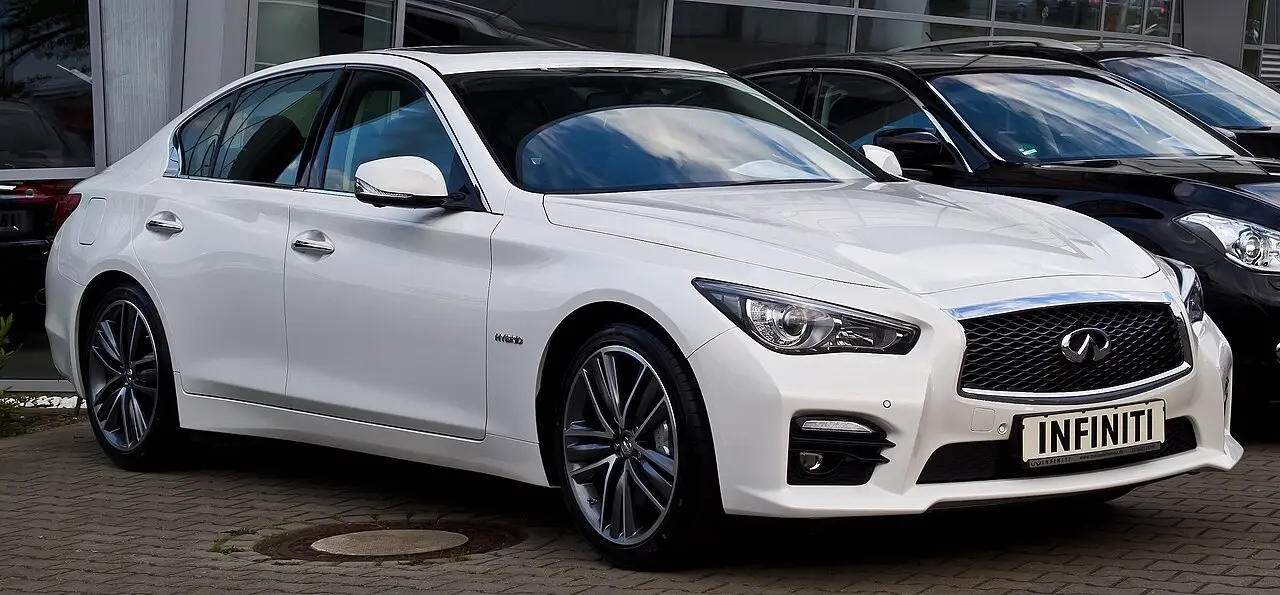
The official data lists 148 versions of the Infiniti Q50 (2013–2024), in the European Union, the United Kingdom, France, the United States, and Canada. Each market publishes its own figures, measured on its own test procedure.
At a glance
Years in the data
2013–2024
Markets
European Union, United Kingdom, France, United States, Canada
Engines
2.0 L to 3.7 L
Power
125 kW (170 PS) to 338 kW (460 PS)
Fuels
Diesel, Petrol, Hybrid, LPG
Lowest consumption (United Kingdom)
4.3 L/100 km (NEDC)
Lowest consumption (France)
4.4 L/100 km (NEDC)
Lowest consumption (Canada)
7.5 L/100 km (5-cycle)
New registrations in the EU
24,154
What is the Infiniti Q50?
The Q50 is a four-door luxury sedan that arrived in 2013, carrying forward the legacy of Infiniti’s G sedan. It brought the brand’s design identity to a roomy saloon with a driver-focused character. Its V37 generation ran from 2014 to 2024.
One of the Q50’s notable technologies was Direct Adaptive Steering, Infiniti’s electronically controlled steering system. The model was also offered as a petrol-electric hybrid, alongside conventional petrol and diesel versions.
Engines and power
Across EU registrations, engine sizes ran from 2.0 to 3.5 litres, and power from 125 kW (170 PS) to 338 kW (460 PS). Listed fuels include hybrid, petrol, diesel, LPG and other. Diesel versions were prominent in Europe: the 2.1-litre diesel rated at 125 kW (170 PS) led the listed annual EU registration figures.
UK versions covered 2.0- to 3.5-litre engines and petrol, diesel and hybrid power. In the USA, versions had 2.0- to 3.7-litre engines and used petrol or hybrid power; Canadian figures cover petrol engines from 2.0 to 3.7 litres.
How economical is the Infiniti Q50?
The lowest listed UK figure is 4.3 L/100 km on the NEDC test. France’s ADEME figures show a low of 4.4 L/100 km, also on NEDC. In the USA, the best combined EPA rating is 31 MPG, with a listed equivalent of 7.6 L/100 km. Canada’s lowest listed NRCan 5-cycle figure is 7.5 L/100 km. These results use different procedures: Europe has used NEDC and WLTP, the USA uses EPA testing, and Canada uses a 5-cycle test, so results across markets are not directly comparable.
EU registrations totalled 24,154 from 2013 to 2020. UK figures cover 2014 to 2018, French figures 2014 to 2015, and US and Canadian figures 2014 to 2024.
Where was the Q50 sold?
The Q50 was sold in the EU, the UK, France, the United States and Canada. Its recorded market periods vary: EU registrations cover 2013 to 2020, while US and Canadian figures extend from 2014 to 2024.
Questions and answers
What kind of car is the Infiniti Q50?
It is a four-door luxury sedan that carried forward the legacy of Infiniti’s G sedan.
Which Q50 engine led EU registrations?
The leading listed version was the 2.1-litre diesel with 125 kW (170 PS), which topped the annual EU registration figures shown.
What is the Q50’s lowest official fuel-consumption figure?
The lowest listed figure is 4.3 L/100 km in UK VCA figures, measured on NEDC. US EPA and Canadian 5-cycle results use different procedures.
What is Direct Adaptive Steering?
It is Infiniti’s electronically controlled steering system, offered on the Q50.
New cars registered in the EU (plus Norway and Iceland), from the European Environment Agency. Figures on the NEDC procedure until 2020 and on WLTP from 2021; versions are grouped by engine and power, with their number of registrations.
Years and version
Engine
Power
Fuel
CO₂
EU registrations
2020
3.5 L
225 kW (306 PS)
Hybrid
197 g/km
74
2020
3.5 L
225 kW (306 PS)
Petrol
187 g/km
28
2019
3.5 L
225 kW (306 PS)
Hybrid
183 g/km
656
2019
3.5 L
225 kW (306 PS)
Petrol
190 g/km
300
2019
2.0 L
155 kW (211 PS)
Petrol
154 g/km
120
2019
2.1 L
125 kW (170 PS)
Diesel
122 g/km
68
2018
2.1 L
125 kW (170 PS)
Diesel
120 g/km
1,458
2018
2.0 L
155 kW (211 PS)
Petrol
195 g/km
824
2018
3.5 L
225 kW (306 PS)
Petrol
163 g/km
464
2018
3.0 L
298 kW (405 PS)
Petrol
207 g/km
74
2018
3.5 L
225 kW (306 PS)
Petrol
157 g/km
34
2017
2.1 L
125 kW (170 PS)
Diesel
120 g/km
2,338
2017
3.5 L
225 kW (306 PS)
Petrol
156 g/km
350
2017
2.1 L
125 kW (170 PS)
Other fuel
121 g/km
236
2017
2.0 L
233 kW (317 PS)
Petrol
151 g/km
218
2017
3.5 L
338 kW (460 PS)
Petrol
159 g/km
188
2017
3.0 L
298 kW (405 PS)
Petrol
206 g/km
88
2017
2.0 L
155 kW (211 PS)
Petrol
149 g/km
34
2017
3.0 L
447 kW (608 PS)
Petrol
206 g/km
16
2017
2.1 L
188 kW (256 PS)
Diesel
127 g/km
14
2016
2.1 L
125 kW (170 PS)
Diesel
121 g/km
4,176
2016
3.5 L
225 kW (306 PS)
Petrol
153 g/km
652
2016
2.0 L
155 kW (211 PS)
Petrol
150 g/km
494
2016
3.5 L
225 kW (306 PS)
Other fuel
159 g/km
62
2016
3.0 L
298 kW (405 PS)
Petrol
206 g/km
38
2015
2.1 L
125 kW (170 PS)
Diesel
121 g/km
4,616
2015
3.5 L
225 kW (306 PS)
Petrol
155 g/km
776
2015
2.0 L
155 kW (211 PS)
Petrol
149 g/km
478
2015
3.5 L
225 kW (306 PS)
Hybrid
154 g/km
42
2015
2.1 L
–
Petrol
152 g/km
12
2014
2.1 L
125 kW (170 PS)
Diesel
123 g/km
3,638
2014
3.5 L
225 kW (306 PS)
Petrol
153 g/km
804
2014
2.0 L
155 kW (211 PS)
Petrol
150 g/km
178
2014
3.5 L
225 kW (306 PS)
Other fuel
147 g/km
64
2014
3.5 L
–
LPG
153 g/km
16
United Kingdom 33 versions
New cars on sale in the UK, from the Vehicle Certification Agency. NEDC figures until 2018 and WLTP figures after; years are the editions a version appeared in.
Years and version
Engine
Fuel
Gearbox
Consumption (combined)
CO₂
2015–20182.0T 17'' wheel · Q50 2.0t 17 inch wheel
2.0 L
Petrol
7-speed automatic
6.3 L/100 km NEDC
146 g/km
2015–20182.0T 19'' wheel · Q50 2.0t 19 inch wheel
2.0 L
Petrol
7-speed automatic
6.5 L/100 km NEDC
151 g/km
2016–2018Q50 2.0t 18 inch wheel
2.0 L
Petrol
7-speed automatic
6.4 L/100 km NEDC
149 g/km
2015–20182.2d 125 Diesel 19" wheel · Q50 2.2d 17-18 inch wheel · Q50 2.2d 18-19 inch wheel
New cars on sale in France, from ADEME Car Labelling. NEDC figures until 2015, WLTP figures in the current catalogue.
Years and version
Engine
Power
Fuel
Gearbox
Consumption (combined)
CO₂
2015Q50 Premium 2.2d 7AT
–
125 kW (170 PS)
Diesel
7-speed automatic
4.8 L/100 km NEDC
124 g/km
2015Q50 Sport 2.2d 7AT
–
125 kW (170 PS)
Diesel
7-speed automatic
4.9 L/100 km NEDC
128 g/km
2015Q50 Premium 2.2d 6MT
–
125 kW (170 PS)
Diesel
6-speed manual
4.4 L/100 km NEDC
114 g/km
2015Q50 Sport 2.2d 6MT
–
125 kW (170 PS)
Diesel
6-speed manual
4.5 L/100 km NEDC
118 g/km
2015Q50 2.0T Premium BVA
–
155 kW (211 PS)
Petrol
7-speed automatic
6.3 L/100 km NEDC
146 g/km
2015Q50 2.0T Sport BVA
–
155 kW (211 PS)
Petrol
7-speed automatic
6.5 L/100 km NEDC
151 g/km
2015Q50 Hyb Premium 7AT
–
225 kW (306 PS)
Hybrid
7-speed automatic
5.9 L/100 km NEDC
139 g/km
2015Q50 Hyb Sport 7AT
–
225 kW (306 PS)
Hybrid
7-speed automatic
6.2 L/100 km NEDC
144 g/km
2015Q50 Hyb Premium 7AT 4x4
–
225 kW (306 PS)
Hybrid
7-speed automatic
6.6 L/100 km NEDC
154 g/km
2015Q50 Hyb Sport 7AT 4x4
–
225 kW (306 PS)
Hybrid
7-speed automatic
6.8 L/100 km NEDC
159 g/km
2014Q50 Premium 2.2d 6MT
–
125 kW (170 PS)
Diesel
6-speed manual
4.4 L/100 km NEDC
114 g/km
2014Q50 Premium 2.2d 7AT
–
125 kW (170 PS)
Diesel
7-speed automatic
4.8 L/100 km NEDC
124 g/km
2014Q50 Sport 2.2d 6MT
–
125 kW (170 PS)
Diesel
6-speed manual
4.5 L/100 km NEDC
118 g/km
2014Q50 Sport 2.2d 7AT
–
125 kW (170 PS)
Diesel
7-speed automatic
4.9 L/100 km NEDC
128 g/km
2014Q50 Hyb 7AT
–
225 kW (306 PS)
Hybrid
7-speed automatic
6.2 L/100 km NEDC
144 g/km
2014Q50 Hyb 7AT 4x4
–
225 kW (306 PS)
Hybrid
7-speed automatic
6.8 L/100 km NEDC
159 g/km
United States 34 versions
Model years sold in the USA, from the EPA and the Department of Energy (fueleconomy.gov). MPG on the EPA test; litres per 100 km = 235.215 ÷ MPG.
Years and version
Engine
Fuel
Gearbox
Drive
Consumption (combined)
CO₂
2021–2024SIDI
3.0 L
Petrol
7-speed automatic
Rear-wheel drive
22 MPG (10.7 L/100 km) EPA
250 g/km
2021–2024SIDI
3.0 L
Petrol
7-speed automatic
Rear-wheel drive
23 MPG (10.2 L/100 km) EPA
241 g/km
2021–2024SIDI
3.0 L
Petrol
7-speed automatic
All-wheel drive
22 MPG (10.7 L/100 km) EPA
250 g/km
2021–2024SIDI
3.0 L
Petrol
7-speed automatic
All-wheel drive
22 MPG (10.7 L/100 km) EPA
255 g/km
2018–2020SIDI
3.0 L
Petrol
7-speed automatic
Rear-wheel drive
23 MPG (10.2 L/100 km) EPA
240 g/km
2018–2020SIDI
3.0 L
Petrol
7-speed automatic
Rear-wheel drive
22 MPG (10.7 L/100 km) EPA
251 g/km
2018–2020SIDI
3.0 L
Petrol
7-speed automatic
All-wheel drive
22 MPG (10.7 L/100 km) EPA
252 g/km
2019–2020SIDI
3.0 L
Petrol
7-speed automatic
All-wheel drive
22 MPG (10.7 L/100 km) EPA
253 g/km
2019SIDI
2.0 L
Petrol
7-speed automatic
All-wheel drive
24 MPG (9.8 L/100 km) EPA
227 g/km
2019SIDI
2.0 L
Petrol
7-speed automatic
Rear-wheel drive
25 MPG (9.4 L/100 km) EPA
221 g/km
2018SIDI
2.0 L
Petrol
7-speed automatic
Rear-wheel drive
25 MPG (9.4 L/100 km) EPA
217 g/km
2018SIDI
2.0 L
Petrol
7-speed automatic
All-wheel drive
24 MPG (9.8 L/100 km) EPA
229 g/km
2017–2018SIDI
3.0 L
Petrol
7-speed automatic
All-wheel drive
22 MPG (10.7 L/100 km) EPA
254 g/km
2017–2018
3.5 L
Hybrid
7-speed automatic
Rear-wheel drive
29 MPG (8.1 L/100 km) EPA
191 g/km
2017–2018
3.5 L
Hybrid
7-speed automatic
All-wheel drive
28 MPG (8.4 L/100 km) EPA
199 g/km
2016–2017SIDI
2.0 L
Petrol
7-speed automatic
Rear-wheel drive
26 MPG (9.0 L/100 km) EPA
214 g/km
2017SIDI
2.0 L
Petrol
7-speed automatic
All-wheel drive
24 MPG (9.8 L/100 km) EPA
227 g/km
2016–2017SIDI
3.0 L
Petrol
7-speed automatic
All-wheel drive
22 MPG (10.7 L/100 km) EPA
256 g/km
2017SIDI
3.0 L
Petrol
7-speed automatic
Rear-wheel drive
23 MPG (10.2 L/100 km) EPA
242 g/km
2017SIDI
3.0 L
Petrol
7-speed automatic
Rear-wheel drive
22 MPG (10.7 L/100 km) EPA
247 g/km
2016
2.0 L
Petrol
7-speed automatic
All-wheel drive
24 MPG (9.8 L/100 km) EPA
226 g/km
2016SIDI
3.0 L
Petrol
7-speed automatic
Rear-wheel drive
22 MPG (10.7 L/100 km) EPA
250 g/km
2016SIDI
3.0 L
Petrol
7-speed automatic
Rear-wheel drive
23 MPG (10.2 L/100 km) EPA
248 g/km
2016SIDI
3.0 L
Petrol
7-speed automatic
All-wheel drive
22 MPG (10.7 L/100 km) EPA
252 g/km
2016SIDI
3.0 L
Petrol
7-speed automatic
All-wheel drive
21 MPG (11.2 L/100 km) EPA
262 g/km
2014–2016
3.5 L
Hybrid
7-speed automatic
Rear-wheel drive
30 MPG (7.8 L/100 km) EPA
183 g/km
2014–2016
3.5 L
Hybrid
7-speed automatic
All-wheel drive
28 MPG (8.4 L/100 km) EPA
196 g/km
2014–2015
3.5 L
Hybrid
7-speed automatic
All-wheel drive
30 MPG (7.8 L/100 km) EPA
182 g/km
2015
3.5 L
Hybrid
7-speed automatic
Rear-wheel drive
31 MPG (7.6 L/100 km) EPA
178 g/km
2014–2015
3.7 L
Petrol
7-speed automatic
Rear-wheel drive
23 MPG (10.2 L/100 km) EPA
239 g/km
2014–2015
3.7 L
Petrol
7-speed automatic
Rear-wheel drive
23 MPG (10.2 L/100 km) EPA
242 g/km
2014–2015
3.7 L
Petrol
7-speed automatic
All-wheel drive
22 MPG (10.7 L/100 km) EPA
255 g/km
2014
3.5 L
Hybrid
7-speed automatic
Rear-wheel drive
31 MPG (7.6 L/100 km) EPA
175 g/km
2014
3.7 L
Petrol
7-speed automatic
All-wheel drive
22 MPG (10.7 L/100 km) EPA
256 g/km
Canada 25 versions
Model years sold in Canada, from Natural Resources Canada fuel consumption ratings (5-cycle test).
Years and version
Engine
Fuel
Gearbox
Consumption (combined)
CO₂
2019–2024Mid-size
3.0 L
Petrol
7-speed automatic
11.1 L/100 km 5-cycle
261 g/km
2020–2024Mid-size
3.0 L
Petrol
7-speed automatic
10.8 L/100 km 5-cycle
254 g/km
2019Mid-size
2.0 L
Petrol
7-speed automatic
9.7 L/100 km 5-cycle
229 g/km
2018–2019Mid-size
3.0 L
Petrol
7-speed automatic
10.8 L/100 km 5-cycle
253 g/km
2018Mid-size
2.0 L
Petrol
7-speed automatic
9.7 L/100 km 5-cycle
228 g/km
2018Mid-size
3.0 L
Petrol
7-speed automatic
11.1 L/100 km 5-cycle
260 g/km
2017–2018Compact
3.5 L
Petrol
7-speed automatic
8.5 L/100 km 5-cycle
200 g/km
2017Mid-size
2.0 L
Petrol
7-speed automatic
9.6 L/100 km 5-cycle
226 g/km
2017Mid-size
3.0 L
Petrol
7-speed automatic
10.9 L/100 km 5-cycle
256 g/km
2017Mid-size
3.0 L
Petrol
7-speed automatic
10.9 L/100 km 5-cycle
257 g/km
2016Mid-size
2.0 L
Petrol
7-speed automatic
9.1 L/100 km 5-cycle
214 g/km
2016Mid-size
2.0 L
Petrol
7-speed automatic
9.6 L/100 km 5-cycle
226 g/km
2016Mid-size
3.0 L
Petrol
7-speed automatic
10.3 L/100 km 5-cycle
242 g/km
2016Mid-size
3.0 L
Petrol
7-speed automatic
10.6 L/100 km 5-cycle
249 g/km
2016Mid-size
3.0 L
Petrol
7-speed automatic
11.1 L/100 km 5-cycle
262 g/km
2016Mid-size
3.0 L
Petrol
7-speed automatic
10.5 L/100 km 5-cycle
247 g/km
2016Mid-size
3.0 L
Petrol
7-speed automatic
10.8 L/100 km 5-cycle
256 g/km
2016Compact
3.5 L
Petrol
7-speed automatic
7.7 L/100 km 5-cycle
181 g/km
2016Compact
3.5 L
Petrol
7-speed automatic
8.2 L/100 km 5-cycle
193 g/km
2014–2015Compact
3.5 L
Petrol
7-speed automatic
7.5 L/100 km 5-cycle
172 g/km
2014–2015Compact
3.5 L
Petrol
7-speed automatic
8.2 L/100 km 5-cycle
189 g/km
2015Mid-size
3.7 L
Petrol
7-speed automatic
10.3 L/100 km 5-cycle
237 g/km
2015Mid-size
3.7 L
Petrol
7-speed automatic
10.8 L/100 km 5-cycle
248 g/km
2014Mid-size
3.7 L
Petrol
7-speed automatic
10.2 L/100 km 5-cycle
235 g/km
2014Mid-size
3.7 L
Petrol
7-speed automatic
10.8 L/100 km 5-cycle
248 g/km
Versions outside these generations
European Union 5 versions
New cars registered in the EU (plus Norway and Iceland), from the European Environment Agency. Figures on the NEDC procedure until 2020 and on WLTP from 2021; versions are grouped by engine and power, with their number of registrations.
Years and version
Engine
Power
Fuel
CO₂
EU registrations
2013
2.1 L
125 kW (170 PS)
Diesel
121 g/km
278
2013
3.5 L
225 kW (306 PS)
Petrol
155 g/km
112
2013
2.1 L
–
Other fuel
122 g/km
100
2013
3.5 L
225 kW (306 PS)
Other fuel
124 g/km
20
2013
–
–
Petrol
159 g/km
16
Official figures are measured on standard test procedures and differ between markets. Your consumption depends on how, where and in what conditions you drive.