The official data lists 68 versions of the Infiniti FX (2003–2014), in the European Union, the United Kingdom, France, the United States, and Canada. Each market publishes its own figures, measured on its own test procedure.
At a glance
Years in the data
2003–2014
Markets
European Union, United Kingdom, France, United States, Canada
Engines
3.0 L to 5.0 L
Power
175 kW (238 PS) to 287 kW (390 PS)
Fuels
Diesel, Petrol
Lowest consumption (France)
8.6 L/100 km (NEDC)
Lowest consumption (United Kingdom)
8.6 L/100 km (NEDC)
Lowest consumption (United States)
12.4 L/100 km (EPA)
New registrations in the EU
9,944
What is the Infiniti FX?
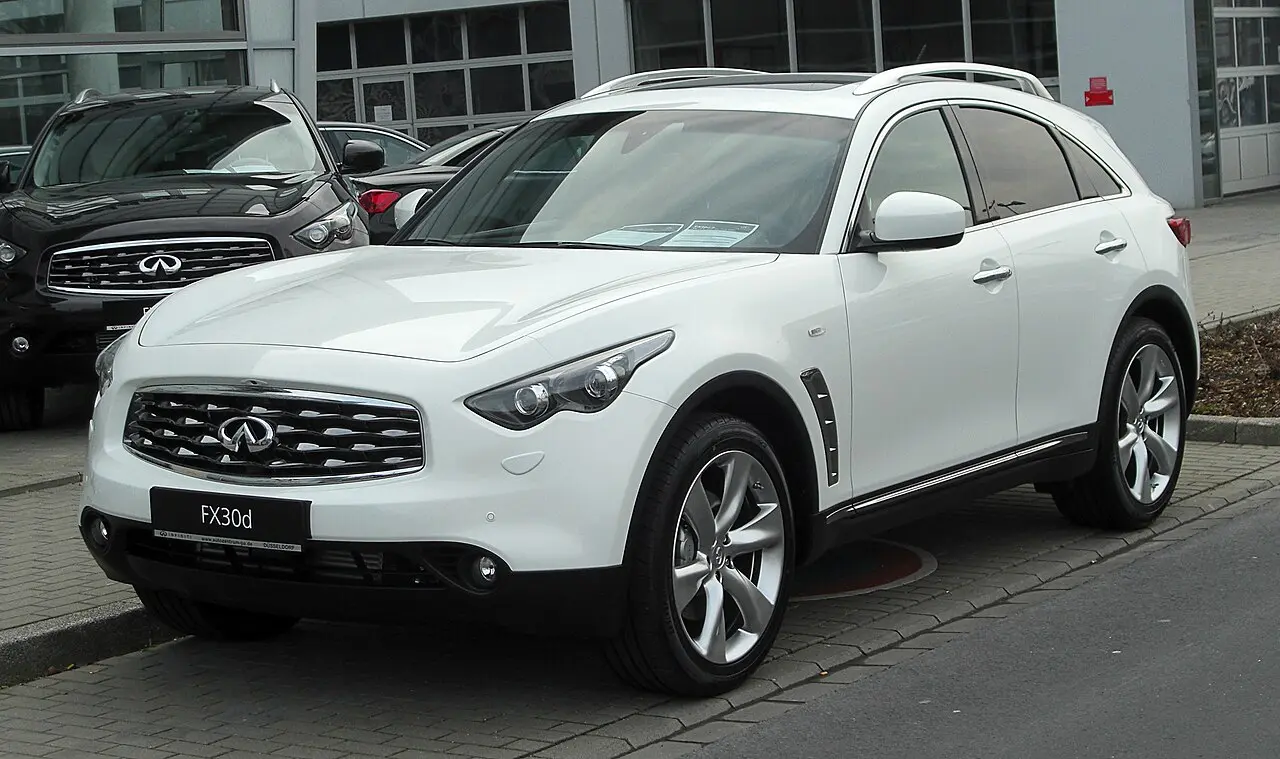
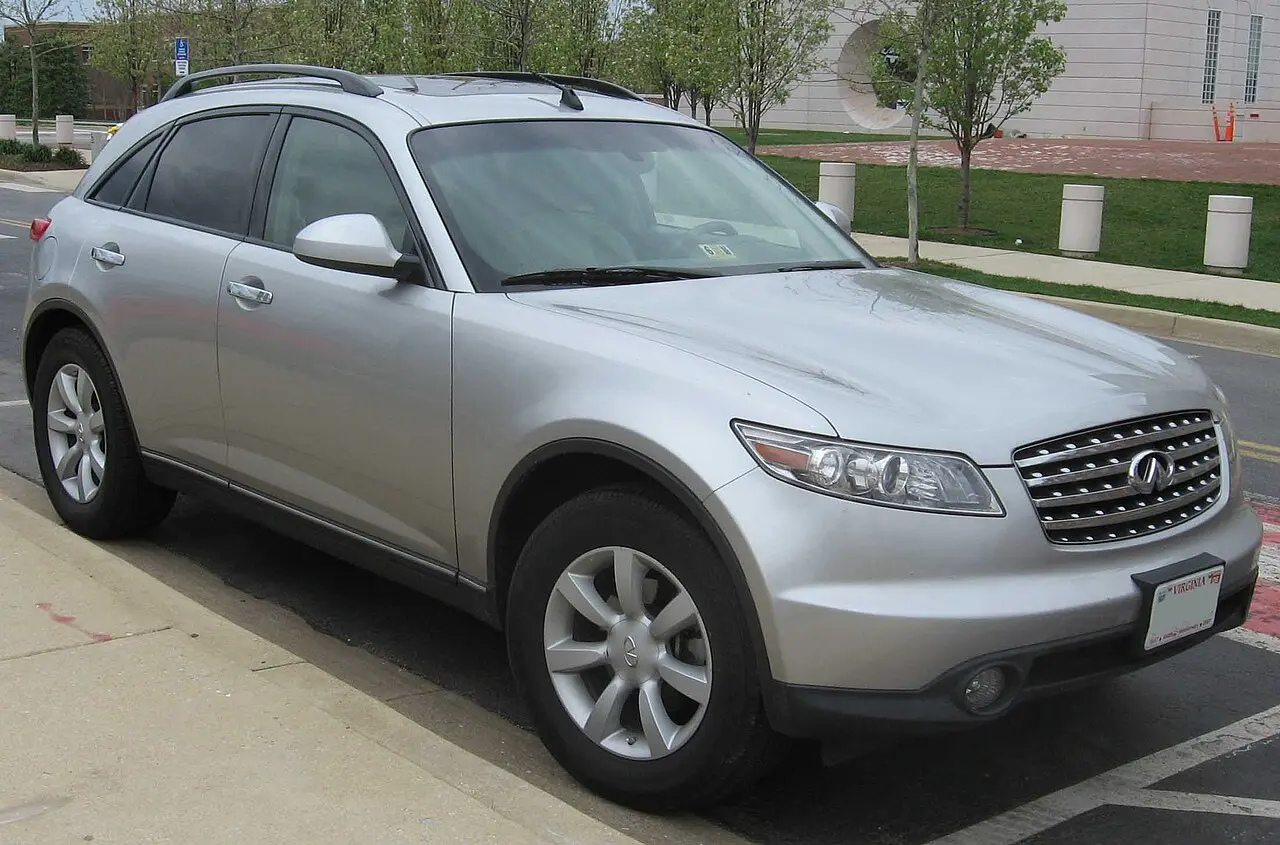
The FX is a premium crossover SUV with a coupe-like roofline and a sporty design. Its long bonnet, muscular proportions and sloping rear gave it a distinctive shape in Infiniti’s range, pairing a high-riding body with a more dramatic profile.
The first FX generation, S50, ran from 2003 to 2008; the second, S51, ran from 2009 to 2013. The second generation carried the original concept forward with updated styling and a revised cabin. Infiniti later used the QX70 name for the model in some markets.
Engines and power
The EU range covered 3.0- to 5.0-litre engines, with power from 175 kW (238 PS) to 287 kW (390 PS). It included diesel and petrol versions, alongside other fuel classifications. The 3.0-litre diesel with 175 kW (238 PS) led the listed EU registration figures in several years.
UK and French figures also show engines from 3.0 to 5.0 litres. US and Canadian figures cover petrol engines from 3.5 to 5.0 litres.
How economical is the Infiniti FX?
The lowest listed UK consumption is 8.6 L/100 km on the NEDC test; French ADEME figures show the same low. The US EPA’s best combined rating is 19 MPG, with a listed equivalent of 12.4 L/100 km. Canada’s lowest listed NRCan 5-cycle figure is 12.8 L/100 km. European NEDC and WLTP procedures differ from US EPA and Canadian 5-cycle tests, so results across markets are not directly comparable.
EU registrations totalled 9,944 from 2010 to 2014. US and Canadian figures cover 2003 to 2013.
Where was the FX sold?
The FX was sold in the EU, the UK, France, the United States and Canada. European versions included diesel power, while US and Canadian figures cover petrol models.
Questions and answers
How many generations of Infiniti FX were there?
There were two: the S50 from 2003 to 2008 and the S51 from 2009 to 2013.
What engines were available in the FX?
EU versions covered 3.0- to 5.0-litre engines and 175 kW (238 PS) to 287 kW (390 PS). Listed fuels include diesel and petrol.
What is the FX’s lowest official fuel-consumption figure?
The lowest listed UK and French figures are 8.6 L/100 km on NEDC. EPA and Canadian 5-cycle ratings use different procedures.
Why is the FX sometimes called the QX70?
Infiniti later used the QX70 name for the model in some markets.
New cars registered in the EU (plus Norway and Iceland), from the European Environment Agency. Figures on the NEDC procedure until 2020 and on WLTP from 2021; versions are grouped by engine and power, with their number of registrations.
Years and version
Engine
Power
Fuel
CO₂
EU registrations
2013
3.0 L
175 kW (238 PS)
Diesel
236 g/km
1,620
2013
3.0 L
–
Other fuel
238 g/km
224
2013
5.0 L
287 kW (390 PS)
Petrol
307 g/km
138
2013
3.7 L
235 kW (320 PS)
Petrol
281 g/km
76
2013
3.0 L
175 kW (238 PS)
Diesel
238 g/km
20
2013
5.0 L
–
Other fuel
307 g/km
12
2013
3.0 L
175 kW (238 PS)
Petrol
225 g/km
10
2012
3.0 L
175 kW (238 PS)
Diesel
235 g/km
1,961
2012
5.0 L
287 kW (390 PS)
Petrol
307 g/km
141
2012
3.7 L
235 kW (320 PS)
Petrol
282 g/km
115
2012
–
–
Petrol
296 g/km
28
2012
3.0 L
175 kW (238 PS)
Diesel
238 g/km
19
2011
3.0 L
175 kW (238 PS)
Diesel
239 g/km
1,848
2011
3.0 L
175 kW (238 PS)
Diesel
238 g/km
830
2011
3.7 L
235 kW (320 PS)
Petrol
279 g/km
292
2011
5.0 L
287 kW (390 PS)
Petrol
307 g/km
258
2011
–
–
Diesel
238 g/km
12
2010
3.0 L
–
Diesel
234 g/km
984
2010
3.7 L
–
Petrol
281 g/km
732
2010
5.0 L
–
Petrol
307 g/km
328
2010
–
–
Other fuel
285 g/km
18
2010
–
–
Petrol
292 g/km
12
2010
3.0 L
–
Petrol
238 g/km
12
United Kingdom 8 versions
New cars on sale in the UK, from the Vehicle Certification Agency. NEDC figures until 2018 and WLTP figures after; years are the editions a version appeared in.
Years and version
Engine
Fuel
Gearbox
Consumption (combined)
CO₂
2013–2014FX30D
3.0 L
Diesel
Automatic
8.6 L/100 km NEDC
225 g/km
2013–2014FX37
3.7 L
Petrol
Automatic
12.1 L/100 km NEDC
282 g/km
2013–2014FX50
5.0 L
Petrol
Automatic
13.1 L/100 km NEDC
307 g/km
2012FX30D
3.0 L
Diesel
6-speed automatic
9.0 L/100 km NEDC
238 g/km
2012FX37 4WD
3.7 L
Petrol
6-speed automatic
12.1 L/100 km NEDC
282 g/km
2012FX50 4WD
5.0 L
Petrol
6-speed automatic
13.1 L/100 km NEDC
307 g/km
2010FX37 4WD
3.7 L
Petrol
6-speed automatic
12.1 L/100 km NEDC
282 g/km
2010FX50 4WD
5.0 L
Petrol
6-speed automatic
13.1 L/100 km NEDC
307 g/km
France 6 versions
New cars on sale in France, from ADEME Car Labelling. NEDC figures until 2015, WLTP figures in the current catalogue.
Years and version
Engine
Power
Fuel
Gearbox
Consumption (combined)
CO₂
2013FX30D
–
175 kW (238 PS)
Diesel
7-speed automatic
8.6 L/100 km NEDC
225 g/km
2013FX30D
–
175 kW (238 PS)
Diesel
7-speed automatic
8.6 L/100 km NEDC
225 g/km
2012–2013FX37
–
235 kW (320 PS)
Petrol
7-speed automatic
12.1 L/100 km NEDC
282 g/km
2012–2013FX50S · FX50
–
287 kW (390 PS)
Petrol
7-speed automatic
13.1 L/100 km NEDC
307 g/km
2012FX30D
–
175 kW (238 PS)
Diesel
7-speed automatic
9.0 L/100 km NEDC
238 g/km
2012FX30D
–
175 kW (238 PS)
Diesel
7-speed automatic
9.0 L/100 km NEDC
238 g/km
United States 8 versions
Model years sold in the USA, from the EPA and the Department of Energy (fueleconomy.gov). MPG on the EPA test; litres per 100 km = 235.215 ÷ MPG.
Years and version
Engine
Fuel
Gearbox
Drive
Consumption (combined)
CO₂
2013
3.7 L
Petrol
7-speed automatic
Rear-wheel drive
19 MPG (12.4 L/100 km) EPA
286 g/km
2013
3.7 L
Petrol
7-speed automatic
All-wheel drive
18 MPG (13.1 L/100 km) EPA
300 g/km
2013
5.0 L
Petrol
7-speed automatic
All-wheel drive
16 MPG (14.7 L/100 km) EPA
340 g/km
2009–2012CLKUP
3.5 L
Petrol
7-speed automatic
Rear-wheel drive
19 MPG (12.4 L/100 km) EPA
291 g/km
2010–2012
3.5 L
Petrol
7-speed automatic
All-wheel drive
18 MPG (13.1 L/100 km) EPA
307 g/km
2010–2012
5.0 L
Petrol
7-speed automatic
All-wheel drive
16 MPG (14.7 L/100 km) EPA
345 g/km
2009CLKUP
3.5 L
Petrol
7-speed automatic
Four- or all-wheel drive
18 MPG (13.1 L/100 km) EPA
307 g/km
2009CLKUP
5.0 L
Petrol
7-speed automatic
Four- or all-wheel drive
16 MPG (14.7 L/100 km) EPA
345 g/km
Canada 7 versions
Model years sold in Canada, from Natural Resources Canada fuel consumption ratings (5-cycle test).
Years and version
Engine
Fuel
Gearbox
Consumption (combined)
CO₂
2013Sport utility vehicle: Small
3.7 L
Petrol
7-speed automatic
12.8 L/100 km 5-cycle
294 g/km
2013Sport utility vehicle: Small
5.0 L
Petrol
7-speed automatic
14.5 L/100 km 5-cycle
334 g/km
2012Sport utility vehicle
3.5 L
Petrol
7-speed automatic
13.2 L/100 km 5-cycle
304 g/km
2011–2012Sport utility vehicle
5.0 L
Petrol
7-speed automatic
14.3 L/100 km 5-cycle
329 g/km
2009–2011Sport utility vehicle
3.5 L
Petrol
7-speed automatic
13.1 L/100 km 5-cycle
301 g/km
2010Sport utility vehicle
5.0 L
Petrol
7-speed automatic
14.4 L/100 km 5-cycle
331 g/km
2009Sport utility vehicle
5.0 L
Petrol
7-speed automatic
14.3 L/100 km 5-cycle
329 g/km
Versions outside these generations
European Union 3 versions
New cars registered in the EU (plus Norway and Iceland), from the European Environment Agency. Figures on the NEDC procedure until 2020 and on WLTP from 2021; versions are grouped by engine and power, with their number of registrations.
Years and version
Engine
Power
Fuel
CO₂
EU registrations
2014
3.0 L
175 kW (238 PS)
Diesel
236 g/km
216
2014
3.7 L
–
Petrol
282 g/km
20
2014
5.0 L
287 kW (390 PS)
Petrol
307 g/km
18
Official figures are measured on standard test procedures and differ between markets. Your consumption depends on how, where and in what conditions you drive.