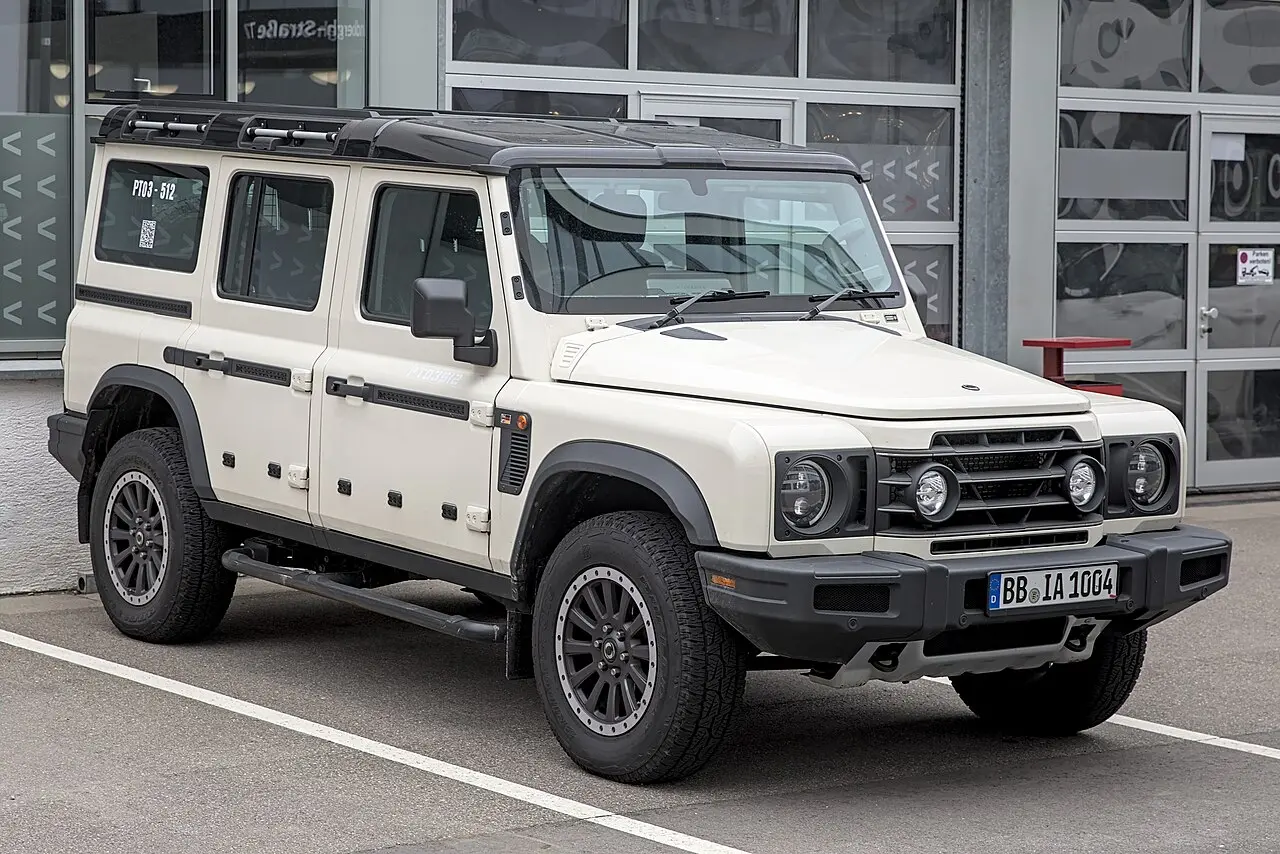
The official data lists 27 versions of the INEOS Grenadier (2022–2026), in the European Union, the United Kingdom, the United States, and Canada. Each market publishes its own figures, measured on its own test procedure.
At a glance
Years in the data
2022–2026
Markets
European Union, United Kingdom, United States, Canada
Engines
3.0 L to 3.0 L
Power
183 kW (249 PS) to 286 kW (389 PS)
Fuels
Diesel, Petrol, Flex fuel (E85)
Lowest consumption (United Kingdom)
10.5 L/100 km (WLTP)
Lowest consumption (European Union)
11.7 L/100 km (WLTP)
Lowest consumption (Canada)
15.0 L/100 km (5-cycle)
New registrations in the EU
3,183
What is the INEOS Grenadier?
The Grenadier is a utilitarian 4x4 built for off-road use, with a practical design intended to suit work as well as everyday driving. Its core hardware includes a ladder-frame chassis, solid beam axles and permanent four-wheel drive.
INEOS Automotive developed the Grenadier as its first vehicle. The design combines British styling with German engineering partnerships. Series production began in 2022 at INEOS Automotive’s Hambach plant in France.
Generations and engines
The first-generation Grenadier spans 2022 to today. The Station Wagon established the range; the Quartermaster double-cab pick-up later added a load bed while sharing the model’s basic architecture.
The engine range uses 3.0-litre petrol and diesel engines. In EU registration figures, listed power runs from 183 kW (249 PS) to 210 kW (286 PS); UK figures extend up to 286 kW (389 PS). EU listings also include flex-fuel E85. US and Canadian listings cover 3.0-litre petrol versions.
Fuel consumption
Official fuel consumption varies by version and market. The lowest listed figure is 10.5 L/100 km in UK WLTP figures. EU WLTP listings start at 11.7 L/100 km; the US EPA figure starts at 15.7 L/100 km, or 15 MPG combined, and Canada’s 5-cycle figure starts at 15 L/100 km. These results are not direct comparisons: Europe uses WLTP or, for some older figures, NEDC, while the US uses EPA testing and Canada uses its 5-cycle procedure.
Where is the Grenadier sold?
Official figures cover the European Economic Area, the UK, the United States and Canada. EU registrations span 2023–2025, while UK figures span 2022–2026. US EPA figures cover 2023–2025, and Canadian figures cover 2025–2026. In the EU, the 3.0-litre diesel rated at 183 kW (249 PS) was the most registered configuration in each listed year, with 973 registrations in 2023, 656 in 2024 and 578 in 2025.
Questions and answers
When did the INEOS Grenadier first go on sale?
Series production began in 2022.
What engines does the Grenadier have?
The range uses 3.0-litre petrol and diesel engines. EU listings also include flex-fuel E85.
What is the Grenadier’s official fuel consumption?
The lowest listed figures vary by market and test procedure: 10.5 L/100 km in UK WLTP figures, 11.7 L/100 km in EU WLTP figures, 15.7 L/100 km in US EPA figures and 15 L/100 km in Canada’s 5-cycle figures.
Where is the Grenadier sold?
Official figures cover the European Economic Area, the UK, the United States and Canada.
New cars registered in the EU (plus Norway and Iceland), from the European Environment Agency. Figures on the NEDC procedure until 2020 and on WLTP from 2021; versions are grouped by engine and power, with their number of registrations.
Years and version
Engine
Power
Fuel
Consumption (combined)
CO₂
EU registrations
2025
3.0 L
183 kW (249 PS)
Diesel
11.7 L/100 km WLTP
302 g/km
578
2025
3.0 L
210 kW (286 PS)
Petrol
14.4 L/100 km WLTP
330 g/km
313
2024
3.0 L
183 kW (249 PS)
Diesel
11.9 L/100 km WLTP
305 g/km
656
2024
3.0 L
210 kW (286 PS)
Petrol
14.4 L/100 km WLTP
331 g/km
201
2024
3.0 L
210 kW (286 PS)
Flex fuel (E85)
14.4 L/100 km WLTP
329 g/km
20
2023
3.0 L
183 kW (249 PS)
Diesel
12.0 L/100 km WLTP
307 g/km
973
2023
3.0 L
210 kW (286 PS)
Petrol
14.4 L/100 km WLTP
332 g/km
442
United Kingdom 16 versions
New cars on sale in the UK, from the Vehicle Certification Agency. NEDC figures until 2018 and WLTP figures after; years are the editions a version appeared in.
Years and version
Engine
Power
Fuel
Gearbox
Consumption (combined)
CO₂
2025–2026Station Wagon Diesel
3.0 L
183 kW (249 PS)
Diesel
8-speed automatic
10.5 L/100 km WLTP
276 g/km
2025–2026Station Wagon Diesel
3.0 L
183 kW (249 PS)
Diesel
8-speed automatic
12.2 L/100 km WLTP
319 g/km
2025–2026Station Wagon Petrol
3.0 L
210 kW (286 PS)
Petrol
8-speed automatic
14.4 L/100 km WLTP
325 g/km
2025–2026Station Wagon Petrol
3.0 L
210 kW (286 PS)
Petrol
8-speed automatic
14.9 L/100 km WLTP
336 g/km
2024Utility Wagon Diesel · Pick-up Diesel
3.0 L
249 kW (339 PS)
Diesel
8-speed automatic
12.1 L/100 km WLTP
317 g/km
2024Station Wagon Diesel
3.0 L
249 kW (339 PS)
Diesel
8-speed automatic
12.2 L/100 km WLTP
319 g/km
2024Station Wagon Diesel
3.0 L
249 kW (339 PS)
Diesel
8-speed automatic
10.5 L/100 km WLTP
276 g/km
2024Utility Wagon Diesel · Pick-up Diesel
3.0 L
249 kW (339 PS)
Diesel
8-speed automatic
10.9 L/100 km WLTP
286 g/km
2024Station Wagon Petrol · Utility Wagon Petrol · Pick-up Petrol
3.0 L
286 kW (389 PS)
Petrol
8-speed automatic
14.4 L/100 km WLTP
325 g/km
2024Station Wagon Petrol · Utility Wagon Petrol · Pick-up Petrol
3.0 L
286 kW (389 PS)
Petrol
8-speed automatic
14.9 L/100 km WLTP
336 g/km
2022–2023Station Wagon Diesel
3.0 L
183 kW (249 PS)
Diesel
8-speed automatic
10.5 L/100 km WLTP
276 g/km
2022–2023Station Wagon Diesel
3.0 L
183 kW (249 PS)
Diesel
8-speed automatic
12.2 L/100 km WLTP
319 g/km
2023Utility Wagon Diesel · Pick-up Diesel
3.0 L
183 kW (249 PS)
Diesel
8-speed automatic
10.9 L/100 km WLTP
286 g/km
2023Utility Wagon Diesel · Pick-up Diesel
3.0 L
183 kW (249 PS)
Diesel
8-speed automatic
12.1 L/100 km WLTP
317 g/km
2022–2023Station Wagon Petrol · Utility Wagon Petrol · Pick-up Petrol
3.0 L
210 kW (286 PS)
Petrol
8-speed automatic
14.4 L/100 km WLTP
325 g/km
2022–2023Station Wagon Petrol · Utility Wagon Petrol · Pick-up Petrol
3.0 L
210 kW (286 PS)
Petrol
8-speed automatic
14.9 L/100 km WLTP
336 g/km
United States 2 versions
Model years sold in the USA, from the EPA and the Department of Energy (fueleconomy.gov). MPG on the EPA test; litres per 100 km = 235.215 ÷ MPG.
Years and version
Engine
Fuel
Gearbox
Drive
Consumption (combined)
CO₂
2023–2025SIDI
3.0 L
Petrol
8-speed automatic
Four-wheel drive
15 MPG (15.7 L/100 km) EPA
368 g/km
2023–2025SIDI
3.0 L
Petrol
8-speed automatic
Four-wheel drive
14 MPG (16.8 L/100 km) EPA
393 g/km
Canada 2 versions
Model years sold in Canada, from Natural Resources Canada fuel consumption ratings (5-cycle test).
Years and version
Engine
Fuel
Gearbox
Consumption (combined)
CO₂
2025–2026Sport utility vehicle: Standard
3.0 L
Petrol
8-speed automatic
15.0 L/100 km 5-cycle
349 g/km
2025–2026Sport utility vehicle: Standard · Pickup truck: Standard
3.0 L
Petrol
8-speed automatic
16.0 L/100 km 5-cycle
372 g/km
Official figures are measured on standard test procedures and differ between markets. Your consumption depends on how, where and in what conditions you drive.