Hyundai

Hyundai Santa Cruz

Hyundai Santa Cruz
Photo: Elise240SX / Wikimedia Commons · CC BY-SA 4.0

The official data lists 18 versions of the Hyundai Santa Cruz (2022–2027), in the United States and Canada. Each market publishes its own figures, measured on its own test procedure.

At a glance

Years in the data
2022–2027
Markets
United States, Canada
Engines
2.5 L
Fuels
Petrol
Lowest consumption (United States)
9.4 L/100 km (EPA)
Lowest consumption (Canada)
10.6 L/100 km (5-cycle)

What is the Hyundai Santa Cruz?

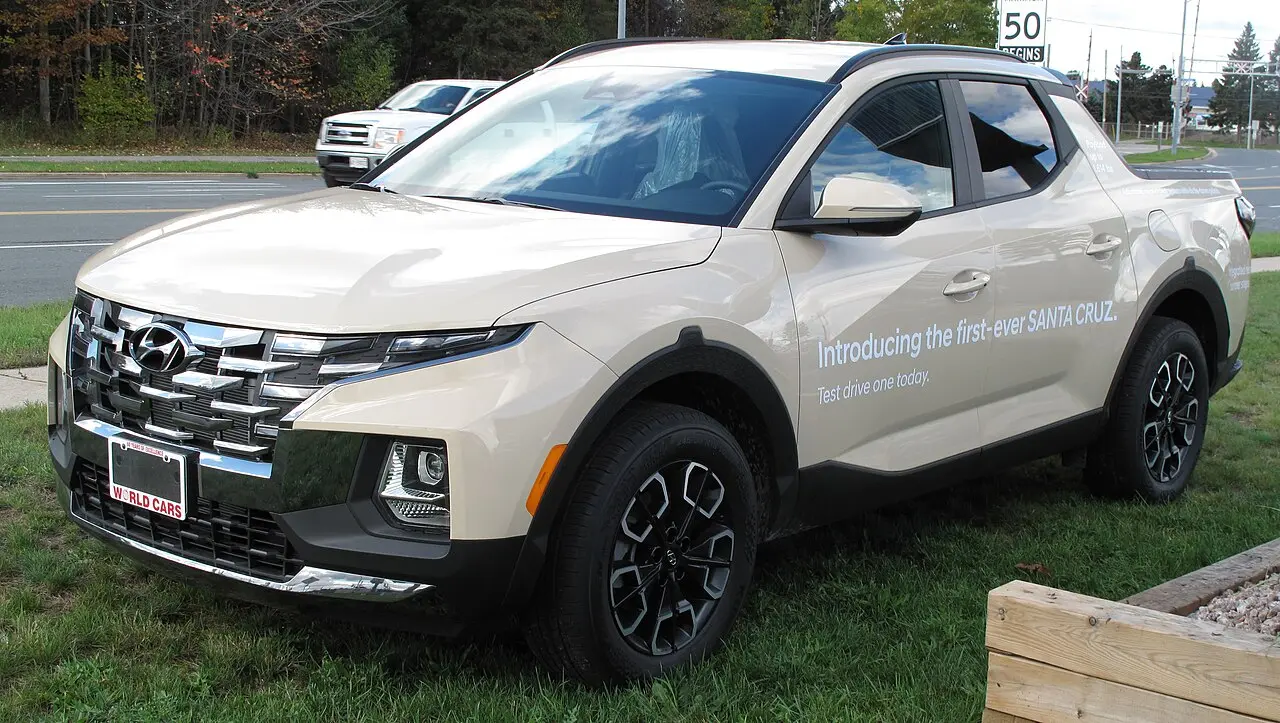
The Santa Cruz is a compact, four-door pickup with a car-like unibody design. Hyundai describes it as a Sport Adventure Vehicle: an open cargo bed paired with the everyday shape and feel of a passenger vehicle. It suits drivers who need room for outdoor gear or household jobs and prefer a smaller pickup.

The Santa Cruz brought a new kind of utility vehicle to Hyundai’s range, drawing on the company’s crossover experience. For 2025, Hyundai updated the front end and dashboard, adding a curved display that brings the driver information and infotainment screens together.

Generations and engines

The first generation, code NX4, has been sold from 2022 to today. It is the Santa Cruz’s only generation so far.

The listed engine is a 2.5-litre petrol unit. Versions vary, but the available figures do not give a power range.

How economical is the Hyundai Santa Cruz?

In the United States, the EPA’s best combined rating is 25 MPG, and the lowest listed consumption is 9.4 L/100 km. In Canada, the lowest listed figure is 10.6 L/100 km under NRCan’s 5-cycle test. The EPA and Canadian 5-cycle procedures differ, so their results are not directly interchangeable.

Where was the Santa Cruz sold?

The Santa Cruz appears in United States figures for 2022–2027 and Canadian figures for 2022–2026. Both listings cover petrol versions with a 2.5-litre engine.

Questions and answers

When did the Hyundai Santa Cruz first go on sale?

Its first generation began in 2022.

What engine does the Santa Cruz use?

The listed engine is a 2.5-litre petrol unit.

What is the Santa Cruz’s best EPA fuel economy?

The best combined EPA rating is 25 MPG.

Is the Santa Cruz sold in Canada?

Canadian figures cover 2022–2026 and use NRCan’s 5-cycle test for fuel-consumption figures.

Santa Cruz first generation (since 2022)

Hyundai Santa Cruz first generation
Photo: Elise240SX / Wikimedia Commons · CC BY-SA 4.0

Model codes: NX4 · Sold in: United States and Canada · References: en.wikipedia.org, edmunds.com

United States 11 versions

Model years sold in the USA, from the EPA and the Department of Energy (fueleconomy.gov). MPG on the EPA test; litres per 100 km = 235.215 ÷ MPG.

Years and versionEngineFuelGearboxDriveConsumption (combined)CO₂
2025–2027SIDI & PFI2.5 LPetrol8-speed automaticFront-wheel drive25 MPG (9.4 L/100 km) EPA221 g/km
2025–2027SIDI & PFI2.5 LPetrol8-speed automaticAll-wheel drive24 MPG (9.8 L/100 km) EPA228 g/km
2026–2027SIDI & PFI2.5 LPetrol8-speed automaticAll-wheel drive20 MPG (11.8 L/100 km) EPA270 g/km
2026SIDI & PFI2.5 LPetrol8-speed automaticAll-wheel drive20 MPG (11.8 L/100 km) EPA269 g/km
2025SIDI & PFI2.5 LPetrol8-speed automated manualAll-wheel drive22 MPG (10.7 L/100 km) EPA252 g/km
2025SIDI & PFI2.5 LPetrol8-speed automated manualAll-wheel drive21 MPG (11.2 L/100 km) EPA260 g/km
2022–2024SIDI & PFI2.5 LPetrol8-speed automated manualAll-wheel drive22 MPG (10.7 L/100 km) EPA250 g/km
2023–2024SIDI & PFI2.5 LPetrol8-speed automaticFront-wheel drive23 MPG (10.2 L/100 km) EPA237 g/km
2023–2024SIDI & PFI2.5 LPetrol8-speed automaticAll-wheel drive23 MPG (10.2 L/100 km) EPA242 g/km
2022SIDI & PFI2.5 LPetrol8-speed automaticFront-wheel drive23 MPG (10.2 L/100 km) EPA239 g/km
2022SIDI & PFI2.5 LPetrol8-speed automaticAll-wheel drive23 MPG (10.2 L/100 km) EPA237 g/km

Canada 7 versions

Model years sold in Canada, from Natural Resources Canada fuel consumption ratings (5-cycle test).

Years and versionEngineFuelGearboxConsumption (combined)CO₂
2026Sport utility vehicle: Small2.5 LPetrol8-speed automatic11.4 L/100 km 5-cycle267 g/km
2026Sport utility vehicle: Small2.5 LPetrol8-speed automatic11.5 L/100 km 5-cycle270 g/km
2025Sport utility vehicle: Small2.5 LPetrol8-speed automated manual10.7 L/100 km 5-cycle251 g/km
2025Sport utility vehicle: Small2.5 LPetrol8-speed automated manual11.1 L/100 km 5-cycle260 g/km
2024Pickup truck: Small2.5 LPetrol8-speed automated manual10.6 L/100 km 5-cycle251 g/km
2023Pickup truck: Small2.5 LPetrol8-speed automated manual10.6 L/100 km 5-cycle250 g/km
2022Pickup truck: Small2.5 LPetrol8-speed automated manual10.6 L/100 km 5-cycle250 g/km

Official figures are measured on standard test procedures and differ between markets. Your consumption depends on how, where and in what conditions you drive.