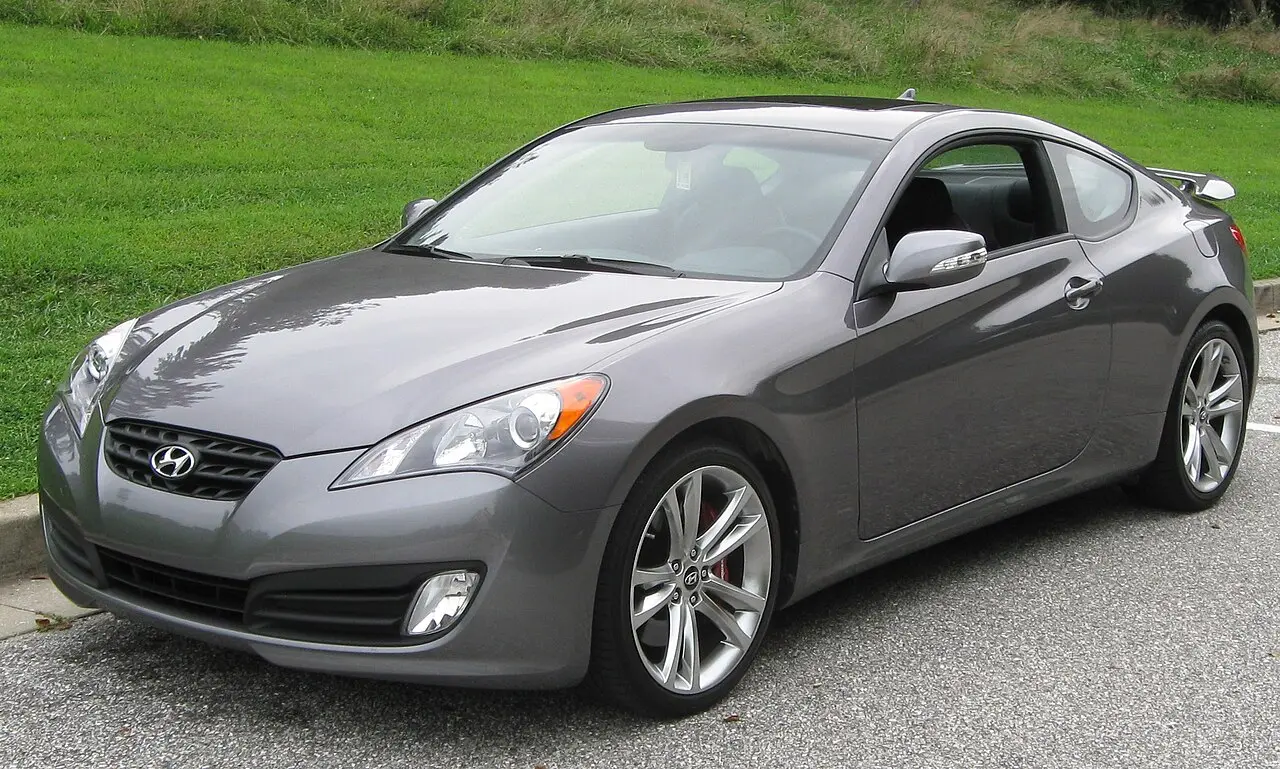
The official data lists 44 versions of the Hyundai Genesis Coupe (2010–2016), in the European Union, the United States, and Canada. Each market publishes its own figures, measured on its own test procedure.
At a glance
Years in the data
2010–2016
Markets
European Union, United States, Canada
Engines
2.0 L to 3.8 L
Power
156 kW (212 PS) to 255 kW (347 PS)
Fuels
Petrol
Lowest consumption (United States)
9.8 L/100 km (EPA)
Lowest consumption (Canada)
9.8 L/100 km (5-cycle)
New registrations in the EU
3,740
What is the Hyundai Genesis Coupe?
The Genesis Coupe is a two-door, rear-wheel-drive sports car and Hyundai’s first rear-wheel-drive sports coupe. Its long bonnet and low roof give it a purposeful shape, while its place in the range set it apart from Hyundai’s everyday cars. It shares its basic platform with the Genesis saloon.
The coupe received a facelift during its run, with a wider grille, revised lights and updated styling. Its single generation, code BK, ran from 2010 to 2016 in the markets listed here.
Engines and power
The petrol range paired a turbocharged 2.0-litre four-cylinder with a 3.8-litre V6. Across EU versions, official power figures span 156 kW (212 PS) to 255 kW (347 PS), giving the coupe two distinct engine choices.
How economical is the Hyundai Genesis Coupe?
In the United States, the EPA’s best combined rating is 24 MPG, and the lowest listed consumption is 9.8 L/100 km. Canada’s five-cycle ratings also give a lowest listed figure of 9.8 L/100 km. These results use different procedures: EPA in the United States and the five-cycle test in Canada.
EU registration figures run from 2010 to 2014, with 3,740 cars registered. The leading listed version was the 3.8-litre petrol rated at 223 kW (303 PS), followed by the 2.0-litre petrol rated at 157 kW (213 PS).
Where was the Hyundai Genesis Coupe sold?
The Genesis Coupe appears in EU registration figures from 2010 to 2014 and in US EPA and Canadian NRCan figures from 2010 to 2016. It was sold as a Hyundai model.
Questions and answers
What engines were available in the Genesis Coupe?
The petrol range spanned 2.0 to 3.8 litres. EU power figures run from 156 kW (212 PS) to 255 kW (347 PS).
How many generations of Genesis Coupe were there?
One: the BK generation, which ran from 2010 to 2016 in the markets listed here.
What is its EPA combined fuel economy figure?
The best combined EPA rating is 24 MPG. The lowest listed US consumption is 9.8 L/100 km.
Model codes: BK · Sold in: European Union, United States, and Canada · References: en.wikipedia.org
European Union 14 versions
New cars registered in the EU (plus Norway and Iceland), from the European Environment Agency. Figures on the NEDC procedure until 2020 and on WLTP from 2021; versions are grouped by engine and power, with their number of registrations.
Years and version
Engine
Power
Fuel
CO₂
EU registrations
2014
2.0 L
202 kW (275 PS)
Petrol
221 g/km
46
2014
3.8 L
255 kW (347 PS)
Petrol
238 g/km
44
2013
3.8 L
255 kW (347 PS)
Petrol
237 g/km
194
2013
2.0 L
157 kW (213 PS)
Petrol
223 g/km
156
2013
2.0 L
202 kW (275 PS)
Petrol
222 g/km
60
2013
3.8 L
223 kW (303 PS)
Petrol
239 g/km
54
2012
2.0 L
157 kW (213 PS)
Petrol
221 g/km
469
2012
3.8 L
223 kW (303 PS)
Petrol
241 g/km
376
2011–2012
2.0 L
156 kW (212 PS)
Petrol
220 g/km
58
2012
3.8 L
255 kW (347 PS)
Petrol
239 g/km
21
2011
3.8 L
223 kW (303 PS)
Petrol
240 g/km
1,164
2011
2.0 L
157 kW (213 PS)
Petrol
219 g/km
956
2010
3.8 L
–
Petrol
241 g/km
100
2010
2.0 L
–
Petrol
220 g/km
42
United States 16 versions
Model years sold in the USA, from the EPA and the Department of Energy (fueleconomy.gov). MPG on the EPA test; litres per 100 km = 235.215 ÷ MPG.
Years and version
Engine
Fuel
Gearbox
Drive
Consumption (combined)
CO₂
2016SIDI
3.8 L
Petrol
8-speed automatic
Rear-wheel drive
19 MPG (12.4 L/100 km) EPA
283 g/km
2016SIDI
3.8 L
Petrol
6-speed manual
Rear-wheel drive
19 MPG (12.4 L/100 km) EPA
283 g/km
2014–2015SIDI
3.8 L
Petrol
8-speed automatic
Rear-wheel drive
19 MPG (12.4 L/100 km) EPA
285 g/km
2014–2015SIDI
3.8 L
Petrol
6-speed manual
Rear-wheel drive
19 MPG (12.4 L/100 km) EPA
286 g/km
2014
2.0 L
Petrol
8-speed automatic
Rear-wheel drive
21 MPG (11.2 L/100 km) EPA
265 g/km
2014
2.0 L
Petrol
6-speed manual
Rear-wheel drive
22 MPG (10.7 L/100 km) EPA
252 g/km
2013
2.0 L
Petrol
8-speed automatic
Rear-wheel drive
21 MPG (11.2 L/100 km) EPA
268 g/km
2013
2.0 L
Petrol
6-speed manual
Rear-wheel drive
24 MPG (9.8 L/100 km) EPA
233 g/km
2013SIDI
3.8 L
Petrol
8-speed automatic
Rear-wheel drive
19 MPG (12.4 L/100 km) EPA
286 g/km
2013SIDI
3.8 L
Petrol
6-speed manual
Rear-wheel drive
21 MPG (11.2 L/100 km) EPA
261 g/km
2010–2012
2.0 L
Petrol
6-speed manual
Rear-wheel drive
24 MPG (9.8 L/100 km) EPA
230 g/km
2011–2012
2.0 L
Petrol
5-speed automatic
Rear-wheel drive
23 MPG (10.2 L/100 km) EPA
240 g/km
2010–2012
3.8 L
Petrol
6-speed manual
Rear-wheel drive
20 MPG (11.8 L/100 km) EPA
276 g/km
2011–2012
3.8 L
Petrol
6-speed automatic
Rear-wheel drive
20 MPG (11.8 L/100 km) EPA
276 g/km
2010
2.0 L
Petrol
5-speed automatic
Rear-wheel drive
23 MPG (10.2 L/100 km) EPA
240 g/km
2010
3.8 L
Petrol
6-speed automatic
Rear-wheel drive
21 MPG (11.2 L/100 km) EPA
263 g/km
Canada 14 versions
Model years sold in Canada, from Natural Resources Canada fuel consumption ratings (5-cycle test).
Official figures are measured on standard test procedures and differ between markets. Your consumption depends on how, where and in what conditions you drive.