



Who is GAZ?
GAZ is the Gorky Automobile Plant, a Russian maker based in Nizhny Novgorod. Its roots go back to an automobile factory established with technical help from Ford; the GAZ name followed when the city was known as Gorky. The plant became known for cars and trucks, and its postwar passenger cars and off-road vehicles remain a distinctive part of its story.
The GAZ models listed here span 1946-1975. They show a range built for different roles: an everyday saloon, a larger Volga passenger car, and a utility vehicle intended for rougher roads. Together, they trace a shift from postwar family transport to a broader mix of passenger and working vehicles.
Pobeda, Volga and GAZ-69
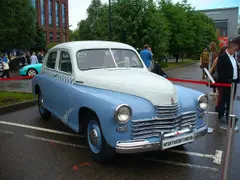
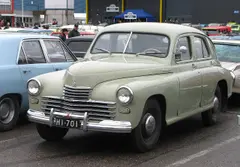
The Pobeda opened this period. Introduced after the war, it was a family saloon with a notably modern, smooth-sided body for its time. Its run from 1946 to 1958 makes it the earliest model in this group, and its place in GAZ’s history is closely tied to the return of civilian car production.
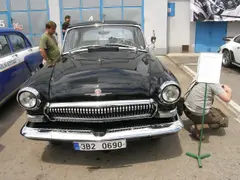
The Volga M21 followed in 1956 and continued through 1970. It sat above the Pobeda as a larger passenger car, carrying GAZ’s saloon line into a new generation. The two models overlapped for a time, then the Volga became the longer-running of the two.
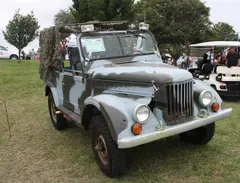
The GAZ-69 brought a different purpose to the range. This utility vehicle was designed for travel over difficult ground and work beyond paved roads. Its 1953-1975 span is the longest of the three listed models. That extended run shows how GAZ’s range included both passenger transport and vehicles built to serve practical, demanding duties.
How did the range develop?
Across the period, GAZ moved from the postwar Pobeda to the more substantial Volga M21, while the GAZ-69 served a separate off-road role. The model years overlap, so this was not a simple one-car-at-a-time handover: the passenger line developed while the utility vehicle remained in production.
The names also reflect GAZ’s identity. Pobeda means “Victory” in Russian, while Volga takes its name from the river. Their designs and roles made them recognisable in the plant’s history, though they addressed different needs: comfortable road travel in the saloons and access to rough terrain in the GAZ-69.
Markets and electrification
No markets are listed for these GAZ models here, so there is no country-by-country fuel-consumption, CO₂ or power comparison to describe. The models belong to a period before modern electrification became part of the passenger-car range; none of the three is presented as an electric or hybrid model.
Fuel-economy figures from different regions can be difficult to compare directly because test procedures differ. European figures may use WLTP or the older NEDC procedure, US ratings use EPA testing, and Canadian ratings use the 5-cycle test.
Questions and answers
What does GAZ stand for?
It is the abbreviation for Gorky Automobile Plant, named for the city where the factory was based.
Which GAZ model in this group ran the longest?
The GAZ-69, listed from 1953 to 1975.
Was the Volga M21 a successor to the Pobeda?
It followed the Pobeda in GAZ’s passenger-car line, with the Volga M21 listed from 1956 to 1970 and the Pobeda from 1946 to 1958.
Did these GAZ models have electric versions?
No electric or hybrid versions are listed for the Pobeda, Volga M21 or GAZ-69.