Chevrolet

Chevrolet Tracker

Chevrolet Tracker
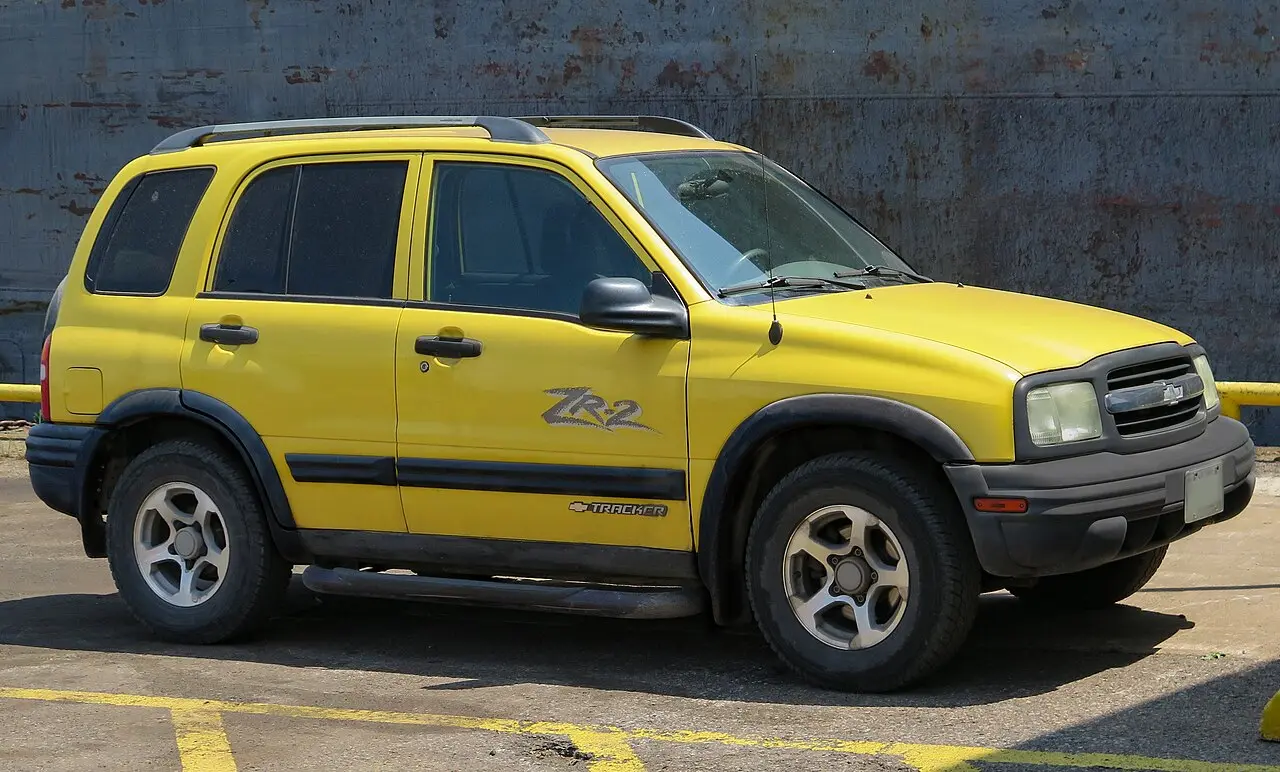
Photo: Elise240SX / Wikimedia Commons · CC BY-SA 4.0

The official data lists 40 versions of the Chevrolet Tracker (1995–2004), in the United States and Canada. Each market publishes its own figures, measured on its own test procedure.

At a glance

Years in the data
1995–2004
Markets
United States, Canada
Engines
1.6 L to 2.5 L
Fuels
Petrol
Lowest consumption (United States)
9.8 L/100 km (EPA)
Lowest consumption (Canada)
9.9 L/100 km (5-cycle)

What is the Chevrolet Tracker?

The Chevrolet Tracker was a compact sport utility vehicle related to Suzuki’s Vitara. Its compact shape and available soft-top body gave it a different feel from a conventional family car.

In the United States, the Tracker name followed the Geo Tracker, a Suzuki-based vehicle sold under GM’s Geo brand. Canadian figures begin in 1995, while US figures begin in 1998.

Tracker generations and engines

The first generation, based on the Vitara, is represented in Canada from 1995 to 1998 and in the United States in 1998. The second generation ran from 1999 to 2004 in both markets.

The petrol engine range ran from 1.6 L to 2.5 L.

How economical is the Chevrolet Tracker?

US EPA figures cover 1998–2004, with a lowest listed consumption of 9.8 L/100 km and a best combined rating of 24 MPG. Canadian figures cover 1995–2004 and list a lowest consumption of 9.9 L/100 km.

The EPA and Canadian NRCan ratings use different test procedures. The Canadian figure is based on the 5-cycle test, so the two markets’ results are not directly equivalent.

Where was the Tracker sold?

The Tracker was sold in the United States and Canada. The first generation is represented in Canada from 1995 and in the United States in 1998; the second generation ran in both countries from 1999 to 2004.

Questions and answers

What kind of vehicle was the Chevrolet Tracker?

It was a compact SUV related to Suzuki’s Vitara.

How many Tracker generations were there?

Two: the first generation is represented from 1995 in Canada and in 1998 in the United States; the second ran from 1999 to 2004.

What engines did it use?

The petrol engine range ran from 1.6 L to 2.5 L.

What was the best combined US EPA rating?

The best combined rating was 24 MPG.

Tracker First generation (1995–1998)

Model codes: Vitara · Sold in: Canada · References: gmauthority.com, en.wikipedia.org

Show all 8 versions

Tracker First generation (1998)

Model codes: Vitara · Sold in: United States · References: cars.com, gmauthority.com

Show all 8 versions

Tracker Second generation (1999–2004)

Chevrolet Tracker Second generation
Photo: Elise240SX / Wikimedia Commons · CC BY-SA 4.0

Model codes: Vitara · Sold in: United States and Canada · References: gmauthority.com, cars.com

United States 16 versions

Model years sold in the USA, from the EPA and the Department of Energy (fueleconomy.gov). MPG on the EPA test; litres per 100 km = 235.215 ÷ MPG.

Years and versionEngineFuelGearboxDriveConsumption (combined)CO₂
20042MODE 2LKUP2.5 LPetrol4-speed automaticRear-wheel drive18 MPG (13.1 L/100 km) EPA307 g/km
20042MODE 2LKUP2.5 LPetrol4-speed automaticFour- or all-wheel drive18 MPG (13.1 L/100 km) EPA307 g/km
1999–20032MODE 2LKUP2.0 LPetrol4-speed automaticFour- or all-wheel drive21 MPG (11.2 L/100 km) EPA263 g/km
1999–20032.0 LPetrol5-speed manualFour- or all-wheel drive21 MPG (11.2 L/100 km) EPA263 g/km
2001–20032MODE 2LKUP2.0 LPetrol4-speed automaticFour- or all-wheel drive21 MPG (11.2 L/100 km) EPA263 g/km
2002–20032MODE 2LKUP2.0 LPetrol4-speed automaticRear-wheel drive22 MPG (10.7 L/100 km) EPA251 g/km
2002–20032.0 LPetrol5-speed manualRear-wheel drive22 MPG (10.7 L/100 km) EPA251 g/km
2001–20032MODE 2LKUP2.5 LPetrol4-speed automaticRear-wheel drive18 MPG (13.1 L/100 km) EPA307 g/km
2001–20032MODE 2LKUP2.5 LPetrol4-speed automaticFour- or all-wheel drive17 MPG (13.8 L/100 km) EPA325 g/km
1999–20012MODE 2LKUP2.0 LPetrol4-speed automaticRear-wheel drive22 MPG (10.7 L/100 km) EPA251 g/km
1999–20012.0 LPetrol5-speed manualRear-wheel drive21 MPG (11.2 L/100 km) EPA263 g/km
1999–20012MODE 2LKUP2.0 LPetrol4-speed automaticRear-wheel drive22 MPG (10.7 L/100 km) EPA251 g/km
20012.0 LPetrol5-speed manualRear-wheel drive21 MPG (11.2 L/100 km) EPA263 g/km
1999–20001.6 LPetrol5-speed manualFour- or all-wheel drive23 MPG (10.2 L/100 km) EPA240 g/km
20001.6 LPetrol5-speed manualRear-wheel drive24 MPG (9.8 L/100 km) EPA230 g/km
19991.6 LPetrol5-speed manualRear-wheel drive23 MPG (10.2 L/100 km) EPA240 g/km

Canada 8 versions

Model years sold in Canada, from Natural Resources Canada fuel consumption ratings (5-cycle test).

Years and versionEngineFuelGearboxConsumption (combined)CO₂
2004Sport utility vehicle2.5 LPetrol4-speed automatic12.9 L/100 km 5-cycle297 g/km
1999–2003Sport utility vehicle2.0 LPetrol4-speed automatic10.9 L/100 km 5-cycle251 g/km
2001–2003Sport utility vehicle2.0 LPetrol5-speed manual11.0 L/100 km 5-cycle253 g/km
2003Sport utility vehicle2.0 LPetrol4-speed automatic11.3 L/100 km 5-cycle260 g/km
1999–2002Sport utility vehicle1.6 LPetrol5-speed manual9.9 L/100 km 5-cycle228 g/km
1999–2002Sport utility vehicle2.0 LPetrol4-speed automatic10.9 L/100 km 5-cycle251 g/km
2000Sport utility vehicle2.0 LPetrol5-speed manual11.1 L/100 km 5-cycle255 g/km
1999Sport utility vehicle2.0 LPetrol5-speed manual11.0 L/100 km 5-cycle253 g/km

Official figures are measured on standard test procedures and differ between markets. Your consumption depends on how, where and in what conditions you drive.