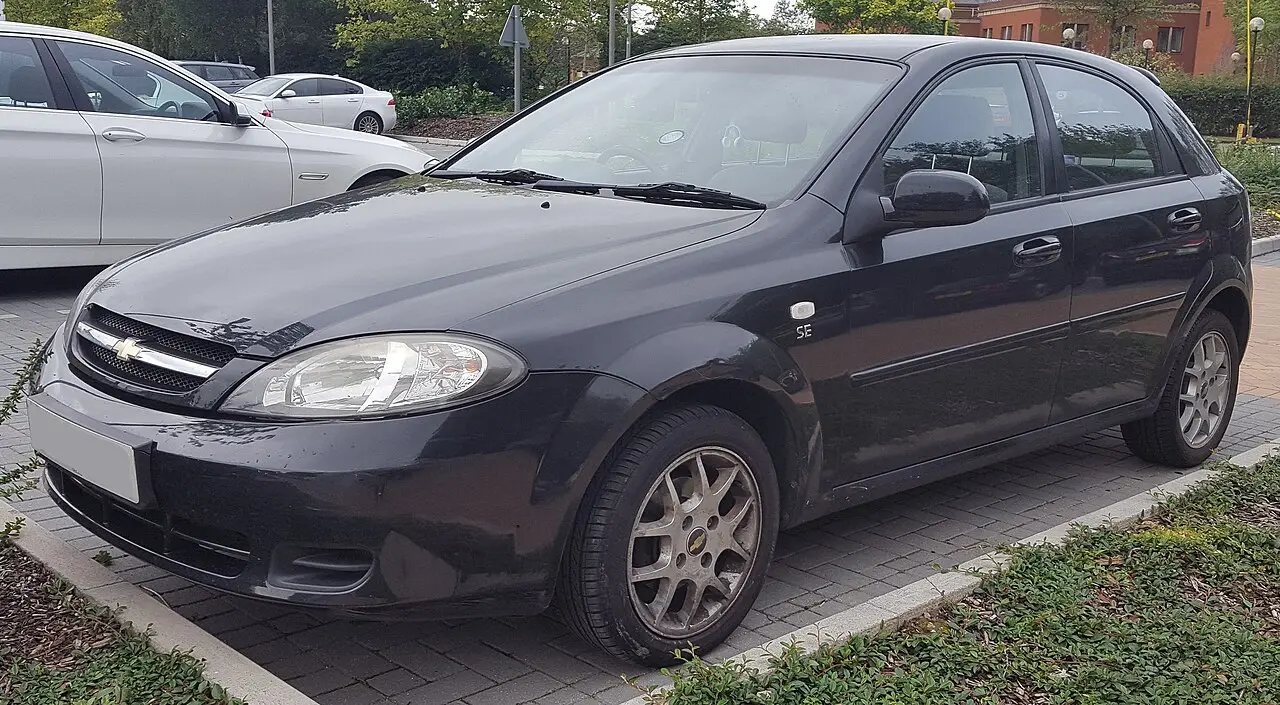
What is the Chevrolet Lacetti?
The Lacetti is a compact family car from GM’s Korean operations. The J200 range included hatchback, sedan and estate body styles, with different shapes to suit everyday passenger and luggage needs. As GM brought Daewoo models into Chevrolet’s European line-up, the Lacetti became one of the names used for this family of cars.
Lacetti generation
The first generation (2003–2013), known by the J200 code, was sold in Europe and the UK. Its hatchback, sedan and estate shared a compact-car role but offered different ways to balance passenger room and luggage space. The model’s Daewoo roots reflect GM’s expansion of its Korean-built cars into Chevrolet’s international range.
Engines and fuel consumption
EU registration figures cover petrol, diesel and LPG versions with engines from 1.4 to 2.0 litres and outputs from 70 kW (95 PS) to 89 kW (121 PS). The most registered configuration was the 1.6-litre petrol, followed by the 2.0-litre diesel. UK figures list petrol engines from 1.4 to 1.8 litres. US and Canadian figures cover 2.0-litre petrol versions.
The lowest listed consumption is 7.1 L/100 km in the UK on NEDC. The lowest US EPA figure is 10.2 L/100 km, with a best combined rating of 23 MPG. Canada lists 10.3 L/100 km on its 5-cycle test. Test procedures differ: WLTP or NEDC in Europe, EPA testing in the US and the 5-cycle procedure in Canada. EU registrations cover 11 versions and total 11,885 from 2010 to 2011.
Where was the Lacetti sold?
The Lacetti appears in figures for the EU and UK, as well as the United States and Canada. EU registrations cover 2010–2011, UK figures cover 2006–2010, and US and Canadian figures cover 2004–2007.
Questions and answers
What body styles did the Lacetti come in?
The range included hatchback, sedan and estate body styles.
What engines were available in the EU figures?
They cover 1.4 to 2.0-litre petrol, diesel and LPG versions, with outputs from 70 kW (95 PS) to 89 kW (121 PS).
How does the lowest listed consumption differ by market?
The UK figure is 7.1 L/100 km on NEDC, the US EPA figure is 10.2 L/100 km, and Canada’s 5-cycle figure is 10.3 L/100 km. The test methods differ.