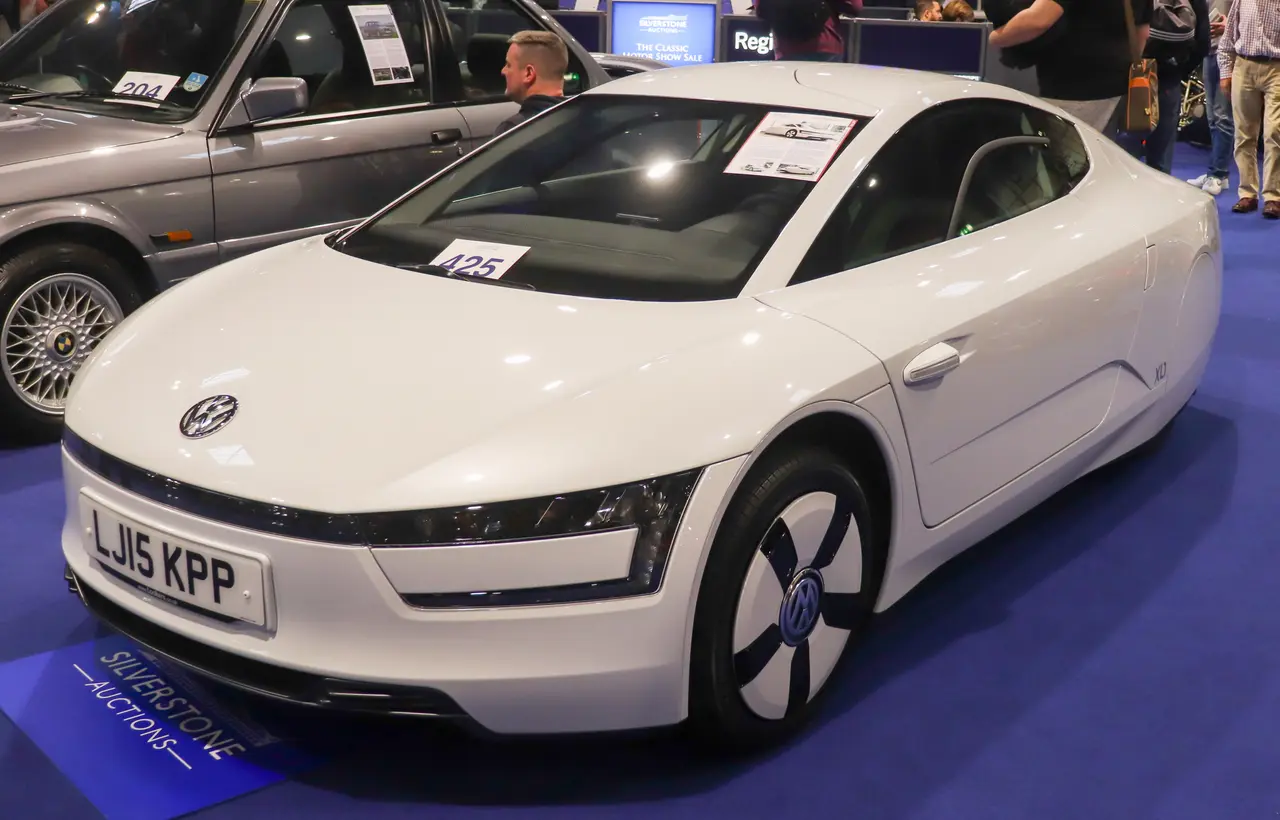
What is the Volkswagen XL1?
The XL1 is a two-seat, low-slung plug-in hybrid built as a small-series showcase for Volkswagen’s work on efficiency. Its tapered body, enclosed rear wheel arches and smooth underside were shaped to reduce drag, while a carbon-fibre structure kept weight down. Side-by-side seating made it more practical than the earlier one-litre prototypes, which placed their occupants in tandem.
This is an unusual Volkswagen: a specialist, carefully built coupe-like car rather than a family model. It suits readers interested in how far a road car can be designed around using less energy.
Generation and power
The XL1 generation ran from 2014 to 2016. It paired a 0.8-litre two-cylinder TDI diesel engine with an electric motor in a plug-in hybrid system. The diesel engine is rated at 35 kW (48 PS); the car could also travel on electric power alone. A seven-speed dual-clutch transmission was part of the system.
How economical is the Volkswagen XL1?
The XL1’s distinctive engineering was aimed at exceptional efficiency. Volkswagen quoted 0.9 litres per 100 kilometres and 21 grams of CO₂ per kilometre for the plug-in hybrid. These are manufacturer figures; the market figures shown here are EU EEA registrations and do not specify a test procedure. They should not be confused with results from the WLTP or older NEDC European tests, or with US EPA and Canadian 5-cycle ratings.
Where was the XL1 sold?
The EU EEA registration record spans 2013–2018, while Volkswagen lists the production generation as 2014–2016. There were 268 registrations recorded in the EU EEA over that period.
Questions and answers
Was the Volkswagen XL1 a plug-in hybrid?
Yes. It combined a 0.8-litre TDI diesel engine with an electric motor.
How much power did its diesel engine make?
The 0.8-litre diesel engine was rated at 35 kW (48 PS).
What CO₂ figure was quoted for the XL1?
Volkswagen quoted 21 g/km for the plug-in hybrid.