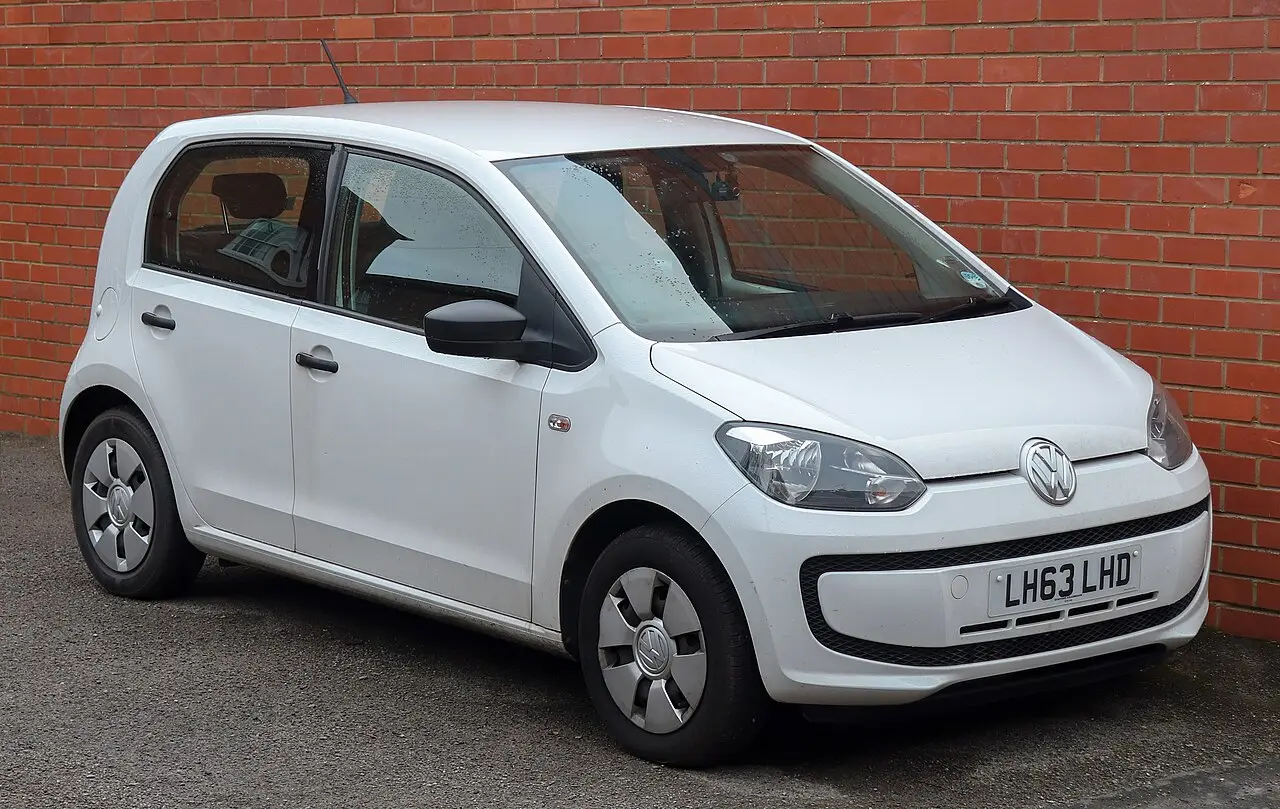
The official data lists 140 versions of the Volkswagen up! (2011–2025), in the European Union, the United Kingdom, and France. Each market publishes its own figures, measured on its own test procedure.
At a glance
Years in the data
2011–2025
Markets
European Union, United Kingdom, France
Engines
1.0 L
Power
44 kW (60 PS) to 85 kW (116 PS)
Fuels
Petrol, Natural gas, Electric, LPG
Lowest consumption (France)
4.1 L/100 km (NEDC)
Lowest consumption (United Kingdom)
4.1 L/100 km (NEDC)
Lowest consumption (European Union)
4.8 L/100 km (WLTP)
New registrations in the EU
1,934,592
What is the Volkswagen up!?
The up! is a small city car with a short body and a cabin designed to make good use of its space. It seats four and suits everyday trips where a compact footprint is useful.
Volkswagen introduced the up! in 2011. Its early technology included City Emergency Braking and a portable navigation and infotainment system called maps+more. Natural-gas and electric versions followed its petrol launch.
Generations and engines
The up! had one generation, sold from 2012 to 2023. The basic small-car idea remained consistent, with different versions offered across markets.
The EU range used 1.0-litre engines, with power from 44 kW (60 PS) to 85 kW (116 PS). Fuel types listed in the EU include petrol, natural gas, LPG and electric. The UK figures list petrol and electric versions; France lists petrol, natural gas and electric.
Fuel consumption and markets
The lowest listed EU consumption is 4.8 L/100 km on WLTP. The UK and French lows are both 4.1 L/100 km on NEDC. WLTP and NEDC are different European test procedures, so the figures are not directly comparable.
The up! appears in EU registration figures from 2011 to 2025, UK figures from 2012 to 2019 and French figures from 2012 to 2015. EU registrations total 1,934,592.
Questions and answers
How many generations of Volkswagen up! were there?
One: Generation I, sold from 2012 to 2023.
What engines were offered in the up!?
The EU range used 1.0-litre engines. Fuel types listed across the EU, UK and France include petrol, natural gas, LPG and electric.
What is the up!’s lowest official fuel consumption?
The UK and French NEDC figures are both 4.1 L/100 km. The EU low is 4.8 L/100 km on WLTP.
Where was the up! sold?
It appears in market figures for the European Union, the United Kingdom and France.
New cars registered in the EU (plus Norway and Iceland), from the European Environment Agency. Figures on the NEDC procedure until 2020 and on WLTP from 2021; versions are grouped by engine and power, with their number of registrations.
Years and version
Engine
Power
Fuel
Consumption (combined)
CO₂
Electric range
EU registrations
2023–2024
1.0 L
48 kW (65 PS)
Petrol
5.1 L/100 km WLTP
116 g/km
–
25,792
2023–2024
1.0 L
85 kW (116 PS)
Petrol
5.5 L/100 km WLTP
125 g/km
–
962
2023
Electric motor
61 kW (83 PS)
Electric
14.5 kWh/100 km WLTP
0 g/km
256 km
7,948
2023
1.0 L
50 kW (68 PS)
Natural gas
5.8 L/100 km WLTP
104 g/km
–
402
2023
Electric motor
67 kW (91 PS)
Electric
14.4 kWh/100 km WLTP
0 g/km
259 km
111
2023
Electric motor
110 kW (150 PS)
Electric
14.4 kWh/100 km WLTP
0 g/km
259 km
48
2023
Electric motor
81 kW (110 PS)
Electric
14.4 kWh/100 km WLTP
0 g/km
259 km
29
2023
Electric motor
95 kW (129 PS)
Electric
14.4 kWh/100 km WLTP
0 g/km
258 km
15
2023
Electric motor
68 kW (92 PS)
Electric
14.4 kWh/100 km WLTP
0 g/km
259 km
12
2023
Electric motor
84 kW (114 PS)
Electric
14.4 kWh/100 km WLTP
0 g/km
259 km
12
2023
Electric motor
112 kW (152 PS)
Electric
14.4 kWh/100 km WLTP
0 g/km
259 km
12
2023
Electric motor
72 kW (98 PS)
Electric
14.4 kWh/100 km WLTP
0 g/km
259 km
11
2023
Electric motor
70 kW (95 PS)
Electric
14.4 kWh/100 km WLTP
0 g/km
259 km
10
2023
Electric motor
85 kW (116 PS)
Electric
14.4 kWh/100 km WLTP
0 g/km
259 km
10
2023
Electric motor
96 kW (131 PS)
Electric
14.4 kWh/100 km WLTP
0 g/km
259 km
10
2022
Electric motor
61 kW (83 PS)
Electric
13.0 kWh/100 km WLTP
0 g/km
258 km
16,372
2022
1.0 L
48 kW (65 PS)
Petrol
4.9 L/100 km WLTP
116 g/km
–
15,766
2022
1.0 L
85 kW (116 PS)
Petrol
5.4 L/100 km WLTP
125 g/km
–
1,564
2022
1.0 L
50 kW (68 PS)
Natural gas
4.9 L/100 km WLTP
105 g/km
–
1,448
2021
Electric motor
61 kW (83 PS)
Electric
13.0 kWh/100 km WLTP
0 g/km
257 km
78,225
2021
1.0 L
48 kW (65 PS)
Petrol
4.8 L/100 km WLTP
116 g/km
–
50,634
2021
1.0 L
50 kW (68 PS)
Natural gas
4.8 L/100 km WLTP
106 g/km
–
6,394
2021
1.0 L
85 kW (116 PS)
Petrol
5.4 L/100 km WLTP
125 g/km
–
3,754
2021
1.0 L
44 kW (60 PS)
Petrol
4.9 L/100 km WLTP
124 g/km
–
1,196
2020
1.0 L
44 kW (60 PS)
Petrol
–
100 g/km
–
48,332
2020
Electric motor
61 kW (83 PS)
Electric
13.4 kWh/100 km NEDC
0 g/km
256 km
42,626
2020
1.0 L
48 kW (65 PS)
Petrol
–
99 g/km
–
15,018
2020
1.0 L
50 kW (68 PS)
Natural gas
–
84 g/km
–
6,629
2020
1.0 L
85 kW (116 PS)
Petrol
–
111 g/km
–
3,064
2020
Electric motor
85 kW (116 PS)
Electric
–
0 g/km
–
946
2020
1.0 L
55 kW (75 PS)
Petrol
–
97 g/km
–
426
2020
Electric motor
60 kW (82 PS)
Electric
14.5 kWh/100 km NEDC
0 g/km
133 km
166
2020
1.0 L
66 kW (90 PS)
Petrol
–
98 g/km
–
96
2020
Electric motor
110 kW (150 PS)
Electric
12.8 kWh/100 km NEDC
0 g/km
–
14
2019
1.0 L
44 kW (60 PS)
Petrol
–
96 g/km
–
104,542
2019
1.0 L
55 kW (75 PS)
Petrol
–
98 g/km
–
23,676
2019
1.0 L
50 kW (68 PS)
Natural gas
–
81 g/km
–
13,224
2019
1.0 L
85 kW (116 PS)
Petrol
–
110 g/km
–
6,736
2019
1.0 L
66 kW (90 PS)
Petrol
–
97 g/km
–
5,062
2019
Electric motor
60 kW (82 PS)
Electric
15.5 kWh/100 km NEDC
0 g/km
–
3,774
2019
Electric motor
61 kW (83 PS)
Electric
13.0 kWh/100 km NEDC
0 g/km
–
184
2019
1.0 L
110 kW (150 PS)
Petrol
–
97 g/km
–
24
2019
1.0 L
48 kW (65 PS)
Petrol
–
129 g/km
–
16
2018
1.0 L
44 kW (60 PS)
Petrol
11.7 kWh/100 km NEDC
98 g/km
–
129,973
2018
1.0 L
55 kW (75 PS)
Petrol
11.7 kWh/100 km NEDC
98 g/km
–
31,730
2017–2018
1.0 L
50 kW (68 PS)
Natural gas
–
82 g/km
–
20,352
2018
1.0 L
66 kW (90 PS)
Petrol
–
101 g/km
–
9,668
2018
1.0 L
85 kW (116 PS)
Petrol
–
111 g/km
–
6,888
2018
Electric motor
60 kW (82 PS)
Electric
12.7 kWh/100 km NEDC
0 g/km
–
4,194
2017
1.0 L
44 kW (60 PS)
Petrol
–
97 g/km
–
135,782
2017
1.0 L
55 kW (75 PS)
Petrol
–
101 g/km
–
32,660
2017
1.0 L
66 kW (90 PS)
Petrol
–
102 g/km
–
17,100
2017
Electric motor
60 kW (82 PS)
Electric
11.7 kWh/100 km NEDC
0 g/km
–
4,220
2017
1.0 L
83 kW (113 PS)
Petrol
–
101 g/km
–
338
2017
1.0 L
99 kW (135 PS)
Petrol
–
108 g/km
–
162
2017
1.0 L
85 kW (116 PS)
Petrol
–
110 g/km
–
30
2016
1.0 L
44 kW (60 PS)
Petrol
–
103 g/km
–
136,973
2016
1.0 L
55 kW (75 PS)
Petrol
–
104 g/km
–
36,626
2016
1.0 L
50 kW (68 PS)
Natural gas
–
80 g/km
–
8,664
2016
1.0 L
44 kW (60 PS)
LPG
–
105 g/km
–
3,630
2016
1.0 L
66 kW (90 PS)
Petrol
–
115 g/km
–
3,232
2016
Electric motor
60 kW (82 PS)
Electric
11.7 kWh/100 km NEDC
0 g/km
–
2,776
2016
1.0 L
55 kW (75 PS)
LPG
–
109 g/km
–
14
2016
1.0 L
85 kW (116 PS)
Petrol
–
153 g/km
–
12
2015
1.0 L
44 kW (60 PS)
Petrol
–
102 g/km
–
149,614
2015
1.0 L
55 kW (75 PS)
Petrol
–
104 g/km
–
37,750
2015
1.0 L
50 kW (68 PS)
Natural gas
–
79 g/km
–
11,124
2015
Electric motor
60 kW (82 PS)
Electric
11.7 kWh/100 km NEDC
0 g/km
–
2,590
2014
1.0 L
44 kW (60 PS)
Petrol
–
102 g/km
–
167,478
2014
1.0 L
55 kW (75 PS)
Petrol
–
105 g/km
–
45,006
2014
1.0 L
50 kW (68 PS)
Natural gas
–
79 g/km
–
17,474
2014
Electric motor
60 kW (82 PS)
Electric
11.7 kWh/100 km NEDC
0 g/km
–
4,282
2014
–
–
Petrol
–
105 g/km
–
170
2013
1.0 L
44 kW (60 PS)
Petrol
–
102 g/km
–
162,322
2013
1.0 L
55 kW (75 PS)
Petrol
–
105 g/km
–
55,500
2012–2013
1.0 L
50 kW (68 PS)
Natural gas
–
79 g/km
–
20,323
2013
Electric motor
60 kW (82 PS)
Electric
11.7 kWh/100 km NEDC
0 g/km
–
1,870
2013
1.0 L
–
Other fuel
–
106 g/km
–
1,410
2013
–
–
Petrol
–
106 g/km
–
194
2013
–
–
Natural gas
–
79 g/km
–
30
2012
1.0 L
44 kW (60 PS)
Petrol
–
102 g/km
–
112,954
2012
1.0 L
55 kW (75 PS)
Petrol
–
105 g/km
–
61,465
2012
–
–
Petrol
–
105 g/km
–
2,214
United Kingdom 30 versions
New cars on sale in the UK, from the Vehicle Certification Agency. NEDC figures until 2018 and WLTP figures after; years are the editions a version appeared in.
2012–2013NOUVELLE up! 1.0 MPI (75ch) BMT · UP! 1.0 MPI (75ch) BVM5 BMT
–
55 kW (75 PS)
Petrol
5-speed manual
4.2 L/100 km NEDC
98 g/km
Versions outside these generations
European Union 6 versions
New cars registered in the EU (plus Norway and Iceland), from the European Environment Agency. Figures on the NEDC procedure until 2020 and on WLTP from 2021; versions are grouped by engine and power, with their number of registrations.
Years and version
Engine
Power
Fuel
Consumption (combined)
CO₂
Electric range
EU registrations
2025
Electric motor
61 kW (83 PS)
Electric
14.6 kWh/100 km WLTP
0 g/km
256 km
130
2025
1.0 L
48 kW (65 PS)
Petrol
5.1 L/100 km WLTP
115 g/km
–
32
2024
Electric motor
61 kW (83 PS)
Electric
14.6 kWh/100 km WLTP
0 g/km
256 km
1,429
2024
1.0 L
50 kW (68 PS)
Natural gas
5.8 L/100 km WLTP
104 g/km
–
13
2011
1.0 L
44 kW (60 PS)
Petrol
–
105 g/km
–
4,582
2011
1.0 L
55 kW (75 PS)
Petrol
–
108 g/km
–
4,320
Official figures are measured on standard test procedures and differ between markets. Your consumption depends on how, where and in what conditions you drive.