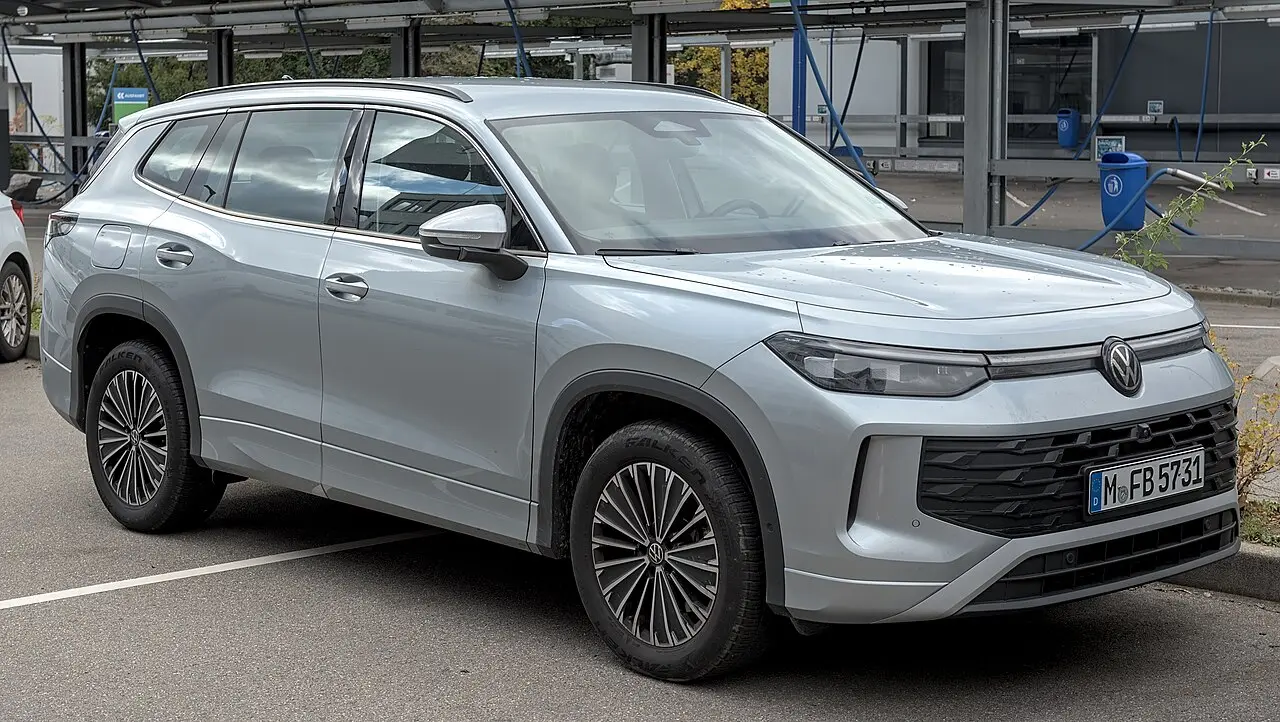
The official data lists 56 versions of the Volkswagen Tayron (2019–2026), in the European Union and the United Kingdom. Each market publishes its own figures, measured on its own test procedure.
At a glance
Years in the data
2019–2026
Markets
European Union, United Kingdom
Engines
1.5 L to 2.0 L
Power
110 kW (150 PS) to 200 kW (272 PS)
Fuels
Diesel, Hybrid, Plug-in hybrid, Petrol
Lowest consumption (European Union)
5.6 L/100 km (WLTP)
Lowest consumption (United Kingdom)
5.6 L/100 km (WLTP)
Plug-in hybrid, weighted (European Union)
0.6 L/100 km (WLTP)
Plug-in hybrid, weighted (United Kingdom)
5.7 L/100 km (WLTP)
New registrations in the EU
48,246
What is the Volkswagen Tayron?
The Tayron is a large Volkswagen SUV with five seats or an optional third row for seven. In Europe it fills the space between the Tiguan and Touareg, with a roomy cabin suited to family trips and everyday use. Volkswagen introduced it as the successor to the Tiguan Allspace, carrying that model’s larger, more flexible format into the range.
The current European and UK generation is the second generation, known by the codes Tayron II and R4. It spans 2025 to today in those markets. Volkswagen has also used the Tayron name in other markets, but this generation brings it to Europe as a large family SUV.
Engines and power
Across the listed EU and UK versions, engine sizes range from 1.5 to 2.0 litres. Choices include petrol, diesel, hybrid and plug-in hybrid. EU power spans 110 kW (150 PS) to 195 kW (265 PS); UK versions range from 110 kW (150 PS) to 200 kW (272 PS).
The range offers conventional petrol and diesel engines, hybrid assistance and plug-in hybrid driving. Among the leading versions in EU registrations were the 2.0-litre diesel with 142 kW (193 PS), the 1.5-litre hybrid with 110 kW (150 PS) and the 1.5-litre plug-in hybrid with 110 kW (150 PS).
How economical is the Volkswagen Tayron?
The lowest stated consumption for petrol, diesel and hybrid versions is 5.6 L/100 km on the WLTP test in both the EU and UK. The lowest EU plug-in hybrid figure is 0.6 L/100 km WLTP; the UK figure is 5.7 L/100 km WLTP. These are weighted figures that assume some driving is electric, so they depend on charging and use. WLTP is the European test procedure.
EU registration figures list 48,246 Tayrons for 2019–2025, spanning the earlier nameplate and the current generation. UK figures cover 2025–2026. Individual consumption and CO₂ results vary by version.
Questions and answers
How many seats does the Tayron have?
It is offered with five seats or, optionally, seven.
What engines are available?
Listed EU and UK versions use engines from 1.5 to 2.0 litres, with petrol, diesel, hybrid and plug-in hybrid options.
What is the Tayron’s lowest official consumption?
The lowest stated figure is 5.6 L/100 km WLTP for petrol, diesel and hybrid versions in both the EU and UK. Plug-in hybrid figures are weighted calculations that assume some electric driving.
Where is the Tayron listed?
The figures cover European Union registrations and UK VCA listings.
New cars registered in the EU (plus Norway and Iceland), from the European Environment Agency. Figures on the NEDC procedure until 2020 and on WLTP from 2021; versions are grouped by engine and power, with their number of registrations.
Years and version
Engine
Power
Fuel
Consumption (combined)
CO₂
Electric range
EU registrations
2025
2.0 L
142 kW (193 PS)
Diesel
6.5 L/100 km WLTP
172 g/km
–
12,396
2025
1.5 L
110 kW (150 PS)
Hybrid
6.4 L/100 km WLTP
146 g/km
–
8,986
2025
1.5 L
110 kW (150 PS)
Plug-in hybrid
0.6 L/100 km WLTP17.5 kWh/100 km WLTP
13 g/km
118 km
8,868
2025
1.5 L
130 kW (177 PS)
Plug-in hybrid
0.6 L/100 km WLTP17.8 kWh/100 km WLTP
14 g/km
115 km
7,648
2025
2.0 L
110 kW (150 PS)
Diesel
5.6 L/100 km WLTP
147 g/km
–
5,615
2025
2.0 L
150 kW (204 PS)
Petrol
7.9 L/100 km WLTP
180 g/km
–
2,944
2025
2.0 L
195 kW (265 PS)
Petrol
8.7 L/100 km WLTP
198 g/km
–
1,087
2025
1.5 L
110 kW (150 PS)
Petrol
–
221 g/km
–
205
2025
2.0 L
200 kW (272 PS)
Petrol
–
262 g/km
–
38
United Kingdom 27 versions
New cars on sale in the UK, from the Vehicle Certification Agency. NEDC figures until 2018 and WLTP figures after; years are the editions a version appeared in.
Years and version
Engine
Power
Fuel
Gearbox
Consumption (combined)
CO₂
Electric range
2025–2026Life 1.5 eTSI 150 PS 7-Speed DSG
1.5 L
110 kW (150 PS)
Hybrid
7-speed automatic
6.1 L/100 km WLTP
139 g/km
–
2025–2026Life 1.5 eTSI 150 PS 7-Speed DSG · R-Line 1.5 eTSI 150 PS 7-Speed DSG
1.5 L
110 kW (150 PS)
Hybrid
7-speed automatic
6.3 L/100 km WLTP
143 g/km
–
2025–2026Elegance 1.5 eTSI 150 PS 7-Speed DSG
1.5 L
110 kW (150 PS)
Hybrid
7-speed automatic
6.1 L/100 km WLTP
138 g/km
–
2025–2026Elegance 1.5 eTSI 150 PS 7-Speed DSG · R-Line 1.5 eTSI 150 PS 7-Speed DSG
1.5 L
110 kW (150 PS)
Hybrid
7-speed automatic
6.5 L/100 km WLTP
147 g/km
–
2025–2026Elegance 2.0 TDI 150 PS 7-Speed DSG 5 Door
2026R-Line Edition 1.5 TSI eHybrid 204 PS 6-Speed DSG
1.5 L
150 kW (204 PS)
Plug-in hybrid
6-speed automatic
6.0 L/100 km WLTP18.2 kWh/100 km WLTP
–
113 km
2026R-Line 1.5 TSI eHybrid 204 PS 6-Speed DSG
1.5 L
150 kW (204 PS)
Plug-in hybrid
6-speed automatic
6.0 L/100 km WLTP18.0 kWh/100 km WLTP
–
114 km
2026R-Line Edition 1.5 TSI eHybrid 272 PS 6-Speed DSG
1.5 L
200 kW (272 PS)
Plug-in hybrid
6-speed automatic
6.0 L/100 km WLTP18.1 kWh/100 km WLTP
–
113 km
2026R-Line 1.5 TSI eHybrid 272 PS 6-Speed DSG
1.5 L
200 kW (272 PS)
Plug-in hybrid
6-speed automatic
5.9 L/100 km WLTP17.9 kWh/100 km WLTP
–
114 km
2025–2026Life 2.0 TDI 150 PS 7-Speed DSG
2.0 L
110 kW (150 PS)
Diesel
7-speed automatic
5.6 L/100 km WLTP
145 g/km
–
2025–2026Life 2.0 TDI 150 PS 7-Speed DSG
2.0 L
110 kW (150 PS)
Diesel
7-speed automatic
5.7 L/100 km WLTP
150 g/km
–
2025–2026R-Line 2.0 TSI 4MOTION 204 PS 7-Speed DSG
2.0 L
150 kW (204 PS)
Petrol
7-speed automatic
7.9 L/100 km WLTP
180 g/km
–
2025–2026R-Line 2.0 TSI 4MOTION 204 PS 7-Speed DSG
2.0 L
150 kW (204 PS)
Petrol
7-speed automatic
8.1 L/100 km WLTP
184 g/km
–
2025–2026R-Line 2.0 TSI 4MOTION 265 PS 7-Speed DSG
2.0 L
195 kW (265 PS)
Petrol
7-speed automatic
8.6 L/100 km WLTP
195 g/km
–
2025–2026R-Line 2.0 TSI 4MOTION 265 PS 7-Speed DSG
2.0 L
195 kW (265 PS)
Petrol
7-speed automatic
8.8 L/100 km WLTP
200 g/km
–
2025Life 1.5 TSI eHybrid 204 PS 6-Speed DSG
1.5 L
150 kW (204 PS)
Plug-in hybrid
6-speed automatic
5.7 L/100 km WLTP
–
174 km
2025Elegance 1.5 TSI eHybrid 204 PS 6-Speed DSG
1.5 L
150 kW (204 PS)
Plug-in hybrid
6-speed automatic
5.7 L/100 km WLTP
–
175 km
2025Match 1.5 TSI eHybrid 204 PS 6-Speed DSG
1.5 L
150 kW (204 PS)
Plug-in hybrid
6-speed automatic
5.8 L/100 km WLTP
–
175 km
2025R-Line 1.5 TSI eHybrid 204 PS 6-Speed DSG
1.5 L
150 kW (204 PS)
Plug-in hybrid
6-speed automatic
6.0 L/100 km WLTP
–
180 km
2025R-Line Edition 1.5 TSI eHybrid 204 PS 6-Speed DSG
1.5 L
150 kW (204 PS)
Plug-in hybrid
6-speed automatic
6.0 L/100 km WLTP
–
182 km
2025R-Line 1.5 TSI eHybrid 272 PS 6-Speed DSG
1.5 L
200 kW (272 PS)
Plug-in hybrid
6-speed automatic
5.9 L/100 km WLTP
–
179 km
2025R-Line Edition 1.5 TSI eHybrid 272 PS 6-Speed DSG
1.5 L
200 kW (272 PS)
Plug-in hybrid
6-speed automatic
6.0 L/100 km WLTP
–
181 km
Versions outside these generations
European Union 20 versions
New cars registered in the EU (plus Norway and Iceland), from the European Environment Agency. Figures on the NEDC procedure until 2020 and on WLTP from 2021; versions are grouped by engine and power, with their number of registrations.
Years and version
Engine
Power
Fuel
Consumption (combined)
CO₂
Electric range
EU registrations
2024
2.0 L
142 kW (193 PS)
Diesel
6.6 L/100 km WLTP
207 g/km
–
56
2024
2.0 L
150 kW (204 PS)
Petrol
–
246 g/km
–
41
2024
1.5 L
110 kW (150 PS)
Hybrid
–
143 g/km
–
36
2024
1.5 L
110 kW (150 PS)
Plug-in hybrid
–
148 g/km
12 km
31
2024
1.5 L
130 kW (177 PS)
Plug-in hybrid
–
151 g/km
31 km
24
2024
2.0 L
162 kW (220 PS)
Petrol
–
244 g/km
–
18
2024
2.0 L
195 kW (265 PS)
Petrol
–
259 g/km
–
17
2024
2.0 L
110 kW (150 PS)
Diesel
–
195 g/km
–
14
2024
1.4 L
110 kW (150 PS)
Petrol
–
216 g/km
–
11
2024
1.5 L
110 kW (150 PS)
Petrol
–
229 g/km
–
10
2024
2.0 L
200 kW (272 PS)
Petrol
–
260 g/km
–
10
2022
2.0 L
162 kW (220 PS)
Petrol
–
241 g/km
–
11
2021
2.0 L
162 kW (220 PS)
Petrol
–
241 g/km
–
20
2021
2.0 L
137 kW (186 PS)
Petrol
–
223 g/km
–
18
2021
1.4 L
110 kW (150 PS)
Plug-in hybrid
–
156 g/km
–
16
2020
2.0 L
137 kW (186 PS)
Petrol
–
225 g/km
–
24
2020
1.4 L
110 kW (150 PS)
Plug-in hybrid
–
149 g/km
–
18
2019
1.4 L
110 kW (150 PS)
Plug-in hybrid
–
182 g/km
–
46
2019
2.0 L
162 kW (220 PS)
Petrol
–
234 g/km
–
20
2019
2.0 L
137 kW (186 PS)
Petrol
–
230 g/km
–
18
Official figures are measured on standard test procedures and differ between markets. Your consumption depends on how, where and in what conditions you drive.