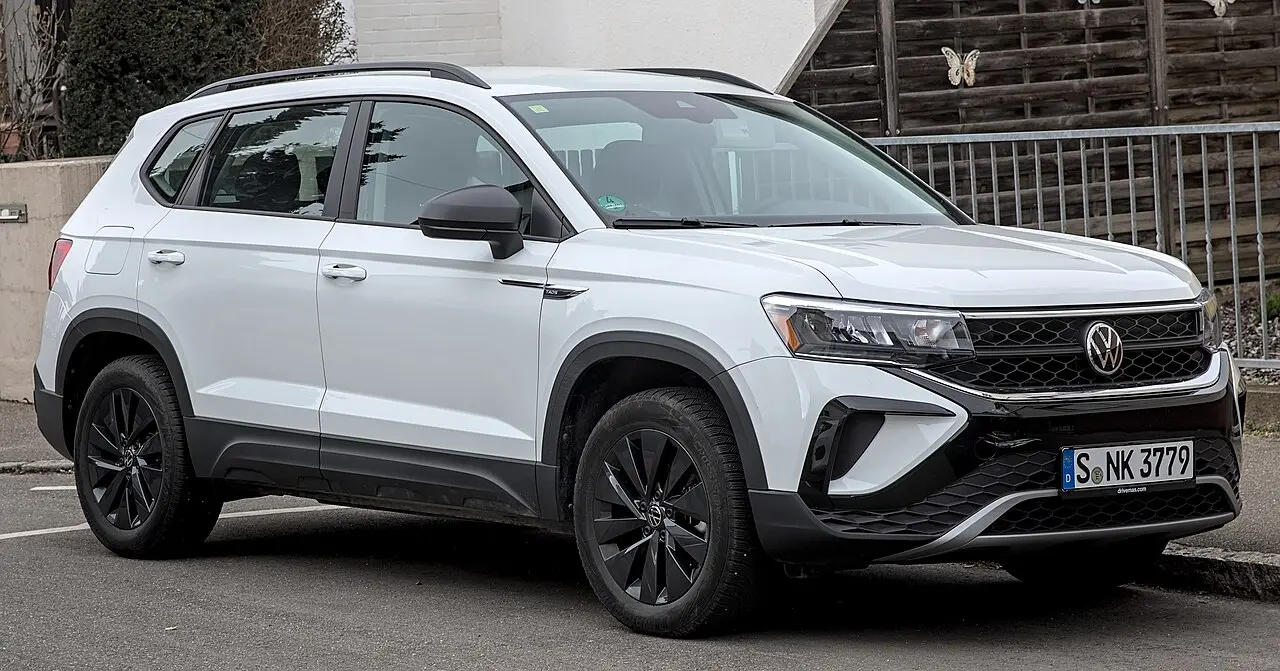
The official data lists 28 versions of the Volkswagen Taos (2020–2027), in the European Union, the United States, and Canada. Each market publishes its own figures, measured on its own test procedure.
At a glance
Years in the data
2020–2027
Markets
European Union, United States, Canada
Engines
1.5 L to 1.5 L
Power
118 kW (160 PS)
Fuels
Petrol
Lowest consumption (Canada)
7.4 L/100 km (5-cycle)
Lowest consumption (United States)
7.6 L/100 km (EPA)
New registrations in the EU
330
What is the Volkswagen Taos?
The Taos is a compact SUV in Volkswagen’s range, with an upright shape and a higher seating position. It is sold in the EU, the United States and Canada, though the versions differ by market.
The first generation, code CT, began in 2020. The model appears in EU registration figures from 2020 to 2025 and in North American test figures from 2022 onward.
Engines and power
The listed engine is a 1.5-litre petrol unit. EU registration figures include versions rated at 118 kW (160 PS) and 130 kW (177 PS).
Fuel consumption and where it was sold
The best combined EPA rating is 31 MPG, and the lowest listed EPA consumption is 7.6 L/100 km. In Canada, the lowest listed consumption is 7.4 L/100 km on the NRCan 5-cycle test. These results use different procedures: EPA and Canada’s 5-cycle tests differ from each other and from Europe’s WLTP and NEDC tests.
EU registration figures cover 2020 to 2025, with 330 registrations across those years. US EPA figures cover 2022 to 2027, while Canadian NRCan figures cover 2022 to 2026.
Questions and answers
What kind of vehicle is the Taos?
It is a compact SUV in Volkswagen’s range.
What engine and power figures are listed?
The engine is 1.5 litres. EU entries include versions rated at 118 kW (160 PS) and 130 kW (177 PS).
How economical is the Taos on official tests?
Its best combined EPA rating is 31 MPG. The lowest listed Canadian figure is 7.4 L/100 km on NRCan’s 5-cycle test.
Model codes: CT · Sold in: European Union, United States, and Canada · References: en.wikipedia.org
European Union 12 versions
New cars registered in the EU (plus Norway and Iceland), from the European Environment Agency. Figures on the NEDC procedure until 2020 and on WLTP from 2021; versions are grouped by engine and power, with their number of registrations.
Years and version
Engine
Power
Fuel
CO₂
EU registrations
2025
1.5 L
130 kW (177 PS)
Petrol
216 g/km
22
2024
1.5 L
130 kW (177 PS)
Petrol
209 g/km
42
2024
1.5 L
118 kW (160 PS)
Petrol
210 g/km
15
2024
1.4 L
110 kW (150 PS)
Petrol
196 g/km
14
2023
1.5 L
130 kW (177 PS)
Petrol
207 g/km
40
2023
1.5 L
118 kW (160 PS)
Petrol
206 g/km
15
2022
1.5 L
118 kW (160 PS)
Petrol
214 g/km
34
2022
1.5 L
130 kW (177 PS)
Petrol
205 g/km
16
2021
1.5 L
118 kW (160 PS)
Petrol
206 g/km
66
2021
1.4 L
110 kW (150 PS)
Petrol
201 g/km
20
2021
1.5 L
130 kW (177 PS)
Petrol
203 g/km
10
2020
1.5 L
118 kW (160 PS)
Petrol
208 g/km
36
United States 8 versions
Model years sold in the USA, from the EPA and the Department of Energy (fueleconomy.gov). MPG on the EPA test; litres per 100 km = 235.215 ÷ MPG.
Years and version
Engine
Fuel
Gearbox
Drive
Consumption (combined)
CO₂
2027SIDI
1.5 L
Petrol
8-speed automatic
Front-wheel drive
30 MPG (7.8 L/100 km) EPA
185 g/km
2027SIDI
1.5 L
Petrol
8-speed automatic
Four-wheel drive
28 MPG (8.4 L/100 km) EPA
196 g/km
2022–2026SIDI
1.5 L
Petrol
8-speed automatic
Front-wheel drive
31 MPG (7.6 L/100 km) EPA
178 g/km
2026SIDI
1.5 L
Petrol
8-speed automatic
Four-wheel drive
28 MPG (8.4 L/100 km) EPA
198 g/km
2025SIDI
1.5 L
Petrol
8-speed automatic
All-wheel drive
28 MPG (8.4 L/100 km) EPA
198 g/km
2024SIDI
1.5 L
Petrol
7-speed automated manual
All-wheel drive
27 MPG (8.7 L/100 km) EPA
204 g/km
2023SIDI
1.5 L
Petrol
7-speed automated manual
All-wheel drive
28 MPG (8.4 L/100 km) EPA
200 g/km
2022SIDI
1.5 L
Petrol
7-speed automatic
All-wheel drive
28 MPG (8.4 L/100 km) EPA
201 g/km
Canada 8 versions
Model years sold in Canada, from Natural Resources Canada fuel consumption ratings (5-cycle test).
Years and version
Engine
Fuel
Gearbox
Consumption (combined)
CO₂
2025–2026Sport utility vehicle: Small
1.5 L
Petrol
8-speed automatic
8.4 L/100 km 5-cycle
198 g/km
2026Sport utility vehicle: Small
1.5 L
Petrol
8-speed automatic
7.4 L/100 km 5-cycle
178 g/km
2025Sport utility vehicle: Small
1.5 L
Petrol
8-speed automatic
7.6 L/100 km 5-cycle
178 g/km
2024Sport utility vehicle: Small
1.5 L
Petrol
8-speed automatic
7.5 L/100 km 5-cycle
178 g/km
2024Sport utility vehicle: Small
1.5 L
Petrol
7-speed automated manual
8.8 L/100 km 5-cycle
208 g/km
2022–2023Sport utility vehicle: Small
1.5 L
Petrol
8-speed automatic
7.6 L/100 km 5-cycle
178 g/km
2023Sport utility vehicle: Small
1.5 L
Petrol
7-speed automated manual
8.5 L/100 km 5-cycle
200 g/km
2022Sport utility vehicle: Small
1.5 L
Petrol
7-speed automatic
8.5 L/100 km 5-cycle
200 g/km
Official figures are measured on standard test procedures and differ between markets. Your consumption depends on how, where and in what conditions you drive.