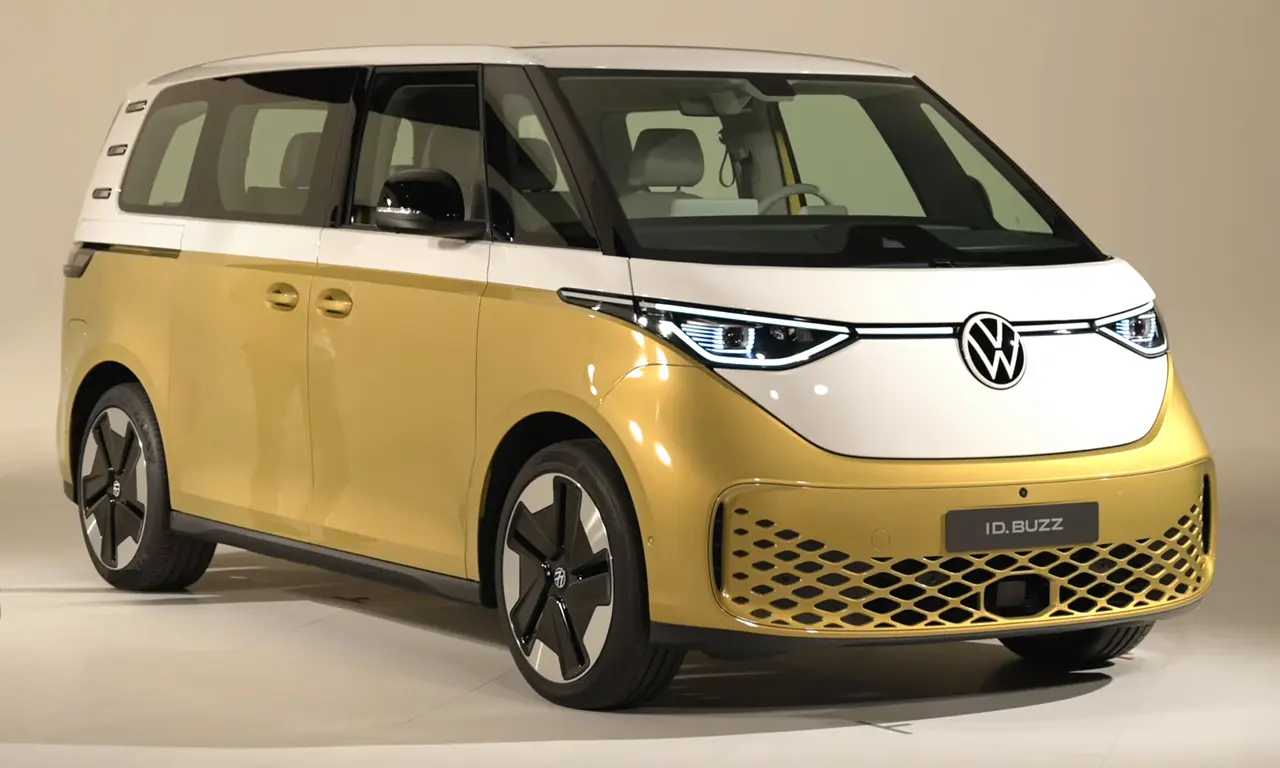
The official data lists 34 versions of the Volkswagen ID. Buzz (2021–2027), in the European Union, the United States, and Canada. Each market publishes its own figures, measured on its own test procedure.
At a glance
Years in the data
2021–2027
Markets
European Union, United States, Canada
Power
70 kW (95 PS) to 250 kW (340 PS)
Fuels
Electric
New registrations in the EU
45,762
What is the Volkswagen ID. Buzz?
The ID. Buzz is Volkswagen’s all-electric passenger van, with styling that reworks familiar Bulli cues for the ID. range. Its upright shape and spacious layout suit family journeys and carrying everyday essentials. The large windows and short front end give the cabin a different feel from a conventional car.
The first generation, code EB, spans 2022 to today. It uses Volkswagen Group’s MEB electric platform, with the battery housed beneath the floor. That layout and the electric drive give the ID. Buzz a fresh take on the people-carrying van that has long been part of Volkswagen’s identity.
Electric motors and power
Every listed version is electric. EU power ranges from 70 kW (95 PS) to 250 kW (340 PS). Among the leading versions in EU registrations were the 210 kW (286 PS), 150 kW (204 PS) and 250 kW (340 PS) models. Canadian listings cover 210 kW (286 PS) and 250 kW (340 PS) versions. US EPA listings include four versions.
As an electric vehicle, the ID. Buzz has no petrol or diesel engine. Official energy-use and CO₂ results vary by version and market.
Where is the ID. Buzz listed?
EU registration figures cover 2021–2025 and record 45,762 vehicles. US EPA listings span 2025–2027, while Canadian NRCan listings cover 2025. Test procedures differ by market: Europe uses WLTP or NEDC, the USA uses EPA testing, and Canada uses the 5-cycle procedure, so results are not directly comparable.
The ID. Buzz carries Volkswagen’s Bulli design heritage into its electric ID family. Its MEB platform and battery beneath the floor shape a modern van around electric drive and passenger space.
Questions and answers
Is the ID. Buzz fully electric?
Yes. Every version listed for the EU, USA and Canada is electric.
What power outputs are listed in Europe?
EU versions range from 70 kW (95 PS) to 250 kW (340 PS).
Which generation is covered?
The first generation, code EB, spans 2022 to today.
Why do official efficiency results differ by market?
Markets use different procedures: Europe uses WLTP or NEDC, the USA uses EPA, and Canada uses the 5-cycle test.
New cars registered in the EU (plus Norway and Iceland), from the European Environment Agency. Figures on the NEDC procedure until 2020 and on WLTP from 2021; versions are grouped by engine and power, with their number of registrations.
Years and version
Engine
Power
Fuel
Consumption (combined)
CO₂
Electric range
EU registrations
2025
Electric motor
210 kW (286 PS)
Electric
27.7 kWh/100 km WLTP
0 g/km
361 km
14,015
2025
Electric motor
250 kW (340 PS)
Electric
25.0 kWh/100 km WLTP
0 g/km
379 km
6,293
2025
Electric motor
90 kW (122 PS)
Electric
–
0 g/km
–
440
2025
Electric motor
125 kW (170 PS)
Electric
20.8 kWh/100 km WLTP
0 g/km
323 km
402
2025
Electric motor
89 kW (121 PS)
Electric
19.6 kWh/100 km WLTP
0 g/km
451 km
346
2025
Electric motor
150 kW (204 PS)
Electric
21.2 kWh/100 km WLTP
0 g/km
412 km
221
2025
Electric motor
80 kW (109 PS)
Electric
23.7 kWh/100 km WLTP
0 g/km
389 km
69
2025
Electric motor
77 kW (105 PS)
Electric
21.1 kWh/100 km WLTP
0 g/km
411 km
44
2025
Electric motor
70 kW (95 PS)
Electric
20.5 kWh/100 km WLTP
0 g/km
338 km
23
2024
Electric motor
150 kW (204 PS)
Electric
21.2 kWh/100 km WLTP
0 g/km
404 km
4,496
2024
Electric motor
89 kW (121 PS)
Electric
19.5 kWh/100 km WLTP
0 g/km
449 km
2,627
2024
Electric motor
210 kW (286 PS)
Electric
21.3 kWh/100 km WLTP
0 g/km
437 km
962
2024
Electric motor
70 kW (95 PS)
Electric
21.1 kWh/100 km WLTP
0 g/km
413 km
213
2024
Electric motor
90 kW (122 PS)
Electric
–
0 g/km
–
78
2024
Electric motor
91 kW (124 PS)
Electric
–
0 g/km
–
71
2024
Electric motor
250 kW (340 PS)
Electric
19.3 kWh/100 km WLTP
0 g/km
607 km
58
2024
Electric motor
77 kW (105 PS)
Electric
21.5 kWh/100 km WLTP
0 g/km
403 km
23
2024
Electric motor
84 kW (114 PS)
Electric
–
0 g/km
–
17
2023
Electric motor
150 kW (204 PS)
Electric
21.2 kWh/100 km WLTP
0 g/km
411 km
12,348
2023
Electric motor
210 kW (286 PS)
Electric
–
0 g/km
–
40
2023
Electric motor
70 kW (95 PS)
Electric
21.4 kWh/100 km WLTP
0 g/km
–
39
2023
Electric motor
77 kW (105 PS)
Electric
–
0 g/km
–
36
2023
Electric motor
89 kW (121 PS)
Electric
–
0 g/km
–
34
2023
Electric motor
80 kW (109 PS)
Electric
–
0 g/km
–
31
2022
Electric motor
150 kW (204 PS)
Electric
20.1 kWh/100 km WLTP
0 g/km
408 km
2,445
2022
Electric motor
70 kW (95 PS)
Electric
19.5 kWh/100 km WLTP
0 g/km
410 km
239
United States 4 versions
Model years sold in the USA, from the EPA and the Department of Energy (fueleconomy.gov). MPG on the EPA test; litres per 100 km = 235.215 ÷ MPG.
Years and version
Engine
Fuel
Gearbox
Drive
Consumption (combined)
CO₂
Electric range
2027
Electric motor
Electric
Automatic
Rear-wheel drive
87 MPGe EPA
0 g/km
394 km
2027
Electric motor
Electric
Automatic
All-wheel drive
82 MPGe EPA
0 g/km
369 km
2025
Electric motor
Electric
Automatic
Rear-wheel drive
83 MPGe EPA
0 g/km
377 km
2025
Electric motor
Electric
Automatic
All-wheel drive
80 MPGe EPA
0 g/km
372 km
Canada 2 versions
Model years sold in Canada, from Natural Resources Canada fuel consumption ratings (5-cycle test).
Years and version
Engine
Power
Fuel
Gearbox
Consumption (combined)
CO₂
Electric range
2025Minivan
Electric motor
210 kW (286 PS)
Electric
Automatic
25.3 kWh/100 km 5-cycle
0 g/km
377 km
2025Minivan
Electric motor
250 kW (340 PS)
Electric
Automatic
26.1 kWh/100 km 5-cycle
0 g/km
372 km
Versions outside these generations
European Union 2 versions
New cars registered in the EU (plus Norway and Iceland), from the European Environment Agency. Figures on the NEDC procedure until 2020 and on WLTP from 2021; versions are grouped by engine and power, with their number of registrations.
Years and version
Engine
Power
Fuel
CO₂
EU registrations
2021
Electric motor
150 kW (204 PS)
Electric
0 g/km
84
2021
Electric motor
70 kW (95 PS)
Electric
0 g/km
68
Official figures are measured on standard test procedures and differ between markets. Your consumption depends on how, where and in what conditions you drive.