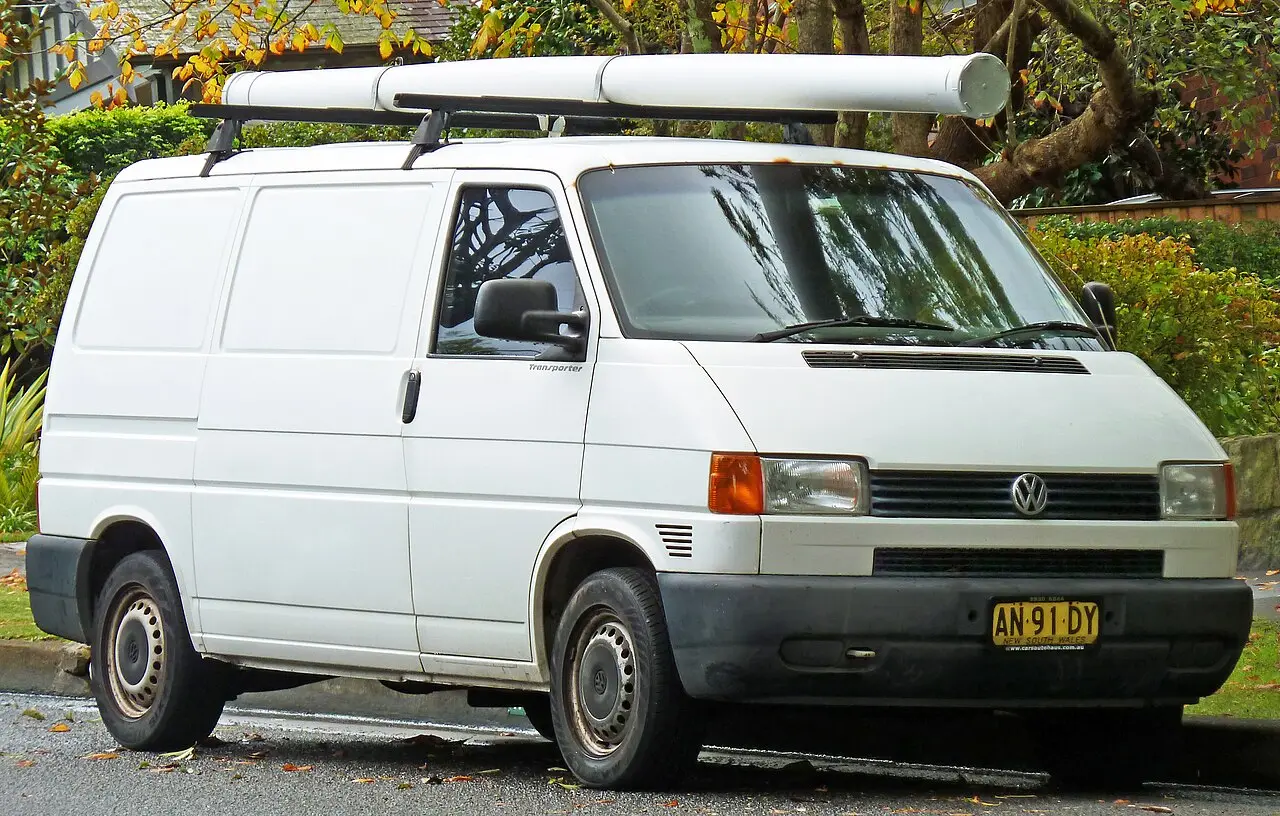
What is the Volkswagen EuroVan?
The EuroVan was the North American name for Volkswagen’s T4 van, part of the Transporter family. It served as a passenger van and could also be adapted for leisure travel. The T4 marked a major change for the Transporter: it was the first in the series with a front-mounted engine and front-wheel drive.
The T4’s layout gave Volkswagen’s van range a new direction. In the United States and Canada, this generation was known as the EuroVan.
Generation and engines
The EuroVan belongs to the T4 generation, with factory codes 70 and 7D. The generation ran from 1993 to 2003 in the US and Canadian listings.
The US EPA listing covers petrol engines from 2.5 L to 2.8 L. Canada’s NRCan listing spans 2.4 L to 2.8 L and includes petrol and diesel engines.
Fuel consumption and markets
US EPA figures for 1993–2003 list a lowest consumption of 13.8 L/100 km and a best combined rating of 17 MPG. Canadian NRCan figures for 1995–2003 list 9.9 L/100 km on the 5-cycle test. These results use different procedures: the US uses EPA testing, Canada uses the 5-cycle method, and European figures use NEDC or WLTP.
The EuroVan was listed in the United States and Canada. It belongs to Volkswagen’s wider Transporter family, which has served passenger and commercial roles.
Questions and answers
What is the EuroVan?
It is the North American name for Volkswagen’s T4 van, used for passenger and leisure travel.
Which generation is the EuroVan?
It is the T4 generation, listed in the US and Canada from 1993 to 2003.
What is the US EPA combined rating?
The best combined rating is 17 MPG, and the lowest listed consumption is 13.8 L/100 km.
Why do US and Canadian consumption figures differ?
The EPA and Canadian NRCan 5-cycle procedures differ, so their results are not directly equivalent.