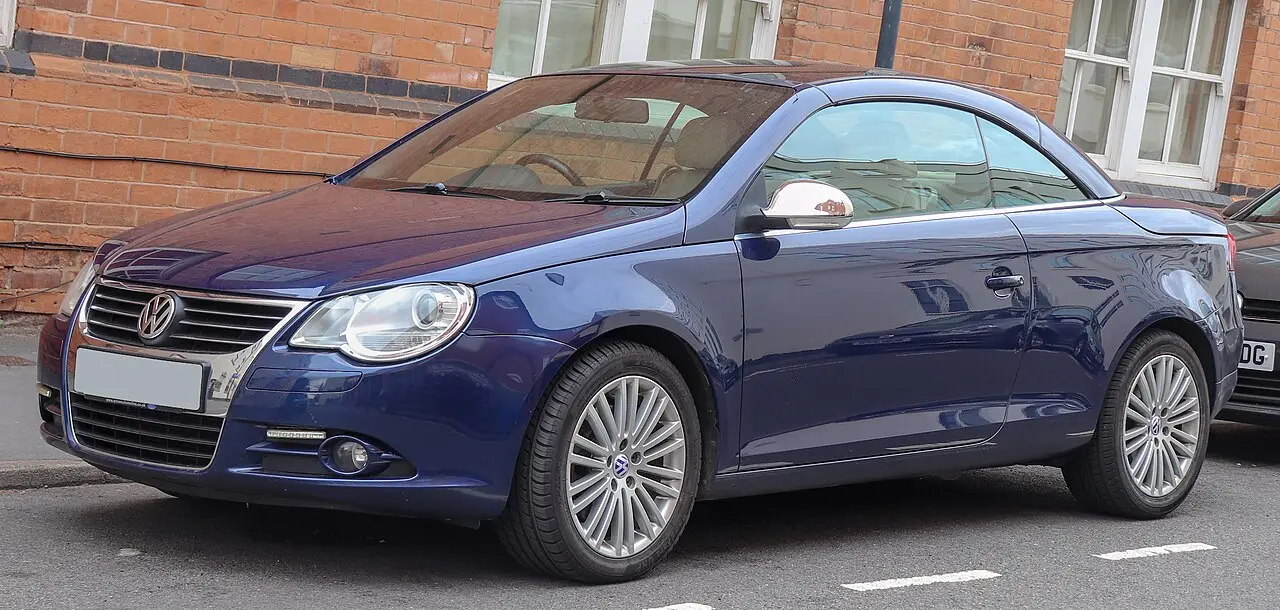
The official data lists 111 versions of the Volkswagen Eos (2007–2016), in the European Union, the United Kingdom, France, the United States, and Canada. Each market publishes its own figures, measured on its own test procedure.
At a glance
Years in the data
2007–2016
Markets
European Union, United Kingdom, France, United States, Canada
Engines
1.4 L to 3.2 L
Power
90 kW (122 PS) to 184 kW (250 PS)
Fuels
Petrol, Diesel
Lowest consumption (France)
4.8 L/100 km (NEDC)
Lowest consumption (United Kingdom)
4.8 L/100 km (NEDC)
Lowest consumption (Canada)
9.3 L/100 km (5-cycle)
New registrations in the EU
70,692
What is the Volkswagen Eos?
The Eos is a four-seat coupé convertible with a folding metal roof and an integrated glass sunroof. With the roof up, it has a coupé profile; fold the roof away and it opens up for top-down driving. It was a distinctive open-top choice in Volkswagen’s passenger-car range.
Volkswagen introduced the Eos in 2006. Its name comes from the Greek goddess of dawn, and it was built in Palmela, Portugal.
Volkswagen Eos generations
The Eos had one generation, Generation I (2007–2015), with factory code 1F. Its five-part roof combined the look of a coupé with a sliding glass sunroof and the option of open-air driving.
Engines, power and official economy
In EU registration figures, Eos engines range from 1.4 L to 3.6 L, with power from 90 kW (122 PS) to 155 kW (211 PS). Petrol, diesel and other fuel classifications appear in figures covering 2010–2016. The leading registered versions include 2.0 L diesels and a 1.4 L petrol.
UK figures cover 2007–2015 and list engines from 1.4 L to 3.2 L, with power from 85 kW (115 PS) to 184 kW (250 PS). The lowest listed consumption is 4.8 L/100 km on the NEDC test. French figures for 2012–2015 also list 4.8 L/100 km on NEDC. In the USA, petrol versions with 2.0 L to 3.2 L engines have a best combined EPA rating of 25 MPG. Canada’s lowest listed figure is 9.3 L/100 km on the 5-cycle test. These market figures use different procedures: WLTP and NEDC in Europe, EPA in the USA and 5-cycle in Canada.
Where was the Eos sold?
Official figures cover the Eos in the European Union, the United Kingdom, France, the USA and Canada. The year spans vary: UK, US and Canadian figures begin in 2007, while EU registration figures begin in 2010.
Questions and answers
How many generations of Volkswagen Eos were there?
One: Generation I, listed as 2007–2015.
What made the Eos roof distinctive?
Its folding metal roof incorporated a sliding glass sunroof, giving the Eos both a coupé profile and open-top driving.
What is the lowest listed Eos fuel consumption?
The UK and French figures both list 4.8 L/100 km on the NEDC test.
New cars registered in the EU (plus Norway and Iceland), from the European Environment Agency. Figures on the NEDC procedure until 2020 and on WLTP from 2021; versions are grouped by engine and power, with their number of registrations.
Years and version
Engine
Power
Fuel
CO₂
EU registrations
2015–2016
1.4 L
90 kW (122 PS)
Petrol
144 g/km
924
2015–2016
1.4 L
–
Petrol
123 g/km
174
2015
2.0 L
103 kW (140 PS)
Diesel
131 g/km
3,308
2014–2015
1.4 L
118 kW (160 PS)
Petrol
157 g/km
984
2015
2.0 L
155 kW (211 PS)
Petrol
170 g/km
566
2015
2.0 L
100 kW (136 PS)
Diesel
140 g/km
12
2014
2.0 L
103 kW (140 PS)
Diesel
132 g/km
3,300
2014
1.4 L
90 kW (122 PS)
Petrol
145 g/km
1,570
2014
2.0 L
155 kW (211 PS)
Petrol
171 g/km
778
2014
2.0 L
100 kW (136 PS)
Diesel
141 g/km
34
2013
2.0 L
103 kW (140 PS)
Diesel
134 g/km
3,738
2013
1.4 L
90 kW (122 PS)
Petrol
146 g/km
1,678
2013
2.0 L
155 kW (211 PS)
Petrol
170 g/km
902
2013
1.4 L
118 kW (160 PS)
Petrol
156 g/km
610
2013
2.0 L
–
Other fuel
146 g/km
118
2013
1.4 L
–
Other fuel
152 g/km
78
2013
2.0 L
100 kW (136 PS)
Diesel
143 g/km
68
2012
2.0 L
103 kW (140 PS)
Diesel
134 g/km
3,898
2012
1.4 L
90 kW (122 PS)
Petrol
146 g/km
2,067
2012
2.0 L
155 kW (211 PS)
Petrol
171 g/km
736
2012
1.4 L
118 kW (160 PS)
Petrol
157 g/km
642
2012
2.0 L
100 kW (136 PS)
Diesel
142 g/km
169
2012
–
–
Petrol
152 g/km
38
2011
2.0 L
103 kW (140 PS)
Diesel
140 g/km
10,144
2011
1.4 L
90 kW (122 PS)
Petrol
147 g/km
7,578
2011
2.0 L
155 kW (211 PS)
Petrol
170 g/km
2,196
2011
1.4 L
118 kW (160 PS)
Petrol
157 g/km
2,188
2011
2.0 L
100 kW (136 PS)
Diesel
144 g/km
212
2011
–
–
Petrol
150 g/km
110
2011
1.4 L
–
Diesel
146 g/km
46
2010
2.0 L
–
Diesel
152 g/km
9,974
2010
1.4 L
–
Petrol
154 g/km
9,352
2010
2.0 L
–
Petrol
180 g/km
1,978
2010
–
–
Petrol
157 g/km
362
2010
3.6 L
–
Petrol
214 g/km
74
2010
1.6 L
–
Petrol
181 g/km
18
United Kingdom 44 versions
New cars on sale in the UK, from the Vehicle Certification Agency. NEDC figures until 2018 and WLTP figures after; years are the editions a version appeared in.
New cars on sale in France, from ADEME Car Labelling. NEDC figures until 2015, WLTP figures in the current catalogue.
Years and version
Engine
Power
Fuel
Gearbox
Consumption (combined)
CO₂
2015EOS 1.4 TSI (122ch) BVM6
–
90 kW (122 PS)
Petrol
6-speed manual
6.2 L/100 km NEDC
144 g/km
2015EOS 2.0 TDI (140ch) FAP DSG6
–
103 kW (140 PS)
Diesel
6-speed automatic
5.3 L/100 km NEDC
139 g/km
2015EOS 2.0 TDI (140ch) FAP BVM6
–
103 kW (140 PS)
Diesel
6-speed manual
4.8 L/100 km NEDC
125 g/km
2015EOS 2.0 TSI (210ch) DSG6
–
155 kW (211 PS)
Petrol
6-speed automatic
7.5 L/100 km NEDC
174 g/km
2014EOS 1.4 TSI (122ch) BMT
–
90 kW (122 PS)
Petrol
6-speed manual
6.2 L/100 km NEDC
144 g/km
2014EOS 2.0 TDI (140ch) FAP BVM6 BMT
–
103 kW (140 PS)
Diesel
6-speed manual
4.8 L/100 km NEDC
125 g/km
2014EOS 2.0 TDI (140ch) FAP DSG6 BMT
–
103 kW (140 PS)
Diesel
6-speed automatic
5.3 L/100 km NEDC
139 g/km
2014EOS 2.0 TSI (210ch) DSG6
–
155 kW (211 PS)
Petrol
6-speed automatic
7.5 L/100 km NEDC
174 g/km
2012–2013EOS 1.4 TSI (122ch) BMT
–
90 kW (122 PS)
Petrol
6-speed manual
6.2 L/100 km NEDC
144 g/km
2012–2013EOS 2.0 TDI (140ch) FAP DSG6 BMT
–
103 kW (140 PS)
Diesel
6-speed automatic
5.3 L/100 km NEDC
139 g/km
2012–2013EOS 2.0 TDI (140ch) FAP BVM6 BMT
–
103 kW (140 PS)
Diesel
6-speed manual
4.8 L/100 km NEDC
125 g/km
2012–2013EOS 2.0 TSI (210ch) DSG6
–
155 kW (211 PS)
Petrol
6-speed automatic
7.5 L/100 km NEDC
174 g/km
United States 9 versions
Model years sold in the USA, from the EPA and the Department of Energy (fueleconomy.gov). MPG on the EPA test; litres per 100 km = 235.215 ÷ MPG.
Years and version
Engine
Fuel
Gearbox
Drive
Consumption (combined)
CO₂
2013–2016SIDI
2.0 L
Petrol
6-speed automated manual
Front-wheel drive
25 MPG (9.4 L/100 km) EPA
220 g/km
2011–2012SIDI
2.0 L
Petrol
6-speed automatic
Front-wheel drive
25 MPG (9.4 L/100 km) EPA
221 g/km
2009–2011SIDI
2.0 L
Petrol
6-speed manual
Front-wheel drive
25 MPG (9.4 L/100 km) EPA
221 g/km
2009–20103MODE
2.0 L
Petrol
6-speed automatic
Front-wheel drive
25 MPG (9.4 L/100 km) EPA
221 g/km
20083MODE
2.0 L
Petrol
6-speed automatic
Front-wheel drive
24 MPG (9.8 L/100 km) EPA
230 g/km
2008
2.0 L
Petrol
6-speed manual
Front-wheel drive
24 MPG (9.8 L/100 km) EPA
230 g/km
2007–20083MODE
3.2 L
Petrol
6-speed automatic
Front-wheel drive
22 MPG (10.7 L/100 km) EPA
251 g/km
2007
2.0 L
Petrol
6-speed manual
Front-wheel drive
24 MPG (9.8 L/100 km) EPA
230 g/km
20073MODE CLKUP
2.0 L
Petrol
6-speed automatic
Front-wheel drive
23 MPG (10.2 L/100 km) EPA
240 g/km
Canada 9 versions
Model years sold in Canada, from Natural Resources Canada fuel consumption ratings (5-cycle test).
Years and version
Engine
Fuel
Gearbox
Consumption (combined)
CO₂
2015Subcompact
2.0 L
Petrol
6-speed automated manual
9.5 L/100 km 5-cycle
219 g/km
2011–2014Subcompact
2.0 L
Petrol
6-speed automatic
9.6 L/100 km 5-cycle
221 g/km
2011Subcompact
2.0 L
Petrol
6-speed manual
9.9 L/100 km 5-cycle
228 g/km
2009–2010Subcompact
2.0 L
Petrol
6-speed automatic
9.3 L/100 km 5-cycle
214 g/km
2009–2010Subcompact
2.0 L
Petrol
6-speed manual
9.8 L/100 km 5-cycle
225 g/km
2007–2008Subcompact
2.0 L
Petrol
6-speed manual
10.0 L/100 km 5-cycle
230 g/km
2008Subcompact
2.0 L
Petrol
6-speed automatic
9.6 L/100 km 5-cycle
221 g/km
2007Subcompact
2.0 L
Petrol
6-speed automatic
10.1 L/100 km 5-cycle
232 g/km
2007Subcompact
3.2 L
Petrol
6-speed automatic
10.7 L/100 km 5-cycle
246 g/km
Versions outside these generations
European Union 1 version
New cars registered in the EU (plus Norway and Iceland), from the European Environment Agency. Figures on the NEDC procedure until 2020 and on WLTP from 2021; versions are grouped by engine and power, with their number of registrations.
Years and version
Engine
Power
Fuel
CO₂
EU registrations
2016
2.0 L
103 kW (140 PS)
Diesel
132 g/km
68
Official figures are measured on standard test procedures and differ between markets. Your consumption depends on how, where and in what conditions you drive.