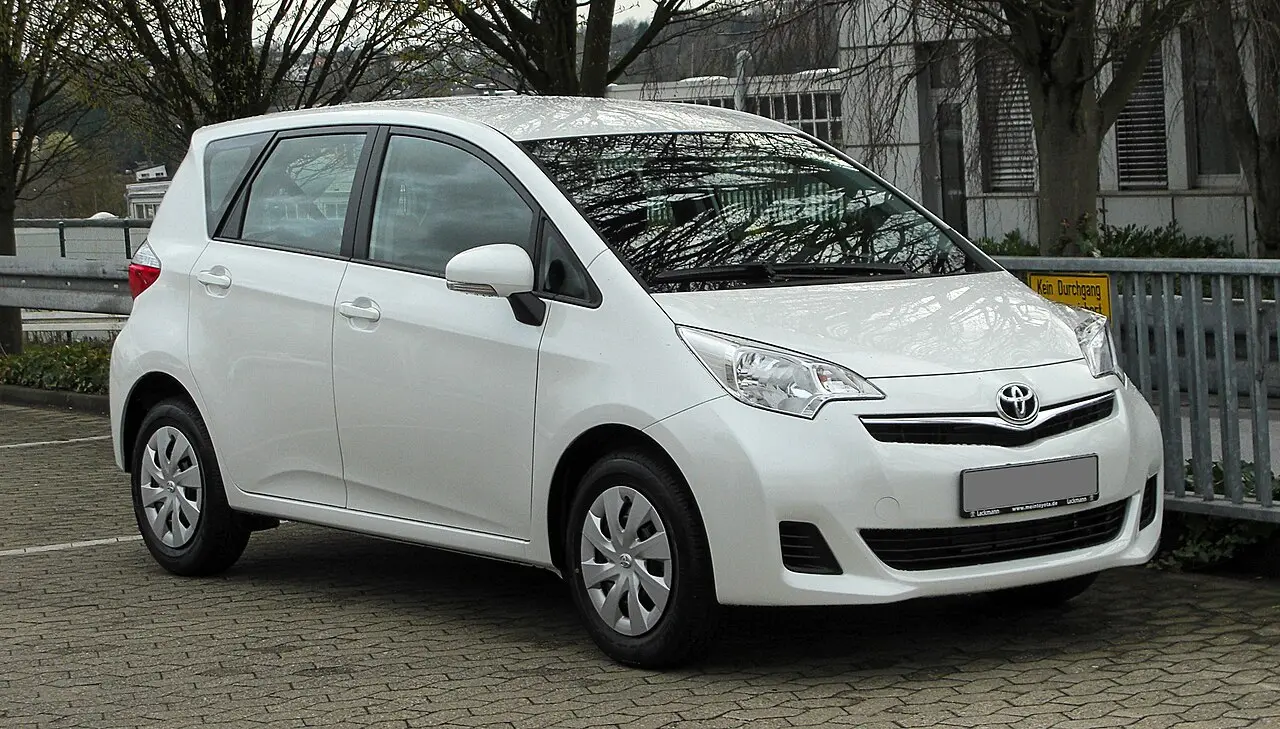
The official data lists 29 versions of the Toyota Verso-S (2011–2016), in the European Union, the United Kingdom, and France. Each market publishes its own figures, measured on its own test procedure.
At a glance
Years in the data
2011–2016
Markets
European Union, United Kingdom, France
Engines
1.3 L to 1.4 L
Power
66 kW (90 PS) to 73 kW (99 PS)
Fuels
Diesel, Petrol
Lowest consumption (France)
4.3 L/100 km (NEDC)
Lowest consumption (United Kingdom)
5.2 L/100 km (NEDC)
New registrations in the EU
99,918
What is the Toyota Verso-S?
The Verso-S is a small five-door people carrier, or mini-MPV, built to make good use of a compact footprint. It returned Toyota to Europe’s small people-carrier segment, following the practical approach of the Yaris Verso. A flexible cabin and folding rear seats made it suited to carrying passengers and everyday luggage.
Generations and engines
The Verso-S had one generation, the XP120, sold from 2011 to 2015. European versions came with petrol and diesel engines. EU figures span 1.3 to 1.4 litres and outputs from 66 kW (90 PS) to 73 kW (99 PS). The most frequently registered configuration was the 1.3-litre petrol with 73 kW (99 PS).
Fuel consumption and CO₂
The lowest listed UK figure is 5.2 L/100 km on the NEDC test. France’s ADEME figures list a low of 4.3 L/100 km, also on NEDC. Consumption varies by engine and version. In official EU registration figures, 99,918 Verso-S cars were registered from 2011 to 2016.
Where was it sold?
The Verso-S appears in official figures for the European Union, the UK and France. UK figures cover petrol versions, while EU and French figures include petrol and diesel. Toyota also sold a related model in Japan under the Ractis name.
Questions and answers
What type of car is the Toyota Verso-S?
It is a small five-door people carrier, designed to combine a compact footprint with flexible passenger and luggage space.
What engines were available?
European versions included 1.3- to 1.4-litre petrol and diesel engines, with outputs from 66 kW (90 PS) to 73 kW (99 PS).
What is the lowest official fuel consumption listed?
France’s ADEME figures list 4.3 L/100 km on NEDC. The UK’s lowest listed figure is 5.2 L/100 km, also on NEDC.
Model codes: XP120 · Sold in: European Union, United Kingdom, and France · References: autobild.de, en.wikipedia.org
European Union 13 versions
New cars registered in the EU (plus Norway and Iceland), from the European Environment Agency. Figures on the NEDC procedure until 2020 and on WLTP from 2021; versions are grouped by engine and power, with their number of registrations.
Years and version
Engine
Power
Fuel
CO₂
EU registrations
2015
1.3 L
73 kW (99 PS)
Petrol
124 g/km
8,570
2015
1.4 L
66 kW (90 PS)
Diesel
113 g/km
648
2014
1.3 L
73 kW (99 PS)
Petrol
123 g/km
9,742
2014
1.4 L
66 kW (90 PS)
Diesel
113 g/km
1,242
2013
1.3 L
73 kW (99 PS)
Petrol
123 g/km
12,450
2013
1.4 L
66 kW (90 PS)
Diesel
114 g/km
2,596
2011–2012
1.3 L
73 kW (99 PS)
Petrol
123 g/km
46,822
2012
1.4 L
66 kW (90 PS)
Diesel
114 g/km
5,830
2012
–
–
Petrol
123 g/km
132
2012
–
–
Diesel
113 g/km
18
2011
1.4 L
66 kW (90 PS)
Diesel
114 g/km
8,092
2011
1.3 L
73 kW (99 PS)
Petrol
124 g/km
3,116
2011
–
–
Petrol
123 g/km
168
United Kingdom 3 versions
New cars on sale in the UK, from the Vehicle Certification Agency. NEDC figures until 2018 and WLTP figures after; years are the editions a version appeared in.
Years and version
Engine
Fuel
Gearbox
Consumption (combined)
CO₂
2012–2014Verso-S 1.33 VVT-i M-drive S
1.3 L
Petrol
Automatic
5.2 L/100 km NEDC
120 g/km
2013–2014Verso-S 1.33 VVT-i 6-speed Manual
1.3 L
Petrol
Manual
5.5 L/100 km NEDC
127 g/km
2012Verso-S 1.33 VVT-i 6-speed Manual
1.3 L
Petrol
6-speed manual
5.5 L/100 km NEDC
127 g/km
France 11 versions
New cars on sale in France, from ADEME Car Labelling. NEDC figures until 2015, WLTP figures in the current catalogue.
Years and version
Engine
Power
Fuel
Gearbox
Consumption (combined)
CO₂
2015VERSO S (90ch) D-4D Style · VERSO S (90ch) D-4D Dynamic
–
66 kW (90 PS)
Diesel
6-speed manual
4.3 L/100 km NEDC
113 g/km
2015VERSO S (100ch) VVT-i Style · VERSO S (100ch) VVT-i Dynamic
–
73 kW (99 PS)
Petrol
6-speed manual
5.5 L/100 km NEDC
127 g/km
2015VERSO S (100ch) VVT-i MultiDrive Style · VERSO S (100ch) VVT-i MultiDrive Dynamic
–
73 kW (99 PS)
Petrol
Continuously variable (CVT)
5.2 L/100 km NEDC
120 g/km
2014VERSO S (90ch) D-4D Dynamic · VERSO S (90ch) D-4D Skyview
–
66 kW (90 PS)
Diesel
6-speed manual
4.3 L/100 km NEDC
113 g/km
2014VERSO S (90ch) D-4D MultiMode Dynamic · VERSO S (90ch) D-4D MultiMode Skyview
–
66 kW (90 PS)
Diesel
6-speed automatic
4.4 L/100 km NEDC
115 g/km
2014VERSO S (100ch) VVT-i Dynamic · VERSO S (100ch) VVT-i Skyview
–
73 kW (99 PS)
Petrol
6-speed manual
5.5 L/100 km NEDC
127 g/km
2014VERSO S (100ch) VVT-i MultiDrive Dynamic · VERSO S (100ch) VVT-i MultiDrive Skyview
–
73 kW (99 PS)
Petrol
Continuously variable (CVT)
5.2 L/100 km NEDC
120 g/km
2012–2013VERSO-S (90ch) 1.4 D-4D (Lounge) · VERSO-S (90ch) 1.4 D-4D (Active et Dynamic) · VERSO S 90 D-4D Skyview and 1 more trim
–
66 kW (90 PS)
Diesel
6-speed manual
4.3 L/100 km NEDC
113 g/km
2012–2013VERSO-S (90ch) 1.4 D-4D MultiMode (Lounge) · VERSO-S (90ch) 1.4 D-4D MultiMode (Dynamic) · VERSO S 90 D-4D MultiMode Skyview and 1 more trim
–
66 kW (90 PS)
Diesel
6-speed automatic
4.4 L/100 km NEDC
115 g/km
2012–2013VERSO-S (99ch) 1.33 VVT-i (Lounge) · VERSO-S (99ch) 1.33 VVT-i (Active et Dynamic) · VERSO S 100 VVT-i Skyview and 1 more trim
–
73 kW (99 PS)
Petrol
6-speed manual
5.5 L/100 km NEDC
127 g/km
2012–2013VERSO-S (99ch) 1.33 VVT-i MultiDrive S (Lounge) · VERSO-S (99ch) 1.33 VVT-i MultiDrive S (Dynamic) · VERSO S 100 VVT-i MultiDrive Skyview and 1 more trim
–
73 kW (99 PS)
Petrol
Continuously variable (CVT)
5.2 L/100 km NEDC
120 g/km
Versions outside these generations
European Union 2 versions
New cars registered in the EU (plus Norway and Iceland), from the European Environment Agency. Figures on the NEDC procedure until 2020 and on WLTP from 2021; versions are grouped by engine and power, with their number of registrations.
Official figures are measured on standard test procedures and differ between markets. Your consumption depends on how, where and in what conditions you drive.