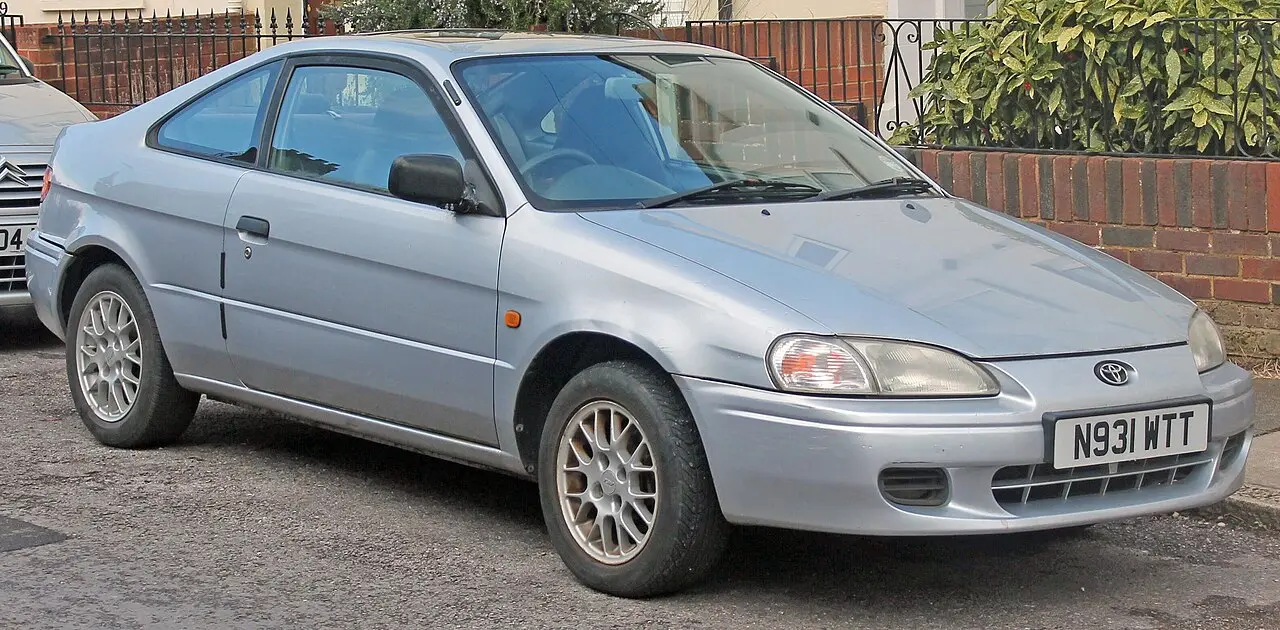
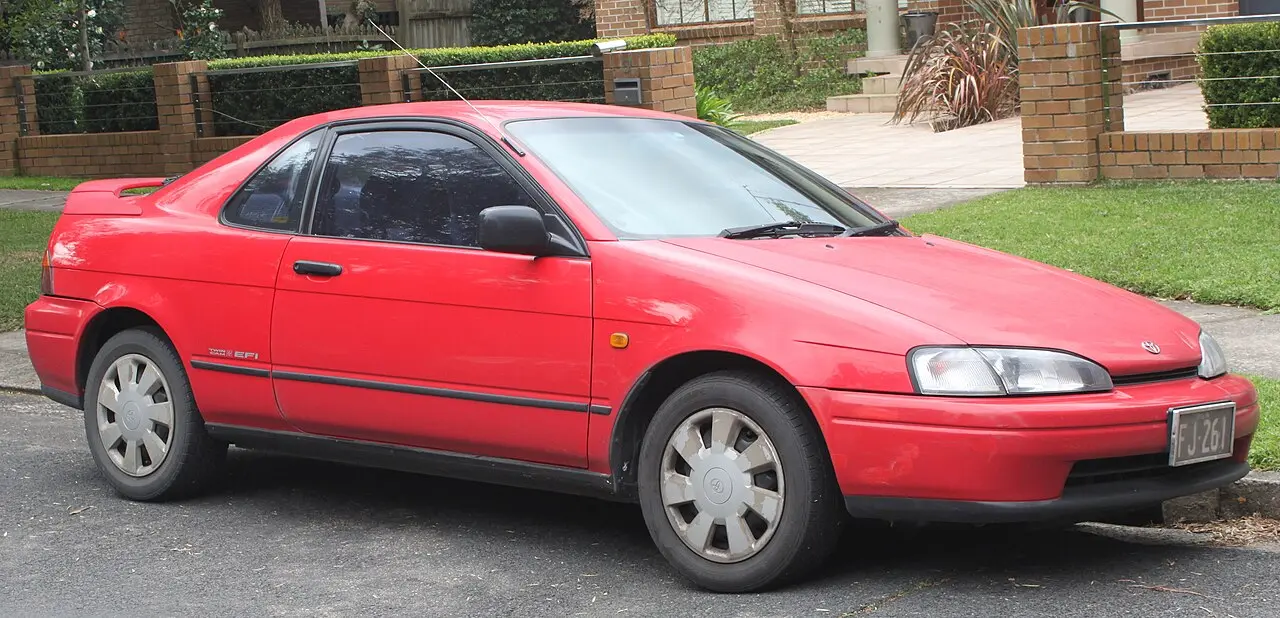
The official data lists 19 versions of the Toyota Paseo (1992–1999), in the United States and Canada. Each market publishes its own figures, measured on its own test procedure.
At a glance
Years in the data
1992–1999
Markets
United States, Canada
Engines
1.5 L
Fuels
Petrol
Lowest consumption (United States)
7.6 L/100 km (EPA)
Lowest consumption (Canada)
7.8 L/100 km (5-cycle)
What is the Toyota Paseo?
The Paseo is a small, two-door coupe that brought a sleeker shape to Toyota’s compact-car range. Toyota’s UK archive describes it as a 2+2 front-wheel-drive coupe, with a small rear seating area behind the front seats. In some markets, Toyota sold it under the Cynos name.
The first generation (EL44) ran from 1992 to 1995, and the second (EL54) from 1996 to 1999. The later generation carried the small-coupe idea forward with a more rounded design.
Engines and power
The listed US and Canadian versions use a 1.5 L petrol engine. Toyota’s UK archive describes a single 1.5-litre 16-valve petrol engine with a five-speed manual transmission.
How economical is the Toyota Paseo?
The lowest listed US consumption is 7.6 L/100 km, and the best combined EPA rating is 31 MPG. Canada’s lowest listed figure is 7.8 L/100 km on the NRCan 5-cycle test. EPA and NRCan use different procedures, so the results reflect their respective national tests.
US figures cover 1992 to 1999, while Canadian figures cover 1995 to 1999. The second generation is also listed in EU, UK and French markets.
Questions and answers
What body style is the Toyota Paseo?
It is a small coupe; Toyota’s UK archive describes it as a 2+2 front-wheel-drive coupe.
What engine is listed for the Paseo?
US and Canadian versions use a 1.5 L petrol engine. Toyota’s UK archive specifies a 1.5-litre 16-valve petrol engine.
What is its lowest listed fuel consumption?
The lowest listed figure is 7.6 L/100 km for the United States on EPA, and 7.8 L/100 km in Canada on NRCan 5-cycle.
Model codes: EL54 · Sold in: United States, Canada, European Union, United Kingdom, and France · References: en.wikipedia.org, es.wikipedia.org
United States 8 versions
Model years sold in the USA, from the EPA and the Department of Energy (fueleconomy.gov). MPG on the EPA test; litres per 100 km = 235.215 ÷ MPG.
Years and version
Engine
Fuel
Gearbox
Drive
Consumption (combined)
CO₂
1999CLKUP
1.5 L
Petrol
4-speed automatic
Front-wheel drive
26 MPG (9.0 L/100 km) EPA
212 g/km
1999
1.5 L
Petrol
5-speed manual
Front-wheel drive
31 MPG (7.6 L/100 km) EPA
178 g/km
1997–1998(FFS) · CLKUP
1.5 L
Petrol
4-speed automatic
Front-wheel drive
26 MPG (9.0 L/100 km) EPA
212 g/km
1997–1998(FFS)
1.5 L
Petrol
5-speed manual
Front-wheel drive
28 MPG (8.4 L/100 km) EPA
197 g/km
1998
1.5 L
Petrol
5-speed manual
Front-wheel drive
27 MPG (8.7 L/100 km) EPA
205 g/km
1997(FFS)
1.5 L
Petrol
5-speed manual
Front-wheel drive
29 MPG (8.1 L/100 km) EPA
190 g/km
1996(FFS)
1.5 L
Petrol
4-speed automatic
Front-wheel drive
27 MPG (8.7 L/100 km) EPA
205 g/km
1996(FFS)
1.5 L
Petrol
5-speed manual
Front-wheel drive
28 MPG (8.4 L/100 km) EPA
197 g/km
Canada 5 versions
Model years sold in Canada, from Natural Resources Canada fuel consumption ratings (5-cycle test).
Years and version
Engine
Fuel
Gearbox
Consumption (combined)
CO₂
1997–1999Minicompact
1.5 L
Petrol
4-speed automatic
9.1 L/100 km 5-cycle
209 g/km
1998–1999Minicompact
1.5 L
Petrol
5-speed manual
8.2 L/100 km 5-cycle
189 g/km
1997Minicompact
1.5 L
Petrol
5-speed manual
8.1 L/100 km 5-cycle
186 g/km
1996Minicompact
1.5 L
Petrol
4-speed automatic
8.8 L/100 km 5-cycle
202 g/km
1996Minicompact
1.5 L
Petrol
5-speed manual
7.8 L/100 km 5-cycle
179 g/km
Official figures are measured on standard test procedures and differ between markets. Your consumption depends on how, where and in what conditions you drive.