Toyota

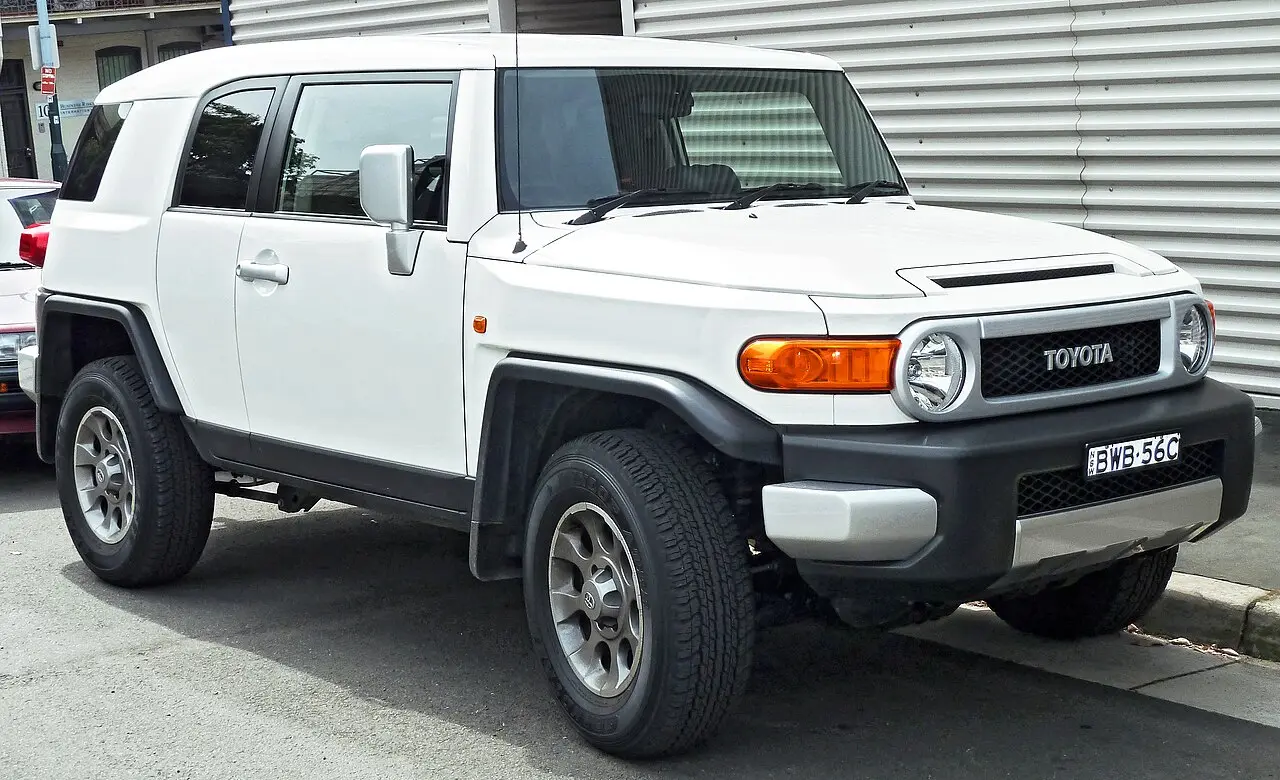
Toyota FJ Cruiser

Toyota FJ Cruiser
Photo: OSX / Wikimedia Commons · Public domain

The official data lists 34 versions of the Toyota FJ Cruiser (2007–2023), in the European Union, the United States, and Canada. Each market publishes its own figures, measured on its own test procedure.

At a glance

Years in the data
2007–2023
Markets
European Union, United States, Canada
Engines
4.0 L
Fuels
Petrol
Lowest consumption (United States)
12.4 L/100 km (EPA)
Lowest consumption (Canada)
12.7 L/100 km (5-cycle)
New registrations in the EU
36

What is the Toyota FJ Cruiser?

The FJ Cruiser is an off-road-focused SUV with styling inspired by Toyota’s FJ40. Its upright windscreen, round headlights, white roof and rear-mounted spare wheel carry those heritage cues into a more modern shape. Rear-hinged access doors give the cabin a distinctive layout.

FJ Cruiser generation

Toyota produced one generation from 2007 to 2014. The FJ Cruiser brought retro styling together with modern SUV equipment and off-road hardware. Toyota says the vehicle drew on the FJ40’s design and used some components from the Land Cruiser Prado.

Engine and power

The FJ Cruiser used a 4.0 L petrol engine in US and Canadian listings. EU registrations include 4.0 L petrol versions rated at 190 kW (258 PS) and 200 kW (272 PS), as well as an entry with no power rating.

How economical is the FJ Cruiser, and where was it sold?

US EPA figures cover 2007–2014 and give a best combined rating of 19 MPG, with a lowest listed consumption of 12.4 L/100 km. Canadian NRCan figures cover the same years and list a lowest consumption of 12.7 L/100 km on the 5-cycle test. The EPA and Canadian 5-cycle procedures differ. EU registration figures show the FJ Cruiser from 2010 through 2023, including registrations after its North American sales period.

Questions and answers

When was the FJ Cruiser generation sold?

Its single generation ran from 2007 to 2014 in the US and Canada.

What engine did the FJ Cruiser use?

US and Canadian listings specify a 4.0 L petrol engine.

What is its best listed US fuel economy?

The EPA best combined rating is 19 MPG; its lowest listed consumption is 12.4 L/100 km.

Was the FJ Cruiser registered in Europe?

Yes. EU registration figures include examples from 2010 through 2023.

FJ Cruiser first generation (2007–2014)

Toyota FJ Cruiser first generation
Photo: OSX / Wikimedia Commons · Public domain

Model codes: XJ10 · Sold in: United States and Canada · References: cars.com, toyota.com

United States 18 versions

Model years sold in the USA, from the EPA and the Department of Energy (fueleconomy.gov). MPG on the EPA test; litres per 100 km = 235.215 ÷ MPG.

Years and versionEngineFuelGearboxDriveConsumption (combined)CO₂
2013–20144.0 LPetrol5-speed automaticRear-wheel drive18 MPG (13.1 L/100 km) EPA310 g/km
2013–20144.0 LPetrol5-speed automaticPart-time four-wheel drive18 MPG (13.1 L/100 km) EPA308 g/km
2013–20144.0 LPetrol6-speed manualAll-wheel drive16 MPG (14.7 L/100 km) EPA332 g/km
20124.0 LPetrol5-speed automaticRear-wheel drive19 MPG (12.4 L/100 km) EPA291 g/km
20124.0 LPetrol5-speed automaticPart-time four-wheel drive18 MPG (13.1 L/100 km) EPA307 g/km
20124.0 LPetrol6-speed manualFour-wheel drive16 MPG (14.7 L/100 km) EPA345 g/km
2010–20114.0 LPetrol5-speed automaticRear-wheel drive19 MPG (12.4 L/100 km) EPA291 g/km
20114.0 LPetrol5-speed automaticPart-time four-wheel drive19 MPG (12.4 L/100 km) EPA291 g/km
20114.0 LPetrol6-speed manualFour-wheel drive17 MPG (13.8 L/100 km) EPA325 g/km
20104.0 LPetrol5-speed automaticPart-time four-wheel drive18 MPG (13.1 L/100 km) EPA307 g/km
20104.0 LPetrol6-speed manualFour-wheel drive17 MPG (13.8 L/100 km) EPA325 g/km
2009CLKUP4.0 LPetrol5-speed automaticRear-wheel drive18 MPG (13.1 L/100 km) EPA307 g/km
2008–2009CLKUP4.0 LPetrol5-speed automaticFour- or all-wheel drive17 MPG (13.8 L/100 km) EPA325 g/km
20094.0 LPetrol6-speed manualFour- or all-wheel drive16 MPG (14.7 L/100 km) EPA345 g/km
2007–20084.0 LPetrol6-speed manualFour- or all-wheel drive16 MPG (14.7 L/100 km) EPA345 g/km
2008CLKUP4.0 LPetrol5-speed automaticRear-wheel drive18 MPG (13.1 L/100 km) EPA307 g/km
2007CLKUP4.0 LPetrol5-speed automaticRear-wheel drive18 MPG (13.1 L/100 km) EPA307 g/km
2007CLKUP4.0 LPetrol5-speed automaticFour- or all-wheel drive17 MPG (13.8 L/100 km) EPA325 g/km

Canada 13 versions

Model years sold in Canada, from Natural Resources Canada fuel consumption ratings (5-cycle test).

Years and versionEngineFuelGearboxConsumption (combined)CO₂
2013–2014Sport utility vehicle: Small4.0 LPetrol5-speed automatic12.9 L/100 km 5-cycle297 g/km
2013–2014Sport utility vehicle: Small4.0 LPetrol6-speed manual13.9 L/100 km 5-cycle320 g/km
2011–2012Sport utility vehicle4.0 LPetrol5-speed automatic12.7 L/100 km 5-cycle292 g/km
2012Sport utility vehicle4.0 LPetrol6-speed manual14.1 L/100 km 5-cycle324 g/km
2011Sport utility vehicle4.0 LPetrol6-speed manual13.8 L/100 km 5-cycle317 g/km
2010Sport utility vehicle4.0 LPetrol5-speed automatic12.8 L/100 km 5-cycle294 g/km
2010Sport utility vehicle4.0 LPetrol6-speed manual13.9 L/100 km 5-cycle320 g/km
2009Sport utility vehicle4.0 LPetrol5-speed automatic13.5 L/100 km 5-cycle311 g/km
2009Sport utility vehicle4.0 LPetrol6-speed manual14.7 L/100 km 5-cycle338 g/km
2008Sport utility vehicle4.0 LPetrol5-speed automatic13.8 L/100 km 5-cycle317 g/km
2008Sport utility vehicle4.0 LPetrol6-speed manual14.8 L/100 km 5-cycle340 g/km
2007Sport utility vehicle4.0 LPetrol5-speed automatic13.7 L/100 km 5-cycle315 g/km
2007Sport utility vehicle4.0 LPetrol6-speed manual14.8 L/100 km 5-cycle340 g/km

Versions outside these generations

European Union 3 versions

New cars registered in the EU (plus Norway and Iceland), from the European Environment Agency. Figures on the NEDC procedure until 2020 and on WLTP from 2021; versions are grouped by engine and power, with their number of registrations.

Years and versionEnginePowerFuelCO₂EU registrations
20234.0 L200 kW (272 PS)Petrol279 g/km12
20214.0 L190 kW (258 PS)Petrol–10
20104.0 L–Petrol272 g/km14

Official figures are measured on standard test procedures and differ between markets. Your consumption depends on how, where and in what conditions you drive.