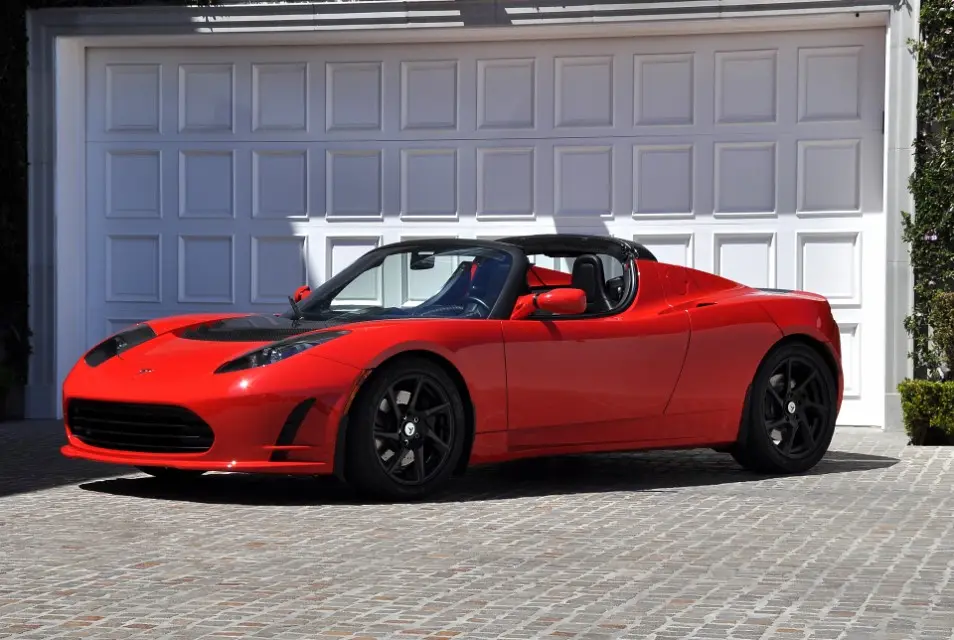
What is the Tesla Roadster?
The first Tesla Roadster was a two-seat, battery-electric sports car. It gave Tesla an entry into car production before the company moved into larger saloons and SUVs. With its compact sports-car shape and electric drive, it brought battery power to a kind of car then usually associated with petrol engines.
The Roadster drew on Lotus sports-car expertise, including a connection to the Elise, while Tesla developed its electric powertrain. It helped establish the company’s early identity around electric cars designed as cars in their own right.
Generation and engineering
The first generation ran from 2008–2012. It was Tesla’s first production model and was based on a substantially adapted Lotus Elise platform. Its sports-car layout set it apart from the larger vehicles that later joined Tesla’s range.
The EU and French listings are electric, with recorded power of 40 kW (54 PS).
Efficiency and emissions
As an electric car, the Roadster produces no tailpipe CO₂ while driving. Official energy-consumption figures depend on the test method and market. European measures may use WLTP or the older NEDC procedure; the US EPA and Canada’s 5-cycle tests use different methods, so figures from different markets should be read in context.
European Economic Area registration figures cover 2010–2013 and total 494 cars. The largest listed annual entry is the electric version in 2012, with 232 registrations. France’s ADEME listings cover 2012–2014 and show an electric version rated at 40 kW (54 PS).
Where was the Roadster sold?
The Roadster appears in European Economic Area registration figures and in France’s ADEME listings. The listed EU registration years are 2010–2013, while the French entries span 2012–2014. Its first-generation span is 2008–2012.
Questions and answers
Was the original Tesla Roadster electric?
Yes. The first-generation Roadster was battery-electric.
What power is listed for the Roadster?
The listed EU and French versions are rated at 40 kW (54 PS).
When was the first-generation Roadster made?
Its generation is dated 2008–2012.
Where is the Roadster listed?
In European Economic Area registration figures and French ADEME listings.