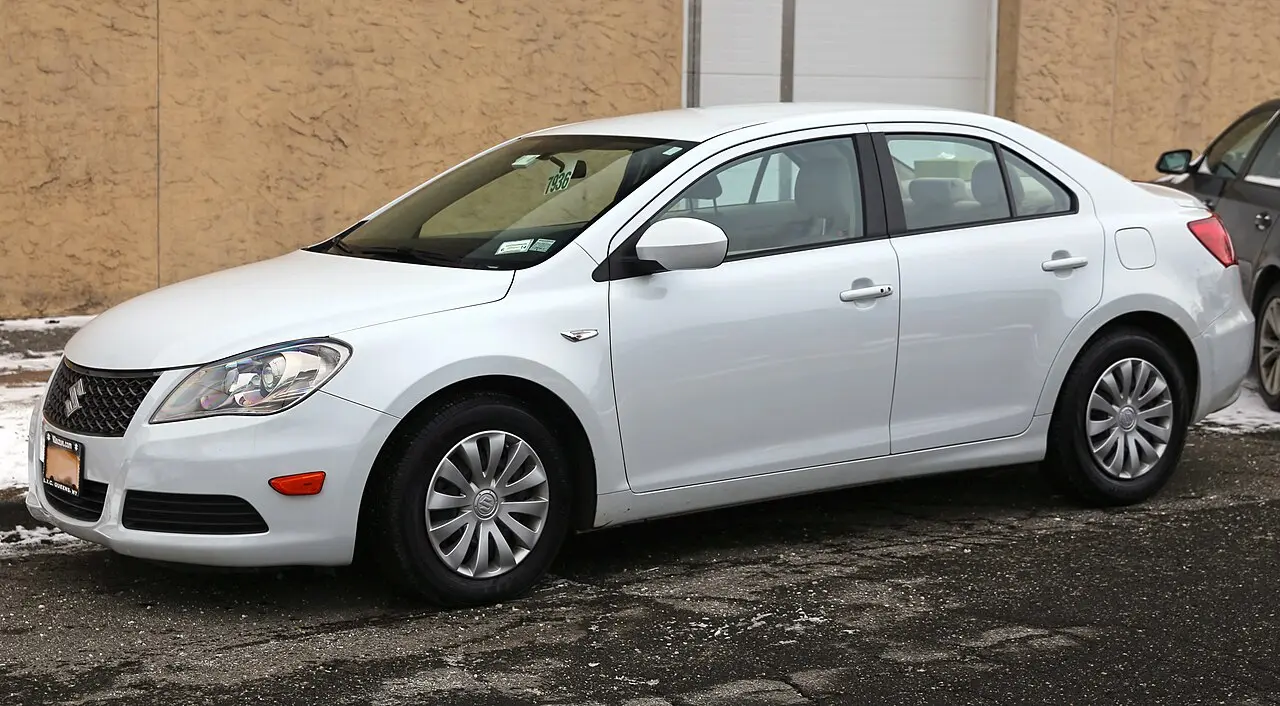
The official data lists 31 versions of the Suzuki Kizashi (2010–2015), in the European Union, the United Kingdom, France, the United States, and Canada. Each market publishes its own figures, measured on its own test procedure.
At a glance
Years in the data
2010–2015
Markets
European Union, United Kingdom, France, United States, Canada
Engines
2.4 L to 2.4 L
Power
131 kW (178 PS)
Fuels
Petrol
Lowest consumption (France)
7.9 L/100 km (NEDC)
Lowest consumption (United Kingdom)
8.3 L/100 km (NEDC)
Lowest consumption (Canada)
8.9 L/100 km (5-cycle)
New registrations in the EU
5,940
What is the Suzuki Kizashi?
The Kizashi is a four-door family saloon that took Suzuki into the mid-size class. The production car arrived in 2009, following a series of concepts that previewed the model. It gave the Japanese maker, known for its compact cars and small vehicles, a more substantial saloon for drivers seeking a roomier cabin and a sporting character.
Generations and engines
The Kizashi had one generation, spanning 2010–2015 in EU figures. Its listed engine was a 2.4-litre petrol unit. EU and French listings give its output as 131 kW (178 PS).
Fuel consumption
The lowest listed consumption is 7.9 L/100 km in France on the NEDC test. The UK listing’s lowest figure is 8.3 L/100 km, also on NEDC. In the USA, the EPA’s best combined figure is 26 MPG, alongside a lowest listed consumption of 9 L/100 km. Canada’s lowest figure is 8.9 L/100 km on its 5-cycle test. WLTP and NEDC in Europe, EPA in the USA and the 5-cycle procedure in Canada use different test methods, so these figures are not directly comparable.
Where was the Kizashi sold?
EU registrations span 2010–2015 and total 5,940. UK and French listings cover 2012–2014, US EPA listings cover 2010–2013, and Canadian figures cover 2011–2013.
Questions and answers
How many generations of Kizashi were there?
One generation is listed, covering 2010–2015 in EU figures.
What engine and power did the European Kizashi have?
EU and French listings identify a 2.4-litre petrol engine producing 131 kW (178 PS).
What is the lowest listed fuel consumption?
France has the lowest listed figure at 7.9 L/100 km on NEDC. US and Canadian ratings use different test procedures.
New cars registered in the EU (plus Norway and Iceland), from the European Environment Agency. Figures on the NEDC procedure until 2020 and on WLTP from 2021; versions are grouped by engine and power, with their number of registrations.
Years and version
Engine
Power
Fuel
CO₂
EU registrations
2015
2.4 L
131 kW (178 PS)
Petrol
187 g/km
70
2014
2.4 L
131 kW (178 PS)
Petrol
186 g/km
434
2013
2.4 L
131 kW (178 PS)
Petrol
188 g/km
744
2013
2.4 L
–
Other fuel
187 g/km
28
2012
2.4 L
131 kW (178 PS)
Petrol
187 g/km
1,242
2011
2.4 L
131 kW (178 PS)
Petrol
187 g/km
2,584
2010
2.4 L
–
Petrol
189 g/km
838
United Kingdom 2 versions
New cars on sale in the UK, from the Vehicle Certification Agency. NEDC figures until 2018 and WLTP figures after; years are the editions a version appeared in.
Years and version
Engine
Fuel
Gearbox
Consumption (combined)
CO₂
2013–20142.4 Sport 4 door 4X4
2.4 L
Petrol
Automatic
8.3 L/100 km NEDC
191 g/km
20122.4 Sport 4 door 4X4
2.4 L
Petrol
6-speed automatic
8.3 L/100 km NEDC
191 g/km
France 6 versions
New cars on sale in France, from ADEME Car Labelling. NEDC figures until 2015, WLTP figures in the current catalogue.
Years and version
Engine
Power
Fuel
Gearbox
Consumption (combined)
CO₂
2014KIZASHI SPORT
–
131 kW (178 PS)
Petrol
6-speed manual
7.9 L/100 km NEDC
183 g/km
2014KIZASHI SPORT 4WD
–
131 kW (178 PS)
Petrol
Continuously variable (CVT)
8.0 L/100 km NEDC
185 g/km
2014KIZASHI SPORT 4WD
–
131 kW (178 PS)
Petrol
Continuously variable (CVT)
8.3 L/100 km NEDC
191 g/km
2012–2013KIZASHI SPORT
–
131 kW (178 PS)
Petrol
6-speed manual
7.9 L/100 km NEDC
183 g/km
2012–2013KIZASHI SPORT 4WD
–
131 kW (178 PS)
Petrol
Continuously variable (CVT)
8.3 L/100 km NEDC
191 g/km
2013KIZASHI SPORT 4WD
–
131 kW (178 PS)
Petrol
Continuously variable (CVT)
8.0 L/100 km NEDC
185 g/km
United States 13 versions
Model years sold in the USA, from the EPA and the Department of Energy (fueleconomy.gov). MPG on the EPA test; litres per 100 km = 235.215 ÷ MPG.
Years and version
Engine
Fuel
Gearbox
Drive
Consumption (combined)
CO₂
2013
2.4 L
Petrol
Continuously variable (CVT)
Front-wheel drive
25 MPG (9.4 L/100 km) EPA
216 g/km
2013
2.4 L
Petrol
6-speed manual
Front-wheel drive
24 MPG (9.8 L/100 km) EPA
226 g/km
2013
2.4 L
Petrol
6-speed manual
Front-wheel drive
24 MPG (9.8 L/100 km) EPA
234 g/km
2013
2.4 L
Petrol
Continuously variable (CVT)
All-wheel drive
25 MPG (9.4 L/100 km) EPA
219 g/km
2013
2.4 L
Petrol
Continuously variable (CVT)
All-wheel drive
25 MPG (9.4 L/100 km) EPA
224 g/km
2010–2012
2.4 L
Petrol
Continuously variable (CVT)
Front-wheel drive
26 MPG (9.0 L/100 km) EPA
212 g/km
2010–2012
2.4 L
Petrol
6-speed manual
Front-wheel drive
24 MPG (9.8 L/100 km) EPA
230 g/km
2010–2012
2.4 L
Petrol
Continuously variable (CVT)
All-wheel drive
25 MPG (9.4 L/100 km) EPA
221 g/km
2011–2012
2.4 L
Petrol
Continuously variable (CVT)
Front-wheel drive
25 MPG (9.4 L/100 km) EPA
221 g/km
2011–2012
2.4 L
Petrol
6-speed manual
Front-wheel drive
24 MPG (9.8 L/100 km) EPA
230 g/km
2010
2.4 L
Petrol
Continuously variable (CVT)
Front-wheel drive
26 MPG (9.0 L/100 km) EPA
212 g/km
2010
2.4 L
Petrol
6-speed manual
Front-wheel drive
25 MPG (9.4 L/100 km) EPA
221 g/km
2010
2.4 L
Petrol
Continuously variable (CVT)
All-wheel drive
25 MPG (9.4 L/100 km) EPA
221 g/km
Canada 3 versions
Model years sold in Canada, from Natural Resources Canada fuel consumption ratings (5-cycle test).
Years and version
Engine
Fuel
Gearbox
Consumption (combined)
CO₂
2011–2013Compact
2.4 L
Petrol
Continuously variable (CVT)
9.5 L/100 km 5-cycle
219 g/km
2011Compact
2.4 L
Petrol
Continuously variable (CVT)
8.9 L/100 km 5-cycle
205 g/km
2011Compact
2.4 L
Petrol
6-speed manual
9.9 L/100 km 5-cycle
228 g/km
Official figures are measured on standard test procedures and differ between markets. Your consumption depends on how, where and in what conditions you drive.