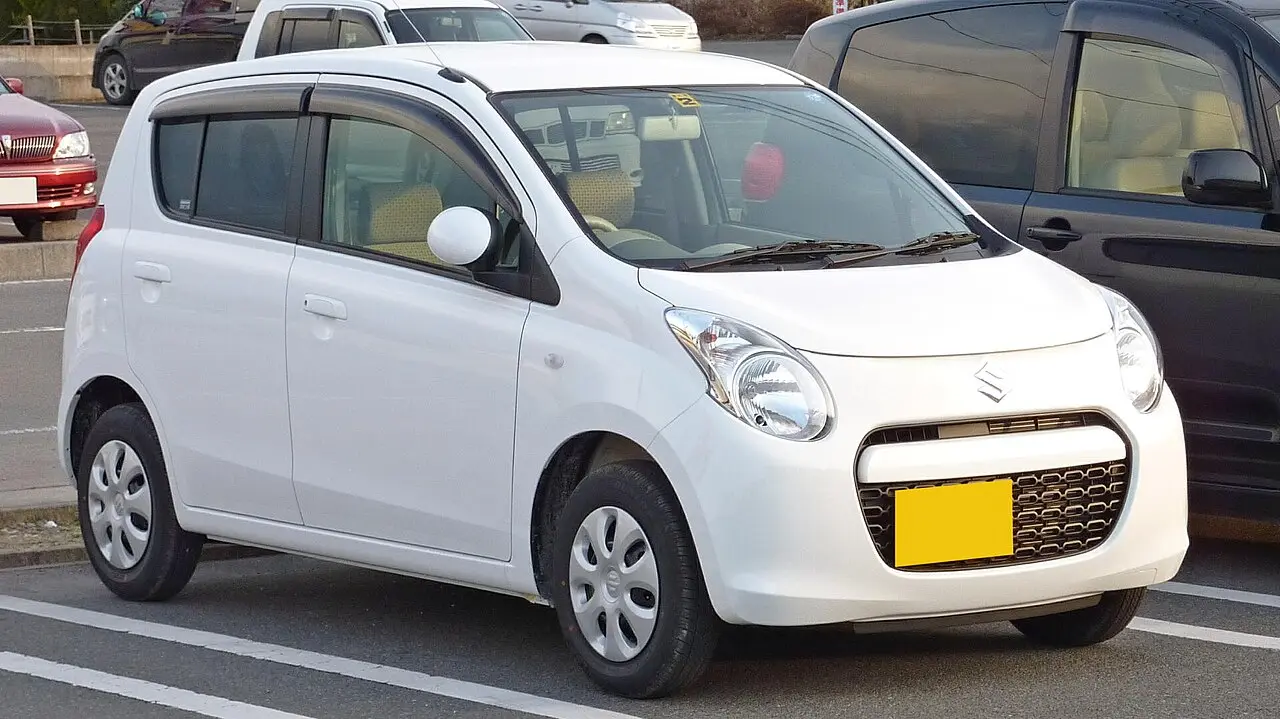
The official data lists 32 versions of the Suzuki Alto (2000–2015), in the European Union, the United Kingdom, and France. Each market publishes its own figures, measured on its own test procedure.
At a glance
Years in the data
2000–2015
Markets
European Union, United Kingdom, France
Engines
0.9 L to 1.1 L
Power
50 kW (68 PS)
Fuels
Petrol, LPG
Lowest consumption (France)
4.3 L/100 km (NEDC)
Lowest consumption (United Kingdom)
4.4 L/100 km (NEDC)
New registrations in the EU
302,512
What kind of car is the Suzuki Alto?
The Suzuki Alto is a small city car, with a compact hatchback body suited to everyday travel and urban streets. Suzuki has made compact cars for decades, and the Alto name has been associated with small cars since its introduction in Japan in 1979.
The seventh-generation Alto (HA25) was sold from 2009 to 2014. Suzuki described the European model as an A-segment car, with a small petrol engine and a focus on economy.
Engine and power
In the European Union, the Alto is listed with engines from 0.9 to 1.0 litres and power of 50 kW (68 PS). UK versions range from 1.0 to 1.1 litres. France’s ADEME listings show a petrol engine producing 50 kW (68 PS). Petrol is listed across these markets; European Union listings also include LPG and other fuel classifications.
The specifications vary by market. The European Union registration figures record 302,512 Altos from 2010 to 2015. UK figures span 2000 to 2014, and France’s ADEME listings span 2012 to 2014.
Fuel consumption
The UK low is 4.4 L/100 km on the NEDC test. France’s lowest listed figure is 4.3 L/100 km, also on NEDC. NEDC is an older European test procedure, so these figures should be read in that context rather than compared directly with WLTP results.
Questions and answers
Which Alto generation was sold in Europe?
The seventh-generation Alto, code HA25, was sold from 2009 to 2014.
What is the Alto’s lowest listed fuel consumption in France?
France’s ADEME listing gives 4.3 L/100 km on the NEDC test.
How powerful is the European Union Alto?
The European Union figures list 50 kW (68 PS) and engines from 0.9 to 1.0 litres.
Model codes: HA25 · Sold in: European Union, United Kingdom, and France · References: autobild.de, cars-data.com
European Union 15 versions
New cars registered in the EU (plus Norway and Iceland), from the European Environment Agency. Figures on the NEDC procedure until 2020 and on WLTP from 2021; versions are grouped by engine and power, with their number of registrations.
Years and version
Engine
Power
Fuel
CO₂
EU registrations
2014
1.0 L
50 kW (68 PS)
Petrol
104 g/km
53,676
2013
1.0 L
50 kW (68 PS)
Petrol
106 g/km
52,812
2013
1.0 L
–
Other fuel
106 g/km
399
2013
1.0 L
50 kW (68 PS)
LPG
93 g/km
12
2012
1.0 L
50 kW (68 PS)
Petrol
110 g/km
38,040
2012
–
–
Petrol
103 g/km
1,394
2012
0.9 L
–
Petrol
103 g/km
290
2012
1.0 L
50 kW (68 PS)
LPG
93 g/km
160
2011
1.0 L
50 kW (68 PS)
Petrol
110 g/km
61,236
2011
–
–
Petrol
106 g/km
1,050
2011
1.0 L
50 kW (68 PS)
LPG
93 g/km
276
2010
1.0 L
–
Petrol
105 g/km
74,370
2010
1.0 L
–
LPG
93 g/km
5,206
2010
–
–
Petrol
109 g/km
2,959
2010
–
–
Other fuel
110 g/km
20
United Kingdom 6 versions
New cars on sale in the UK, from the Vehicle Certification Agency. NEDC figures until 2018 and WLTP figures after; years are the editions a version appeared in.
Years and version
Engine
Fuel
Gearbox
Consumption (combined)
CO₂
2013–20141.0 SZ · 1.0 SZ3 · 1.0 SZ4
1.0 L
Petrol
Manual
4.4 L/100 km NEDC
99 g/km
2013–20141.0 SZ4
1.0 L
Petrol
Automatic
5.2 L/100 km NEDC
118 g/km
20121.0 SZ2 · 1.0 SZ3 · 1.0 SZ4 and 1 more trim
1.0 L
Petrol
5-speed manual
4.4 L/100 km NEDC
103 g/km
20121.0 SZ4
1.0 L
Petrol
4-speed automatic
5.2 L/100 km NEDC
122 g/km
2009–20101.0 Hatchback 5 door from VIN MA3GFC31S00106000
1.0 L
Petrol
5-speed manual
4.4 L/100 km NEDC
103 g/km
2009–20101.0 Hatchback 5 door from VIN MA3GFC31S00106646
1.0 L
Petrol
4-speed automatic
5.2 L/100 km NEDC
122 g/km
France 4 versions
New cars on sale in France, from ADEME Car Labelling. NEDC figures until 2015, WLTP figures in the current catalogue.
Years and version
Engine
Power
Fuel
Gearbox
Consumption (combined)
CO₂
2014ALTO 1.0
–
50 kW (68 PS)
Petrol
5-speed manual
4.3 L/100 km NEDC
99 g/km
2014ALTO 1.0 BVA
–
50 kW (68 PS)
Petrol
4-speed automatic
5.1 L/100 km NEDC
118 g/km
2012–2013ALTO 1.0 BVA
–
50 kW (68 PS)
Petrol
4-speed automatic
5.1 L/100 km NEDC
118 g/km
2012–2013ALTO 1.0
–
50 kW (68 PS)
Petrol
5-speed manual
4.3 L/100 km NEDC
99 g/km
Versions outside these generations
European Union 1 version
New cars registered in the EU (plus Norway and Iceland), from the European Environment Agency. Figures on the NEDC procedure until 2020 and on WLTP from 2021; versions are grouped by engine and power, with their number of registrations.
Years and version
Engine
Power
Fuel
CO₂
EU registrations
2015
1.0 L
50 kW (68 PS)
Petrol
105 g/km
10,612
United Kingdom 6 versions
New cars on sale in the UK, from the Vehicle Certification Agency. NEDC figures until 2018 and WLTP figures after; years are the editions a version appeared in.
Years and version
Engine
Fuel
Gearbox
Consumption (combined)
CO₂
2003–20041.1 GL/GLS 5-door From VIN MA3FFB21S00144416
1.1 L
Petrol
5-speed manual
4.9 L/100 km NEDC
119 g/km
2003–20041.1 GL(A)/GLS(A) 5-door From VIN MA3FFB21S00151669
1.1 L
Petrol
3-speed automatic
6.2 L/100 km NEDC
152 g/km
2001–20021.0 GL 3 door From VIN MA3EFA12S00520001 · 1.0 GL 5 door From VIN MA3EFB12S00520001
1.0 L
Petrol
5-speed manual
5.4 L/100 km NEDC
134 g/km
2001–20021.0 GL(A) 3 door From VIN MA3EFA12S00520001 · 1.0 GL(A) 5 door From VIN MA3EFB12S00520001 · 1.0 GL(A) 5 door From VIN MA3EFB12S00520001
1.0 L
Petrol
3-speed automatic
7.0 L/100 km NEDC
171 g/km
2000–20011.0 GL · 1.0 GL 3 door Up to VIN Prefix MA3EFA11S · 1.0 GL 5 door Up to VIN Prefix MA3EFB11S
1.0 L
Petrol
5-speed manual
5.7 L/100 km NEDC
134 g/km
2000–20011.0 GL(A) · 1.0 GL(A) 3 door Up to VIN Prefix MA3EFA11S · 1.0 GL(A) 5 door Up to VIN Prefix MA3EFB11S
1.0 L
Petrol
3-speed automatic
7.2 L/100 km NEDC
171 g/km
Official figures are measured on standard test procedures and differ between markets. Your consumption depends on how, where and in what conditions you drive.