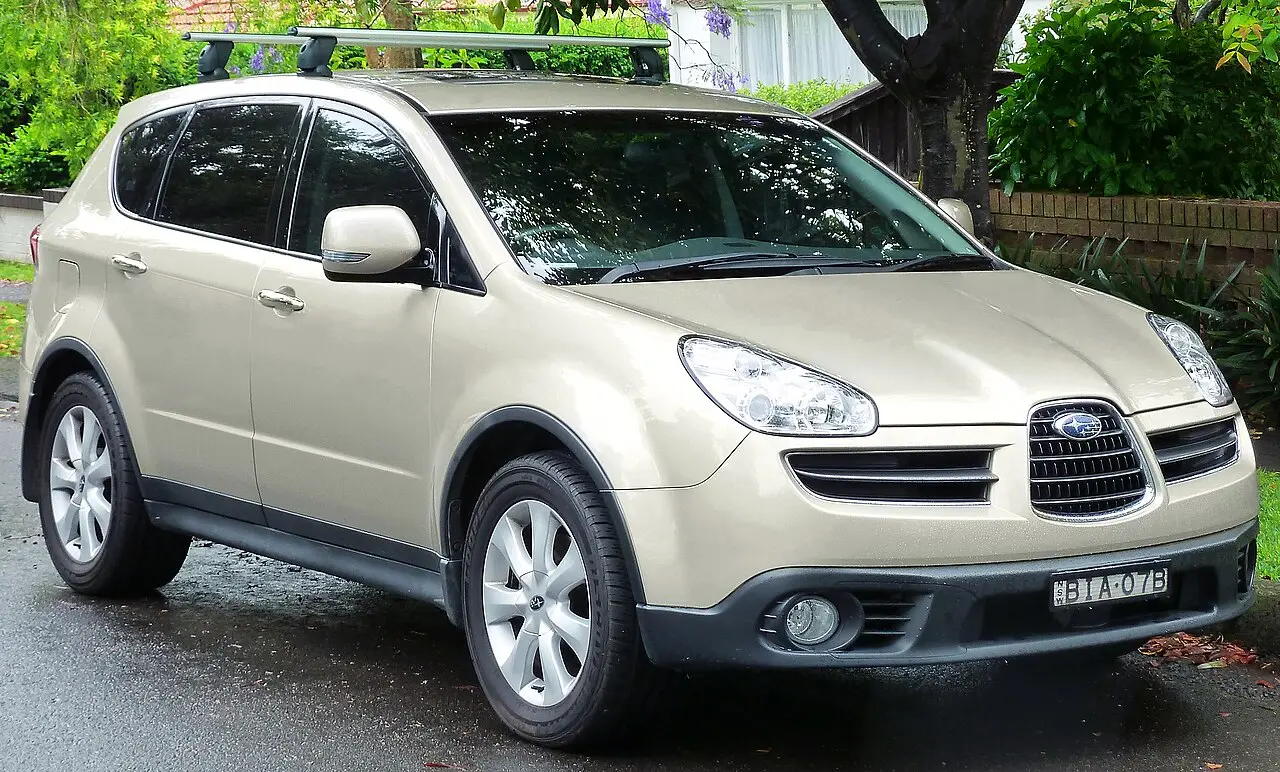
The official data lists 13 versions of the Subaru Tribeca (2006–2014), in the European Union, the United Kingdom, the United States, and Canada. Each market publishes its own figures, measured on its own test procedure.
At a glance
Years in the data
2006–2014
Markets
European Union, United Kingdom, United States, Canada
Engines
3.0 L to 3.6 L
Fuels
Petrol
Lowest consumption (United Kingdom)
11.6 L/100 km (NEDC)
Lowest consumption (United States)
13.1 L/100 km (EPA)
Lowest consumption (Canada)
13.1 L/100 km (5-cycle)
New registrations in the EU
310
What is the Subaru Tribeca?
The Tribeca was Subaru’s mid-size crossover SUV, positioned as a larger, family-oriented vehicle in the brand’s range. It was offered with five or seven seats, including a third row for extra passengers. Its raised stance and flexible cabin suited drivers looking for an SUV-style vehicle for family journeys.
First introduced as the B9 Tribeca, the model brought a distinctive design direction to Subaru. A later redesign softened its look and dropped the B9 prefix. Its horizontally opposed engine and all-wheel-drive layout gave the crossover a recognisable place in the brand’s range.
Generation and engines
The first-generation Tribeca, code WX, ran from 2006 to 2014. Its petrol engine range included 3.0 L and 3.6 L six-cylinder options. The larger engine became the main option after the model’s update.
Fuel consumption and registrations
United States EPA figures for 2006–2014 give the Tribeca a best combined rating of 18 MPG and lowest listed consumption of 13.1 L/100 km. Canada’s figures give the same lowest consumption on the 5-cycle test. The United Kingdom listing gives 11.6 L/100 km on the NEDC test for 2007–2009. These results use different procedures: EPA in the United States, 5-cycle in Canada, and NEDC in the UK, so they are not directly comparable.
In European Union registration figures, 310 Tribecas were registered in 2010.
Questions and answers
How many generations of Subaru Tribeca are listed?
One: the first generation, code WX, sold from 2006 to 2014.
What engines were available?
The petrol range included 3.0 L and 3.6 L six-cylinder engines.
What is the lowest listed consumption for the Tribeca?
The United States EPA and Canadian NRCan listings each give 13.1 L/100 km, using different test procedures.
New cars registered in the EU (plus Norway and Iceland), from the European Environment Agency. Figures on the NEDC procedure until 2020 and on WLTP from 2021; versions are grouped by engine and power, with their number of registrations.
Years and version
Engine
Fuel
CO₂
EU registrations
2010
3.6 L
Petrol
276 g/km
276
2010
3.0 L
Petrol
291 g/km
18
2010
–
Other fuel
277 g/km
16
United Kingdom 2 versions
New cars on sale in the UK, from the Vehicle Certification Agency. NEDC figures until 2018 and WLTP figures after; years are the editions a version appeared in.
Years and version
Engine
Fuel
Gearbox
Consumption (combined)
CO₂
2008–20093.6 AWD 5/7 Seater · 3.6 SE7
3.6 L
Petrol
5-speed automatic
11.6 L/100 km NEDC
275 g/km
2007–20083.0 AWD 5/7 Seater
3.0 L
Petrol
5-speed automatic
12.3 L/100 km NEDC
291 g/km
United States 4 versions
Model years sold in the USA, from the EPA and the Department of Energy (fueleconomy.gov). MPG on the EPA test; litres per 100 km = 235.215 ÷ MPG.
Years and version
Engine
Fuel
Gearbox
Drive
Consumption (combined)
CO₂
2013–2014
3.6 L
Petrol
5-speed automatic
All-wheel drive
18 MPG (13.1 L/100 km) EPA
304 g/km
2010–2012
3.6 L
Petrol
5-speed automatic
All-wheel drive
18 MPG (13.1 L/100 km) EPA
307 g/km
2008–20092MODE CLKUP
3.6 L
Petrol
5-speed automatic
Four- or all-wheel drive
18 MPG (13.1 L/100 km) EPA
307 g/km
2006–20072MODE CLKUP
3.0 L
Petrol
5-speed automatic
Four- or all-wheel drive
18 MPG (13.1 L/100 km) EPA
307 g/km
Canada 4 versions
Model years sold in Canada, from Natural Resources Canada fuel consumption ratings (5-cycle test).
Years and version
Engine
Fuel
Gearbox
Consumption (combined)
CO₂
2010–2014Sport utility vehicle · Sport utility vehicle: Small
3.6 L
Petrol
5-speed automatic
13.1 L/100 km 5-cycle
301 g/km
2008–2009Sport utility vehicle
3.6 L
Petrol
5-speed automatic
13.1 L/100 km 5-cycle
301 g/km
2007Sport utility vehicle
3.0 L
Petrol
5-speed automatic
13.2 L/100 km 5-cycle
304 g/km
2006Sport utility vehicle
3.0 L
Petrol
5-speed automatic
13.2 L/100 km 5-cycle
304 g/km
Official figures are measured on standard test procedures and differ between markets. Your consumption depends on how, where and in what conditions you drive.