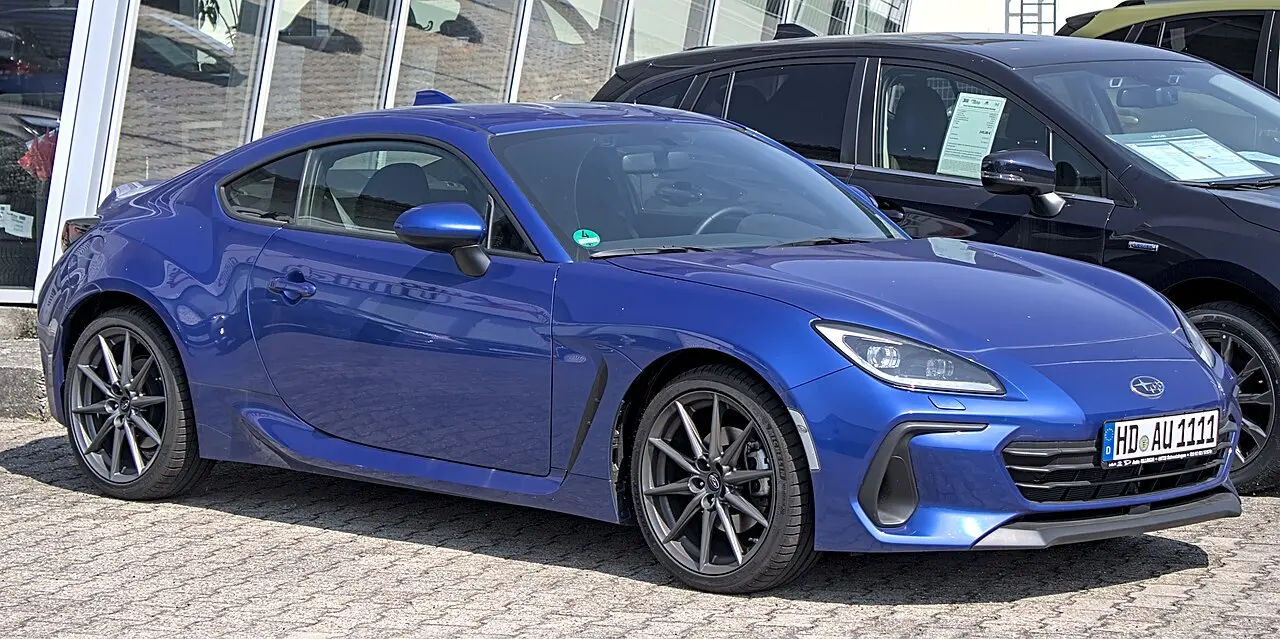
Subaru

Subaru BRZ

Subaru BRZ
Photo: Alexander-93 / Wikimedia Commons · CC BY-SA 4.0

The official data lists 71 versions of the Subaru BRZ (2012–2027), in the European Union, the United Kingdom, France, the United States, and Canada. Each market publishes its own figures, measured on its own test procedure.

At a glance

Years in the data
2012–2027
Markets
European Union, United Kingdom, France, United States, Canada
Engines
2.0 L to 2.4 L
Power
147 kW (200 PS) to 200 kW (272 PS)
Fuels
Petrol
Lowest consumption (France)
6.9 L/100 km (NEDC)
Lowest consumption (United Kingdom)
6.9 L/100 km (NEDC)
Lowest consumption (United States)
8.4 L/100 km (EPA)
New registrations in the EU
7,812

What is the Subaru BRZ?

The Subaru BRZ is a two-door sports coupe with a front-mounted engine and rear-wheel drive. Its low-mounted boxer engine and compact shape give it a clear sporting purpose, while the coupe body suits drivers who want a focused car for everyday roads and spirited drives.

The BRZ’s horizontally opposed Subaru boxer engine sits low in the chassis. That layout is part of the car’s character, which has remained consistent across its generations.

BRZ generations

The first generation ran from 2012 to 2021 under the ZC6 code. The second generation, ZD8, began in 2022 and continues today. The newer generation moved from a 2.0-litre engine to a 2.4-litre engine in EU, US and Canadian figures. Subaru’s launch material also highlighted revised chassis dynamics, while keeping the front-engine, rear-wheel-drive layout.

Engines, power and fuel consumption

EU registration figures list BRZ petrol engines from 2.0 to 2.4 litres, with power from 147 kW (200 PS) to 172 kW (234 PS). The most registered recent EU configuration was the 2.4-litre petrol version rated at 172 kW (234 PS). Earlier leading entries used the 2.0-litre engine rated at 147 kW (200 PS). UK figures list 2.0-litre versions with power from 147 kW (200 PS) to 200 kW (272 PS).

Consumption figures depend on the market’s test procedure: Europe uses WLTP or NEDC, the US uses the EPA method, and Canada uses a 5-cycle test. The EU figure reaches 8.5 L/100 km on WLTP, while UK and French NEDC figures reach 6.9 L/100 km. US EPA and Canadian 5-cycle figures each reach 8.4 L/100 km; the EPA best combined rating is 28 MPG.

Where was the BRZ sold?

The BRZ appears in EU registration figures from 2012 to 2025, UK figures from 2012 to 2021 and French figures from 2012 to 2015. US EPA figures span 2013 to 2027, while Canadian 5-cycle figures run from 2013 to 2026.

Questions and answers

Is the BRZ rear-wheel drive?

Yes. The BRZ is a front-engine, rear-wheel-drive sports coupe.

What engine sizes does the BRZ use?

EU, US and Canadian figures include 2.0-litre and 2.4-litre petrol engines; UK and French figures include 2.0-litre versions.

What is the BRZ’s lowest listed fuel consumption?

The lowest listed figure is 6.9 L/100 km in UK and French NEDC figures. US EPA and Canadian 5-cycle figures reach 8.4 L/100 km, while the EU WLTP figure reaches 8.5 L/100 km.

BRZ first generation (2012–2021)

Model codes: ZC6 · References: en.wikipedia.org

Show all 61 versions

BRZ second generation (since 2022)

Subaru BRZ second generation
Photo: Alexander-93 / Wikimedia Commons · CC BY-SA 4.0

Model codes: ZD8 · References: en.wikipedia.org

European Union 2 versions

New cars registered in the EU (plus Norway and Iceland), from the European Environment Agency. Figures on the NEDC procedure until 2020 and on WLTP from 2021; versions are grouped by engine and power, with their number of registrations.

Years and versionEnginePowerFuelConsumption (combined)CO₂EU registrations
20252.4 L172 kW (234 PS)Petrol8.8 L/100 km WLTP200 g/km243
2023–20242.4 L172 kW (234 PS)Petrol8.8 L/100 km WLTP200 g/km1,329

United States 5 versions

Model years sold in the USA, from the EPA and the Department of Energy (fueleconomy.gov). MPG on the EPA test; litres per 100 km = 235.215 ÷ MPG.

Years and versionEngineFuelGearboxDriveConsumption (combined)CO₂
2025–2027SIDI & PFI2.4 LPetrol6-speed automaticRear-wheel drive25 MPG (9.4 L/100 km) EPA225 g/km
2026–2027SIDI & PFI2.4 LPetrol6-speed manualRear-wheel drive22 MPG (10.7 L/100 km) EPA248 g/km
2022–2025SIDI & PFI2.4 LPetrol6-speed manualRear-wheel drive22 MPG (10.7 L/100 km) EPA247 g/km
2024SIDI & PFI2.4 LPetrol6-speed automaticRear-wheel drive25 MPG (9.4 L/100 km) EPA224 g/km
2022–2023SIDI & PFI2.4 LPetrol6-speed automaticRear-wheel drive25 MPG (9.4 L/100 km) EPA225 g/km

Canada 3 versions

Model years sold in Canada, from Natural Resources Canada fuel consumption ratings (5-cycle test).

Years and versionEngineFuelGearboxConsumption (combined)CO₂
2022–2026Minicompact2.4 LPetrol6-speed manual10.5 L/100 km 5-cycle247 g/km
2025–2026Minicompact2.4 LPetrol6-speed automatic9.6 L/100 km 5-cycle225 g/km
2022–2024Minicompact2.4 LPetrol6-speed automatic9.5 L/100 km 5-cycle224 g/km

Official figures are measured on standard test procedures and differ between markets. Your consumption depends on how, where and in what conditions you drive.