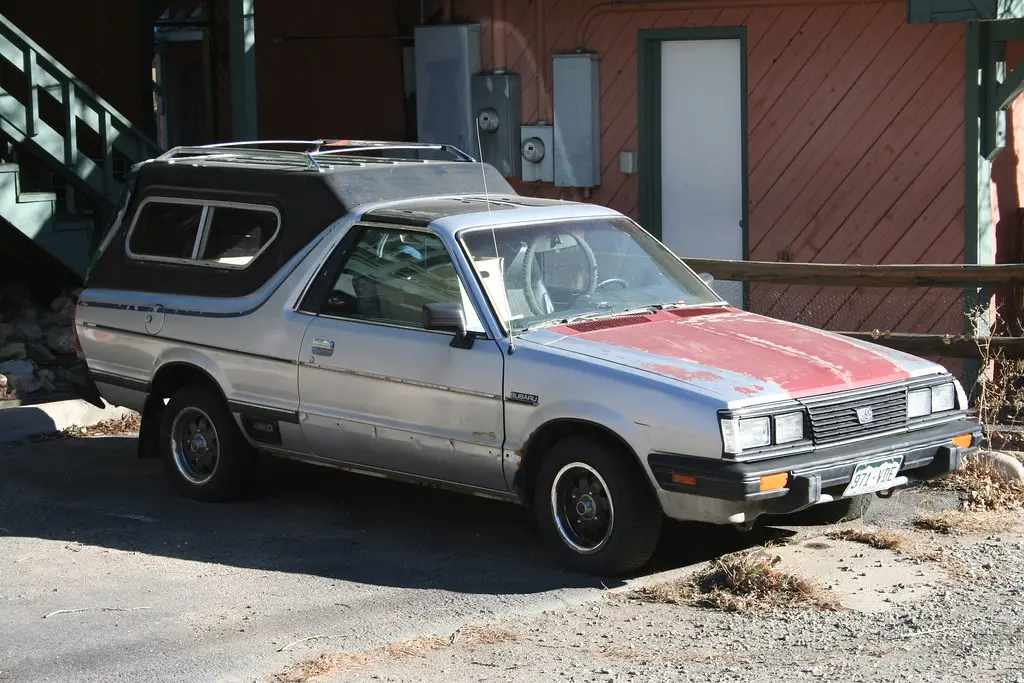
What is the Subaru BRAT?
The Subaru BRAT is a compact utility vehicle that blends a two-seat car cabin with an open pickup bed. Its name stands for Bi-drive Recreational All-terrain Transporter, and the unusual layout reflects Subaru’s early focus on practical, four-wheel-drive vehicles. Based on the Leone, it offered a small-bed alternative for drivers who wanted a vehicle for everyday travel as well as carrying gear.
The BRAT sits between a passenger car and a light pickup in character. Its modest size and two-seat cabin suit people who value a compact footprint and an open cargo area over carrying a larger crew. Subaru’s history identifies it as a small dual-range four-wheel-drive vehicle; it helped establish the brand’s association with practical all-terrain transport.
Generations and engines
The second generation was sold in the United States from 1984 to 1987. The BRAT range ended in the US after that period. Subaru’s model history places the vehicle in the maker’s Leone-based family, whose four-wheel-drive approach shaped the BRAT’s combination of car-like travel and utility.
US EPA listings for these years cover six versions, all with petrol engines of 1.8 litres. The available figures here do not distinguish power outputs between versions, so the model is best understood by its shared engine size and compact utility format.
How economical is the Subaru BRAT?
For the United States, the EPA lists a best combined figure of 25 MPG. The lowest consumption shown is 9.4 L/100 km on the EPA test. EPA results use a different procedure from European WLTP or NEDC tests and Canada’s five-cycle method, so figures from those markets should not be treated as directly equivalent.
The BRAT figures presented here are for US-market petrol versions from 1984 to 1987. Subaru’s distinctive take on the small pickup was aimed at drivers who needed a little cargo space and four-wheel-drive utility in a relatively compact vehicle.
Questions and answers
What years was the second-generation Subaru BRAT sold in the United States?
The second generation was sold in the US from 1984 to 1987.
What engine did the US-market BRAT use?
The EPA-listed versions use a 1.8-litre petrol engine.
What is the Subaru BRAT’s EPA fuel economy?
Its best combined EPA figure is 25 MPG; the lowest listed consumption is 9.4 L/100 km.