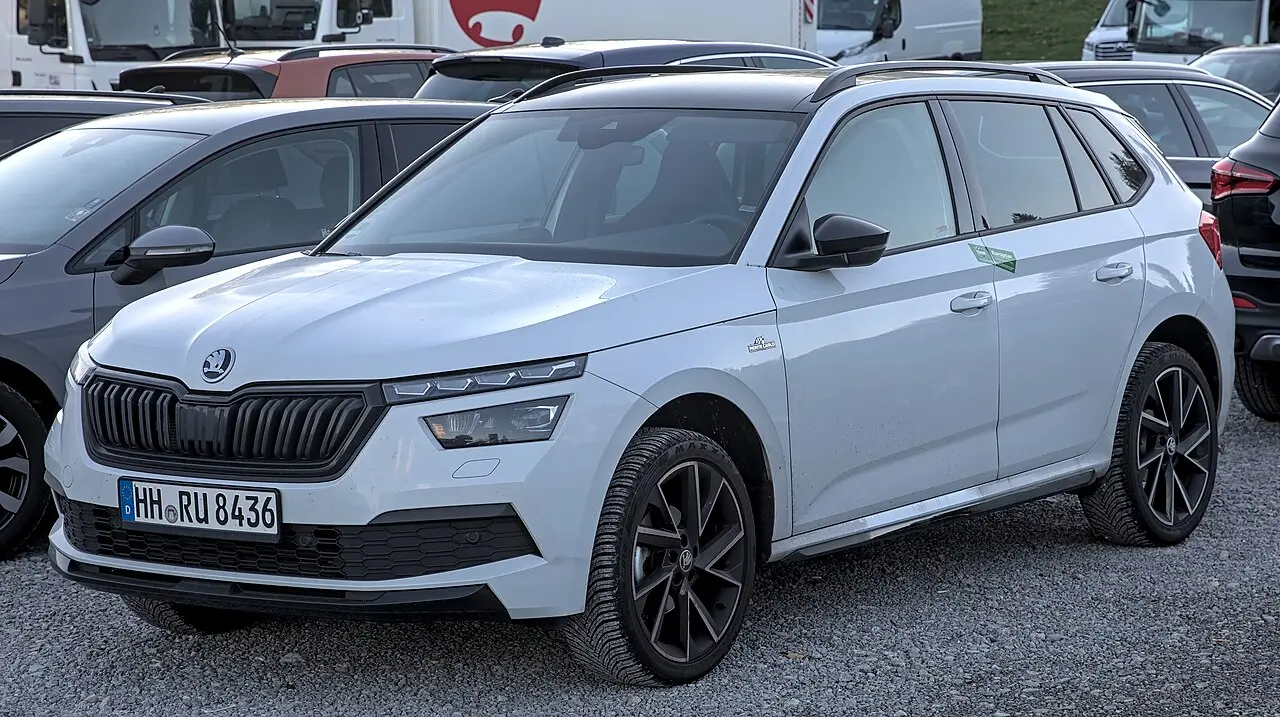
The official data lists 90 versions of the Škoda Kamiq (2019–2026), in the European Union, the United Kingdom, and France. Each market publishes its own figures, measured on its own test procedure.
At a glance
Years in the data
2019–2026
Markets
European Union, United Kingdom, France
Engines
1.0 L to 1.6 L
Power
66 kW (90 PS) to 110 kW (150 PS)
Fuels
Petrol, LPG, Natural gas, Diesel
Lowest consumption (European Union)
4.3 L/100 km (WLTP)
Lowest consumption (France)
5.4 L/100 km (WLTP)
Lowest consumption (United Kingdom)
5.4 L/100 km (WLTP)
New registrations in the EU
641,188
What is the Škoda Kamiq?
The Kamiq is Škoda’s city SUV, combining a raised seating position with the compact dimensions of a small car. It sits at the smaller end of the brand’s SUV family, below the Karoq and Kodiaq, and is suited to town journeys and everyday family use.
Introduced in 2019, the Kamiq is identified as generation I, code NW. EU registration figures cover 2019–2025, while UK figures cover 2025–2026 and French figures cover 2026. A design and equipment update brought revised front and rear styling and optional Matrix LED headlights.
Engines and power
The EU range spans 1.0- to 1.6-litre engines, with power from 66 kW (90 PS) to 110 kW (150 PS). It includes petrol, LPG, natural gas and diesel versions. UK figures cover 1.0- and 1.5-litre petrol engines rated from 70 kW (95 PS) to 110 kW (150 PS). French figures show 1.0- and 1.5-litre petrol engines with 81 kW (110 PS) to 110 kW (150 PS).
The 1.0-litre petrol versions with 81 kW (110 PS) and 85 kW (116 PS) feature among the most registered Kamiqs in the EU figures.
Fuel consumption and CO₂
The lowest listed consumption is 4.3 L/100 km in EU figures on the WLTP test. UK and French figures list 5.4 L/100 km, also on WLTP. WLTP is the European test procedure used for these figures; results vary across markets and versions.
Questions and answers
What generation is the Škoda Kamiq?
The Kamiq is generation I, code NW, introduced in 2019.
Which engines are listed for the Kamiq?
EU figures span 1.0 to 1.6 litres and 66 kW (90 PS) to 110 kW (150 PS). UK and French figures show 1.0- and 1.5-litre petrol engines.
What is the Kamiq’s lowest listed fuel consumption?
EU figures list 4.3 L/100 km on WLTP. UK and French figures list 5.4 L/100 km on WLTP.
New cars registered in the EU (plus Norway and Iceland), from the European Environment Agency. Figures on the NEDC procedure until 2020 and on WLTP from 2021; versions are grouped by engine and power, with their number of registrations.
Years and version
Engine
Power
Fuel
Consumption (combined)
CO₂
EU registrations
2025
1.0 L
85 kW (116 PS)
Petrol
5.6 L/100 km WLTP
126 g/km
56,697
2025
1.5 L
110 kW (150 PS)
Petrol
5.7 L/100 km WLTP
129 g/km
23,766
2025
1.0 L
70 kW (95 PS)
Petrol
5.5 L/100 km WLTP
124 g/km
10,220
2025
1.0 L
81 kW (110 PS)
Petrol
5.7 L/100 km WLTP
129 g/km
39
2025
1.0 L
–
LPG
5.6 L/100 km WLTP
125 g/km
24
2024
1.0 L
85 kW (116 PS)
Petrol
5.7 L/100 km WLTP
126 g/km
38,097
2024
1.5 L
110 kW (150 PS)
Petrol
5.8 L/100 km WLTP
130 g/km
27,922
2024
1.0 L
81 kW (110 PS)
Petrol
5.8 L/100 km WLTP
130 g/km
14,799
2024
1.0 L
70 kW (95 PS)
Petrol
5.5 L/100 km WLTP
125 g/km
10,659
2024
1.0 L
66 kW (90 PS)
Natural gas
5.6 L/100 km WLTP
101 g/km
140
2023
1.0 L
81 kW (110 PS)
Petrol
5.7 L/100 km WLTP
129 g/km
45,034
2023
1.5 L
110 kW (150 PS)
Petrol
5.9 L/100 km WLTP
133 g/km
24,457
2023
1.0 L
70 kW (95 PS)
Petrol
5.5 L/100 km WLTP
125 g/km
8,667
2023
1.0 L
66 kW (90 PS)
Natural gas
5.6 L/100 km WLTP
101 g/km
329
2023
1.0 L
67 kW (91 PS)
Petrol
5.7 L/100 km WLTP
129 g/km
150
2023
1.5 L
67 kW (91 PS)
Petrol
5.8 L/100 km WLTP
132 g/km
122
2023
1.0 L
110 kW (150 PS)
Petrol
5.7 L/100 km WLTP
129 g/km
77
2023
1.5 L
81 kW (110 PS)
Petrol
5.8 L/100 km WLTP
131 g/km
27
2023
1.0 L
84 kW (114 PS)
Petrol
5.7 L/100 km WLTP
129 g/km
25
2023
1.0 L
95 kW (129 PS)
Petrol
5.7 L/100 km WLTP
129 g/km
21
2023
1.0 L
61 kW (83 PS)
Petrol
5.7 L/100 km WLTP
129 g/km
18
2023
1.0 L
85 kW (116 PS)
Petrol
5.6 L/100 km WLTP
134 g/km
18
2023
1.5 L
95 kW (129 PS)
Petrol
5.9 L/100 km WLTP
132 g/km
18
2023
1.0 L
96 kW (131 PS)
Petrol
5.6 L/100 km WLTP
128 g/km
17
2023
1.5 L
72 kW (98 PS)
Petrol
5.9 L/100 km WLTP
132 g/km
17
2023
1.5 L
116 kW (158 PS)
Petrol
5.8 L/100 km WLTP
131 g/km
17
2023
1.0 L
120 kW (163 PS)
Petrol
5.7 L/100 km WLTP
129 g/km
16
2023
1.5 L
84 kW (114 PS)
Petrol
5.9 L/100 km WLTP
132 g/km
16
2023
1.0 L
68 kW (92 PS)
Petrol
5.6 L/100 km WLTP
127 g/km
15
2023
1.0 L
112 kW (152 PS)
Petrol
5.7 L/100 km WLTP
129 g/km
15
2023
1.0 L
117 kW (159 PS)
Petrol
5.7 L/100 km WLTP
130 g/km
14
2023
1.5 L
85 kW (116 PS)
Petrol
5.9 L/100 km WLTP
133 g/km
13
2023
1.5 L
132 kW (179 PS)
Petrol
5.9 L/100 km WLTP
132 g/km
13
2023
1.0 L
72 kW (98 PS)
Petrol
5.6 L/100 km WLTP
128 g/km
12
2023
1.0 L
131 kW (178 PS)
Petrol
5.7 L/100 km WLTP
129 g/km
12
2023
1.5 L
91 kW (124 PS)
Petrol
5.9 L/100 km WLTP
132 g/km
12
2023
1.5 L
90 kW (122 PS)
Petrol
5.8 L/100 km WLTP
132 g/km
11
2023
1.5 L
120 kW (163 PS)
Petrol
5.9 L/100 km WLTP
133 g/km
11
2023
1.0 L
69 kW (94 PS)
Petrol
5.7 L/100 km WLTP
131 g/km
10
2023
1.0 L
140 kW (190 PS)
Petrol
5.7 L/100 km WLTP
130 g/km
10
2023
1.5 L
61 kW (83 PS)
Petrol
5.9 L/100 km WLTP
132 g/km
10
2023
1.5 L
70 kW (95 PS)
Petrol
5.8 L/100 km WLTP
131 g/km
10
2023
1.5 L
96 kW (131 PS)
Petrol
5.9 L/100 km WLTP
132 g/km
10
2023
1.5 L
140 kW (190 PS)
Petrol
5.9 L/100 km WLTP
132 g/km
10
2022
1.0 L
81 kW (110 PS)
Petrol
5.4 L/100 km WLTP
129 g/km
36,877
2022
1.5 L
110 kW (150 PS)
Petrol
5.6 L/100 km WLTP
135 g/km
15,241
2022
1.0 L
70 kW (95 PS)
Petrol
5.2 L/100 km WLTP
124 g/km
6,171
2022
1.0 L
66 kW (90 PS)
Natural gas
5.3 L/100 km WLTP
101 g/km
2,438
2021
1.0 L
81 kW (110 PS)
Petrol
5.5 L/100 km WLTP
129 g/km
76,088
2021
1.5 L
110 kW (150 PS)
Petrol
5.7 L/100 km WLTP0.5 kWh/100 km WLTP
135 g/km
40,866
2021
1.0 L
70 kW (95 PS)
Petrol
5.4 L/100 km WLTP0.5 kWh/100 km WLTP
128 g/km
14,374
2021
1.0 L
66 kW (90 PS)
Natural gas
5.3 L/100 km WLTP
101 g/km
11,332
2021
1.0 L
85 kW (116 PS)
Petrol
5.1 L/100 km WLTP
135 g/km
3,806
2021
1.6 L
85 kW (116 PS)
Diesel
4.3 L/100 km WLTP
137 g/km
1,930
2021
1.0 L
81 kW (110 PS)
Diesel
–
135 g/km
12
2021
1.6 L
81 kW (110 PS)
Petrol
–
171 g/km
10
2020
1.0 L
85 kW (116 PS)
Petrol
–
113 g/km
70,799
2020
1.5 L
110 kW (150 PS)
Petrol
–
114 g/km
40,498
2019–2020
1.0 L
70 kW (95 PS)
Petrol
–
116 g/km
14,567
2020
1.6 L
85 kW (116 PS)
Diesel
–
112 g/km
12,514
2020
1.0 L
66 kW (90 PS)
Natural gas
–
94 g/km
7,458
2020
1.0 L
81 kW (110 PS)
Petrol
–
108 g/km
3,828
2019
1.0 L
85 kW (116 PS)
Petrol
–
114 g/km
15,244
2019
1.5 L
110 kW (150 PS)
Petrol
–
114 g/km
3,428
2019
1.6 L
85 kW (116 PS)
Diesel
–
112 g/km
2,098
2019
1.2 L
85 kW (116 PS)
Petrol
–
177 g/km
12
United Kingdom 21 versions
New cars on sale in the UK, from the Vehicle Certification Agency. NEDC figures until 2018 and WLTP figures after; years are the editions a version appeared in.
Years and version
Engine
Power
Fuel
Gearbox
Consumption (combined)
CO₂
2025–2026Design Edition 1.0 TSI 95 PS 5G Man · SE Edition 1.0 TSI 95 PS 5G Man
1.0 L
70 kW (95 PS)
Petrol
5-speed manual
5.4 L/100 km WLTP
123 g/km
2025–2026Design Edition 1.0 TSI 95 PS 5G Man
1.0 L
70 kW (95 PS)
Petrol
5-speed manual
5.5 L/100 km WLTP
125 g/km
2025–2026SE Edition 1.0 TSI 95 PS 5G Man
1.0 L
70 kW (95 PS)
Petrol
5-speed manual
5.7 L/100 km WLTP
128 g/km
2025–2026Design Edition 1.0 TSI 116 PS 6G Man · SE Edition 1.0 TSI 116 PS 6G Man
1.0 L
85 kW (116 PS)
Petrol
6-speed manual
5.4 L/100 km WLTP
122 g/km
2025–2026Design Edition 1.0 TSI 116 PS 6G Man
1.0 L
85 kW (116 PS)
Petrol
6-speed manual
5.5 L/100 km WLTP
124 g/km
2025–2026Design Edition 1.0 TSI 116 PS DSG · SE Edition 1.0 TSI 116 PS DSG
1.0 L
85 kW (116 PS)
Petrol
7-speed automatic
5.6 L/100 km WLTP
126 g/km
2025–2026Design Edition 1.0 TSI 116 PS DSG
1.0 L
85 kW (116 PS)
Petrol
7-speed automatic
5.7 L/100 km WLTP
128 g/km
2025–2026Monte Carlo Edition 1.0 TSI 116 PS 6G Man
1.0 L
85 kW (116 PS)
Petrol
6-speed manual
5.6 L/100 km WLTP
126 g/km
2025–2026Monte Carlo Edition 1.0 TSI 116 PS 6G Man · SE L Edition 1.0 TSI 116 PS 6G Man
1.0 L
85 kW (116 PS)
Petrol
6-speed manual
5.7 L/100 km WLTP
128 g/km
2025–2026Monte Carlo Edition 1.0 TSI 116 PS DSG · SE L Edition 1.0 TSI 116 PS DSG
1.0 L
85 kW (116 PS)
Petrol
7-speed automatic
5.7 L/100 km WLTP
129 g/km
2025–2026Monte Carlo Edition 1.0 TSI 116 PS DSG · SE Edition 1.0 TSI 116 PS DSG
1.0 L
85 kW (116 PS)
Petrol
7-speed automatic
5.8 L/100 km WLTP
131 g/km
2025–2026SE Edition 1.0 TSI 116 PS 6G Man
1.0 L
85 kW (116 PS)
Petrol
6-speed manual
5.6 L/100 km WLTP
127 g/km
2025–2026SE L Edition 1.0 TSI 116 PS 6G Man
1.0 L
85 kW (116 PS)
Petrol
6-speed manual
5.5 L/100 km WLTP
125 g/km
2025–2026SE L Edition 1.0 TSI 116 PS DSG
1.0 L
85 kW (116 PS)
Petrol
7-speed automatic
5.8 L/100 km WLTP
132 g/km
2025–2026Monte Carlo Edition 1.5 TSI 150 PS 6G Man
1.5 L
110 kW (150 PS)
Petrol
6-speed manual
5.9 L/100 km WLTP
133 g/km
2025–2026Monte Carlo Edition 1.5 TSI 150 PS 6G Man · SE L Edition 1.5 TSI 150 PS 6G Man
1.5 L
110 kW (150 PS)
Petrol
6-speed manual
6.0 L/100 km WLTP
135 g/km
2025–2026Monte Carlo Edition 1.5 TSI 150 PS DSG
1.5 L
110 kW (150 PS)
Petrol
7-speed automatic
5.8 L/100 km WLTP
130 g/km
2025–2026Monte Carlo Edition 1.5 TSI 150 PS DSG
1.5 L
110 kW (150 PS)
Petrol
7-speed automatic
5.8 L/100 km WLTP
132 g/km
2025–2026SE L Edition 1.5 TSI 150 PS 6G Man
1.5 L
110 kW (150 PS)
Petrol
6-speed manual
5.8 L/100 km WLTP
132 g/km
2025–2026SE L Edition 1.5 TSI 150 PS DSG
1.5 L
110 kW (150 PS)
Petrol
7-speed automatic
5.7 L/100 km WLTP
130 g/km
2025–2026SE L Edition 1.5 TSI 150 PS DSG
1.5 L
110 kW (150 PS)
Petrol
7-speed automatic
5.9 L/100 km WLTP
132 g/km
France 3 versions
New cars on sale in France, from ADEME Car Labelling. NEDC figures until 2015, WLTP figures in the current catalogue.
Years and version
Engine
Power
Fuel
Gearbox
Consumption (combined)
CO₂
2026Kamiq 1.0 TSI (110ch) DSG7 Norme AP châssis classique Monte-Carlo clA Full LED et alt 140A famA
1.0 L
81 kW (110 PS)
Petrol
7-speed automatic
5.5 L/100 km WLTP
124 g/km
2026Kamiq 1.5 TSI (150ch) DSG7 Norme AP châssis classique clB avec Full LED et alt 140A famB
1.5 L
110 kW (150 PS)
Petrol
7-speed automatic
6.2 L/100 km WLTP
140 g/km
2026Kamiq 1.5 TSI (150ch) DSG7 Norme AP châssis classique clA avec Full LED et alt 140A famA
1.5 L
110 kW (150 PS)
Petrol
7-speed automatic
5.4 L/100 km WLTP
124 g/km
Official figures are measured on standard test procedures and differ between markets. Your consumption depends on how, where and in what conditions you drive.