SEAT

SEAT Arosa

SEAT Arosa
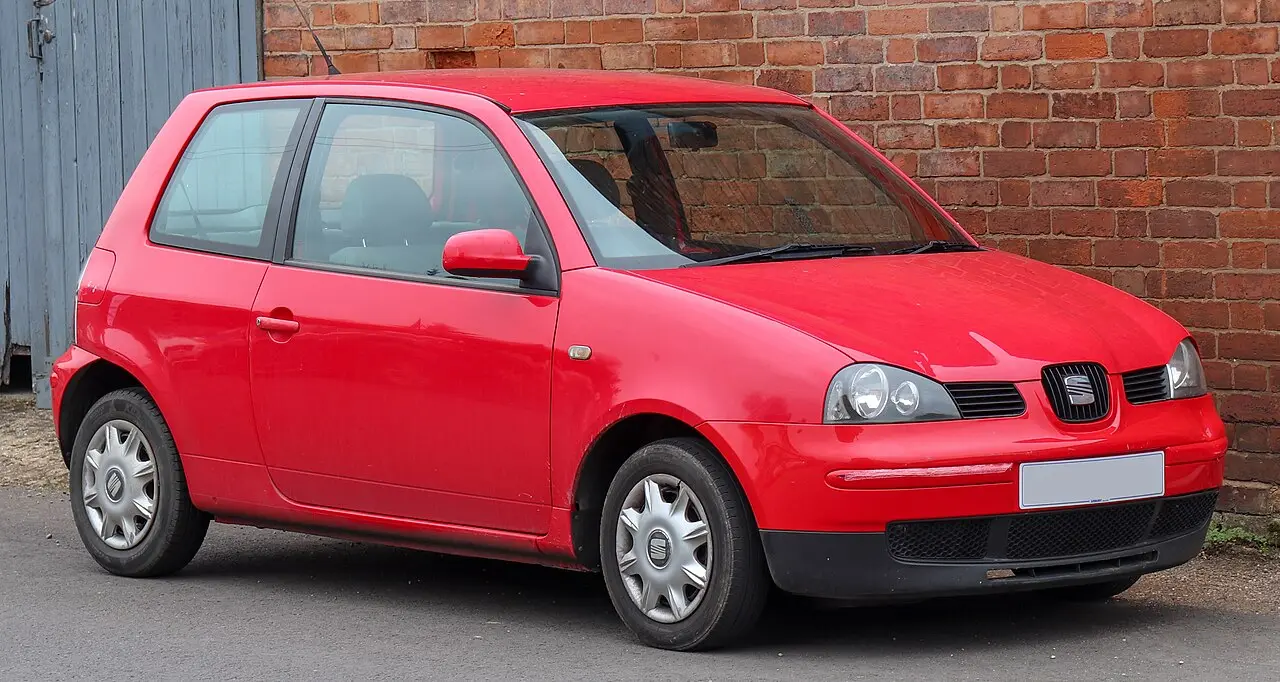
Photo: Vauxford / Wikimedia Commons · CC BY-SA 4.0

The official data lists 11 versions of the SEAT Arosa (2000–2004), in the United Kingdom. Each market publishes its own figures, measured on its own test procedure.

At a glance

Years in the data
2000–2004
Markets
United Kingdom
Engines
1.0 L to 1.7 L
Power
37 kW (50 PS) to 75 kW (101 PS)
Fuels
Petrol, Diesel
Lowest consumption (United Kingdom)
4.4 L/100 km (NEDC)

What is the SEAT Arosa?

The Arosa was SEAT’s small city car: a three-door hatchback made for urban driving and everyday errands. It sat at the compact end of the range, with a short body and a cabin designed to make good use of the space. SEAT introduced it in 1997 as the Marbella’s successor in the city-car role.

The Arosa arrived as SEAT was becoming part of the Volkswagen Group, while retaining its Spanish identity. It was initially built in Germany, then production moved to Martorell, near Barcelona.

Generations and design

The Arosa had one generation, known by the internal code 6H, running from 1997 to 2004. A restyling in 2000 refreshed its appearance while keeping the compact city-car shape.

The engine range included petrol and diesel options. Its first-generation line-up included a 1.0-litre petrol engine, a 1.4-litre petrol and diesel options. SEAT’s own history also records a 101 PS 1.4 16-valve petrol and a 75 PS 1.4 TDI three-cylinder among the early offerings. The company explored a 1.2 TDI 3L, but built only a few prototypes.

Engines and official fuel consumption

In United Kingdom VCA figures for 2000–2004, the Arosa range covered 1.0-litre to 1.7-litre engines, with power from 37 kW (50 PS) to 75 kW (101 PS). Petrol and diesel versions were offered. The lowest listed official consumption is 4.4 L/100 km on the NEDC test, an older European procedure.

The Arosa was sold in Europe and the UK. Its compact size and choice of petrol and diesel engines suited city driving, while its cabin layout gave it room for everyday use.

Questions and answers

When was the SEAT Arosa sold?

The Arosa’s first generation ran from 1997 to 2004. UK VCA figures cover 2000–2004.

What engines and power were available?

The UK range spanned 1.0-litre to 1.7-litre engines, with petrol and diesel fuels and power from 37 kW (50 PS) to 75 kW (101 PS).

What is the Arosa’s lowest official fuel consumption?

The lowest listed UK figure is 4.4 L/100 km on the NEDC test.

Arosa first generation (1997–2004)

SEAT Arosa first generation
Photo: Vauxford / Wikimedia Commons · CC BY-SA 4.0

Model codes: 6H · Sold in: European Union and United Kingdom · References: en.wikipedia.org, en.wikipedia.org

United Kingdom 11 versions

New cars on sale in the UK, from the Vehicle Certification Agency. NEDC figures until 2018 and WLTP figures after; years are the editions a version appeared in.

Years and versionEnginePowerFuelGearboxConsumption (combined)CO₂
2003–20041.0 (50 PS) · 1.0 (50 PS) up to December 20021.0 L37 kW (50 PS)Petrol5-speed manual5.8 L/100 km NEDC139 g/km
2003–20041.4 MPI Auto (60 PS)1.4 L44 kW (60 PS)Petrol4-speed automatic7.5 L/100 km NEDC180 g/km
2003–20041.4 16V Sport (100 PS)1.4 L74 kW (100 PS)Petrol5-speed manual6.7 L/100 km NEDC161 g/km
2001–20031.4 Tdi · 1.4 TDI1.4 L–Diesel5-speed manual4.4 L/100 km NEDC119 g/km
2001–20021.0 & S Models (50 bhp) · 1.0 (50 bhp)1.0 L37 kW (51 PS)Petrol5-speed manual5.8 L/100 km NEDC139 g/km
2000–20021.4 60 bhp · 1.4 Auto S (60 bhp) · 1.4 MPI Auto (60 bhp)1.4 L45 kW (61 PS)Petrol4-speed automatic7.5 L/100 km NEDC180 g/km
2001–20021.4 16v Sport (100 bhp)1.4 L75 kW (101 PS)Petrol5-speed manual6.7 L/100 km NEDC161 g/km
2000–20011.4 16V 100 bhp · 1.4 16v Sport (100 bhp)1.4 L75 kW (101 PS)Petrol5-speed manual6.6 L/100 km NEDC158 g/km
20011.4 Tdi S (75 bhp)1.4 L56 kW (76 PS)Diesel5-speed manual4.4 L/100 km NEDC119 g/km
20001.0 50 bhp1.0 L37 kW (51 PS)Petrol5-speed manual5.6 L/100 km NEDC134 g/km
20001.7 SDI 60 bhp1.7 L45 kW (61 PS)Diesel5-speed manual4.4 L/100 km NEDC119 g/km

Official figures are measured on standard test procedures and differ between markets. Your consumption depends on how, where and in what conditions you drive.