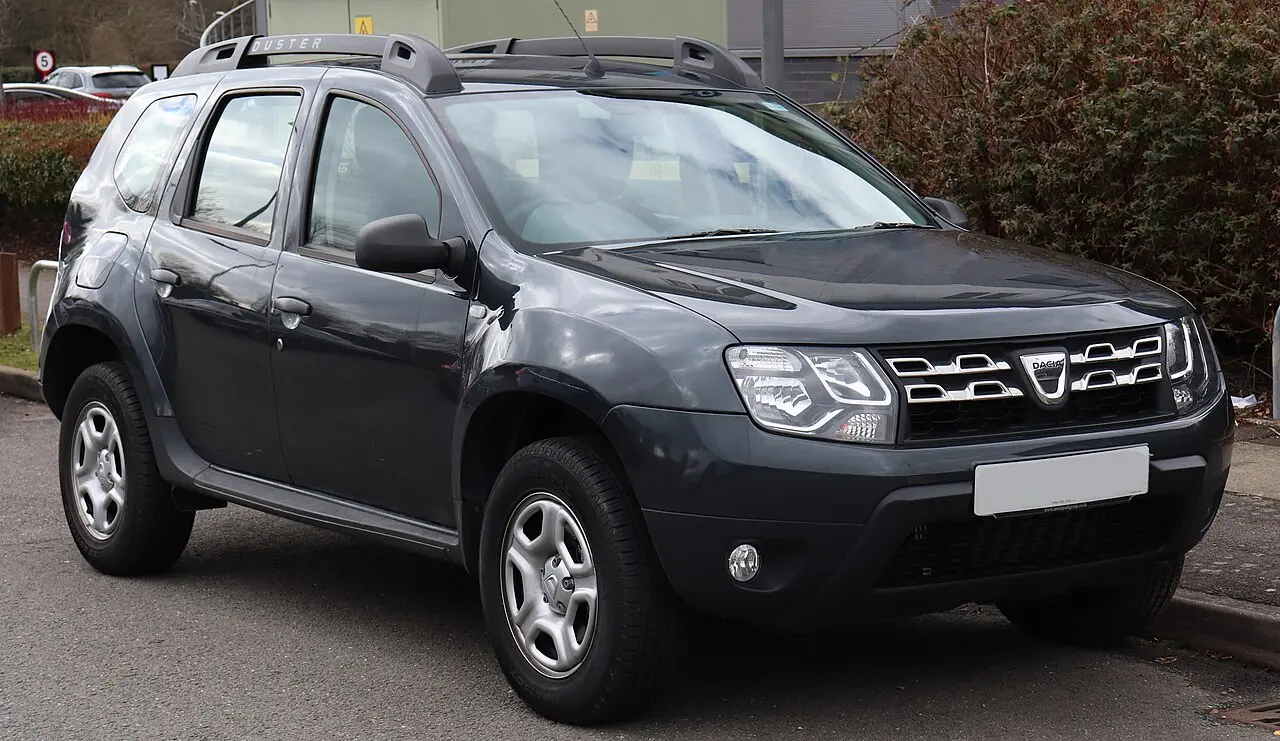
Renault

Renault Duster

Renault Duster
Photo: Vauxford / Wikimedia Commons · CC BY-SA 4.0

The official data lists 17 versions of the Renault Duster (2010–2022), in the European Union. Each market publishes its own figures, measured on its own test procedure.

At a glance

Years in the data
2010–2022
Markets
European Union
Engines
1.0 L to 2.0 L
Power
74 kW (101 PS) to 206 kW (280 PS)
Fuels
Petrol, Diesel, LPG
New registrations in the EU
4,398

What is the Dacia Duster?

The Duster is a compact SUV from Dacia, Renault Group’s Romanian carmaker. Its taller stance and practical layout give it a distinct place in Dacia’s range. In some markets, the model is sold under the Renault name.

The European model history includes two generations: Duster I, code H79, from 2010 to 2017, and Duster II, code HM, from 2017 to 2023. The second generation carried on the compact SUV format with a new design.

Engines and power

European listings span 1.0- to 2.0-litre engines and outputs from 74 kW (101 PS) to 206 kW (280 PS). The fuels represented include petrol, diesel and LPG. The largest EU registration entry is a 1.5-litre diesel with 85 kW (116 PS), followed by a 1.0-litre petrol and a 1.0-litre LPG version, each with 74 kW (101 PS).

These leading registration entries are from 2020. The range includes petrol and diesel engines as well as LPG versions.

How economical is the Dacia Duster?

The Duster is listed with petrol, diesel and LPG engines. For fuel economy figures, test procedures vary by market: European figures use NEDC or WLTP, depending on the vehicle and registration period; the USA uses EPA testing, while Canada uses a 5-cycle procedure.

EU registration years span 2010–2022. The two European generations ran from 2010 to 2017 and 2017 to 2023.

Questions and answers

How many Duster generations are listed for Europe?

Two: Duster I ran from 2010 to 2017, followed by Duster II from 2017 to 2023.

Which fuels were available?

The EU listings include petrol, diesel and LPG.

What power range is listed?

European versions range from 74 kW (101 PS) to 206 kW (280 PS).

Duster Duster I (2010–2017)

Model codes: H79 · Sold in: European Union · References: largus.fr, en.wikipedia.org

Show 1 version

Duster Duster II (2017–2023)

Renault Duster Duster II
Photo: Vauxford / Wikimedia Commons · CC BY-SA 4.0

Model codes: HM · Sold in: European Union · References: en.wikipedia.org

European Union 16 versions

New cars registered in the EU (plus Norway and Iceland), from the European Environment Agency. Figures on the NEDC procedure until 2020 and on WLTP from 2021; versions are grouped by engine and power, with their number of registrations.

Years and versionEnginePowerFuelCO₂EU registrations
20222.0 L105 kW (143 PS)Petrol237 g/km97
20221.3 L206 kW (280 PS)Petrol142 g/km50
20221.5 L206 kW (280 PS)Diesel138 g/km21
20212.0 L105 kW (143 PS)Petrol–88
20201.5 L85 kW (116 PS)Diesel111 g/km2,536
20201.0 L74 kW (101 PS)Petrol121 g/km673
20201.0 L74 kW (101 PS)LPG112 g/km220
20201.3 L96 kW (131 PS)Petrol130 g/km186
20201.3 L110 kW (150 PS)Petrol132 g/km158
20201.0 L67 kW (91 PS)Petrol129 g/km24
20191.5 L85 kW (116 PS)Diesel121 g/km62
20191.5 L70 kW (95 PS)Diesel114 g/km42
20191.3 L96 kW (131 PS)Petrol139 g/km36
20181.2 L92 kW (125 PS)Petrol142 g/km86
20181.5 L80 kW (109 PS)Diesel120 g/km72
20181.6 L84 kW (114 PS)Petrol149 g/km33

Official figures are measured on standard test procedures and differ between markets. Your consumption depends on how, where and in what conditions you drive.