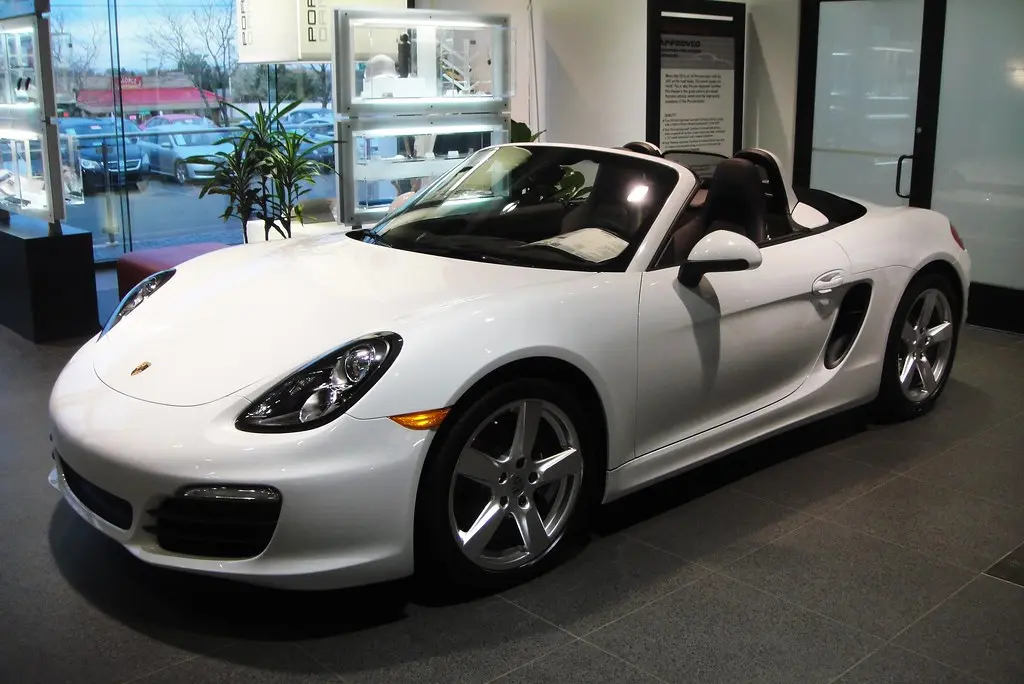
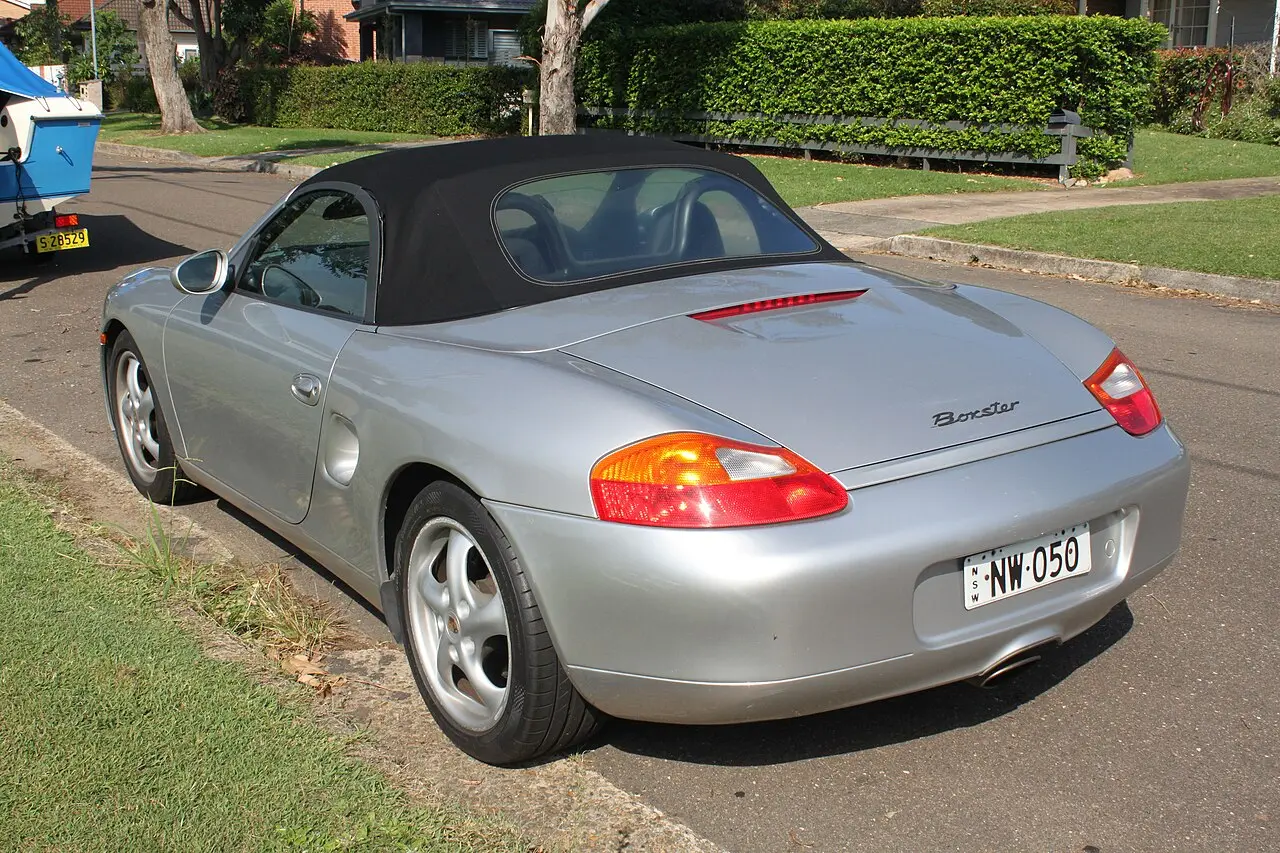
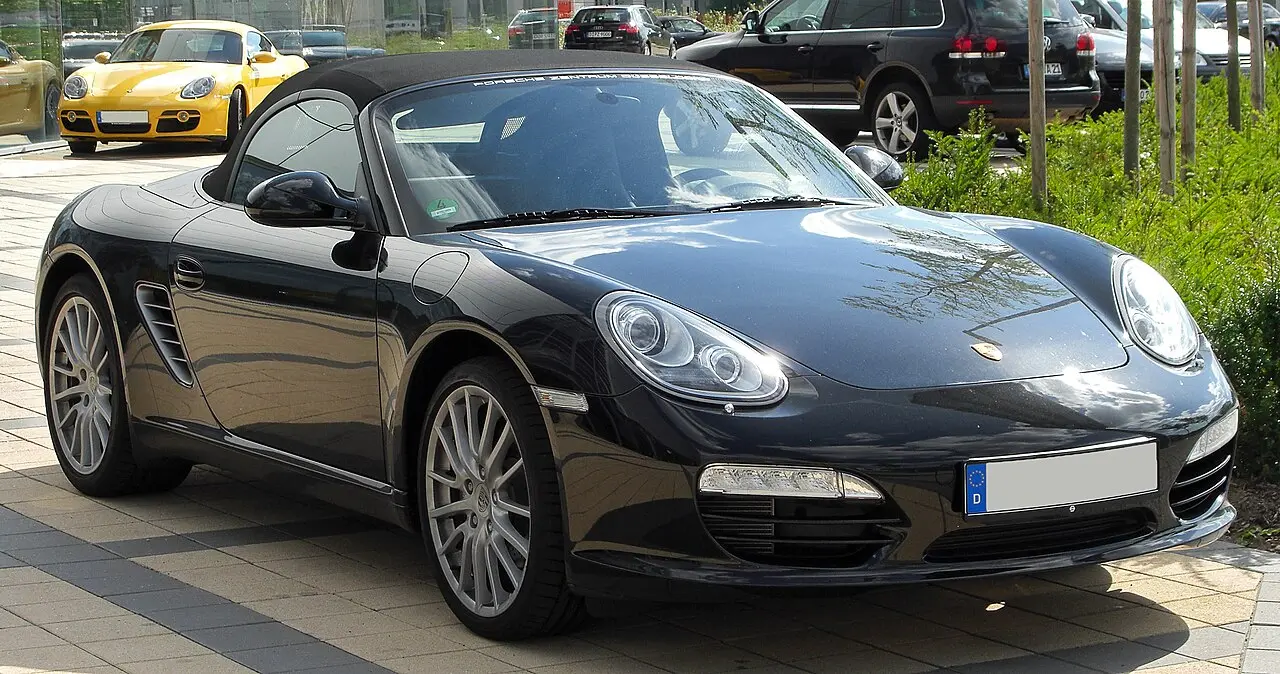
The official data lists 212 versions of the Porsche Boxster (1997–2024), in the European Union, the United Kingdom, France, the United States, and Canada. Each market publishes its own figures, measured on its own test procedure.
At a glance
Years in the data
1997–2024
Markets
European Union, United Kingdom, France, United States, Canada
Engines
2.0 L to 3.8 L
Power
155 kW (211 PS) to 360 kW (489 PS)
Fuels
Petrol, Electric
Lowest consumption (France)
7.7 L/100 km (NEDC)
Lowest consumption (United Kingdom)
7.7 L/100 km (NEDC)
Lowest consumption (Canada)
9.2 L/100 km (5-cycle)
New registrations in the EU
52,630
What is the Porsche Boxster?
The Boxster is Porsche’s two-seat, mid-engined roadster. Its open body and central engine layout give it a distinct place in the company’s sports-car range. The name combines “boxer”, for the engine type, and “roadster”. The production car launched in 1996, drawing on Porsche’s mid-engined sports-car heritage, including the 550 Spyder and 718 RS 60 Spyder.
The first production generation was the 986. EU registrations cover 2010–2024, UK figures 2003–2016, French figures 2012–2015, US figures 1997–2020 and Canadian figures 1997–2019.
Boxster generations
The first generation, 986, ran from 1997–2004. It brought a water-cooled flat-six engine to Porsche’s production roadster range. The 987 followed from 2005–2012, with a new design and revised interior. The 981 ran from 2013–2016. The mid-engined layout remained central to the Boxster throughout these generations.
Engines and power
EU engine sizes range from 2.0 to 4.0 litres, with power from 155 kW (211 PS) to 360 kW (489 PS). UK engine figures cover 2.7 to 3.4 litres; the USA lists 2.0 to 3.8 litres, and Canada 2.0 to 3.4 litres. French figures show power from 195 kW (265 PS) to 243 kW (330 PS). Petrol is listed in the UK, France, USA and Canada; EU registrations also include electric and other categories.
How economical is the Porsche Boxster?
The lowest listed consumption is 7.7 L/100 km in both UK and French figures, measured on NEDC. The USA’s lowest figure is 9.4 L/100 km under EPA testing, with a best combined rating of 25 MPG. Canada lists 9.2 L/100 km under NRCan’s 5-cycle test. European NEDC procedures differ from the EPA test in the USA and the 5-cycle test in Canada, so the results are best read within each market.
Questions and answers
Is the Boxster a convertible?
Yes. It is a two-seat roadster with an open-top body.
What are the Boxster generations and years?
The 986 ran from 1997–2004, the 987 from 2005–2012 and the 981 from 2013–2016.
What is the lowest listed Boxster fuel consumption?
The lowest stated figure is 7.7 L/100 km on NEDC, in both the UK and France.
Which markets have official Boxster figures?
EU figures and registrations are available, alongside figures for the UK, France, the USA and Canada.
New cars registered in the EU (plus Norway and Iceland), from the European Environment Agency. Figures on the NEDC procedure until 2020 and on WLTP from 2021; versions are grouped by engine and power, with their number of registrations.
Years and version
Engine
Power
Fuel
CO₂
EU registrations
2016
3.8 L
276 kW (375 PS)
Petrol
230 g/km
1,796
2016
2.7 L
195 kW (265 PS)
Petrol
185 g/km
1,508
2016
3.4 L
243 kW (330 PS)
Petrol
195 g/km
1,230
2016
3.4 L
232 kW (315 PS)
Petrol
193 g/km
178
2016
2.0 L
220 kW (299 PS)
Petrol
164 g/km
122
2016
2.5 L
257 kW (349 PS)
Petrol
191 g/km
118
2016
2.7 L
155 kW (211 PS)
Petrol
183 g/km
24
2016
3.4 L
276 kW (375 PS)
Petrol
206 g/km
10
2015
2.7 L
195 kW (265 PS)
Petrol
185 g/km
4,296
2015
3.4 L
243 kW (330 PS)
Petrol
193 g/km
2,950
2015
3.4 L
232 kW (315 PS)
Petrol
193 g/km
800
2015
3.8 L
276 kW (375 PS)
Petrol
230 g/km
742
2015
2.7 L
155 kW (211 PS)
Petrol
185 g/km
52
2014
2.7 L
195 kW (265 PS)
Petrol
185 g/km
5,050
2014
3.4 L
232 kW (315 PS)
Petrol
192 g/km
3,470
2014
3.4 L
243 kW (330 PS)
Petrol
194 g/km
1,024
2014
2.7 L
155 kW (211 PS)
Petrol
188 g/km
40
2013
2.7 L
195 kW (265 PS)
Petrol
185 g/km
5,728
2013
3.4 L
232 kW (315 PS)
Petrol
194 g/km
5,192
2013
2.7 L
–
Other fuel
186 g/km
80
2013
2.7 L
155 kW (211 PS)
Petrol
183 g/km
62
2013
3.4 L
–
Other fuel
199 g/km
56
United Kingdom 9 versions
New cars on sale in the UK, from the Vehicle Certification Agency. NEDC figures until 2018 and WLTP figures after; years are the editions a version appeared in.
Years and version
Engine
Fuel
Gearbox
Consumption (combined)
CO₂
2014–20162.7 Euro 6
2.7 L
Petrol
6-speed manual
8.4 L/100 km NEDC
195 g/km
2014–20162.7 PDK Euro 6
2.7 L
Petrol
7-speed automatic
7.9 L/100 km NEDC
183 g/km
2014–2016GTS PDK · S PDK Euro 6
3.4 L
Petrol
7-speed automatic
8.2 L/100 km NEDC
190 g/km
2014–2016S Euro 6 · GTS
3.4 L
Petrol
6-speed manual
9.0 L/100 km NEDC
211 g/km
2013–20142.7 Manual · 2.7
2.7 L
Petrol
Manual
8.2 L/100 km NEDC
192 g/km
2013–20142.7 PDK
2.7 L
Petrol
Automatic
7.7 L/100 km NEDC
180 g/km
2013–20143.4 Manual · S
3.4 L
Petrol
Manual
8.8 L/100 km NEDC
206 g/km
2013–20143.4 PDK · S PDK
3.4 L
Petrol
Automatic
8.0 L/100 km NEDC
188 g/km
2014GTS
3.4 L
Petrol
Manual
9.0 L/100 km NEDC
211 g/km
France 14 versions
New cars on sale in France, from ADEME Car Labelling. NEDC figures until 2015, WLTP figures in the current catalogue.
Years and version
Engine
Power
Fuel
Gearbox
Consumption (combined)
CO₂
2015BOXSTER
–
195 kW (265 PS)
Petrol
6-speed manual
8.2 L/100 km NEDC
192 g/km
2015BOXSTER PDK
–
195 kW (265 PS)
Petrol
7-speed automatic
7.7 L/100 km NEDC
180 g/km
2015BOXSTER (EURO6)
–
195 kW (265 PS)
Petrol
6-speed manual
8.4 L/100 km NEDC
195 g/km
2015BOXSTER PDK (EURO6)
–
195 kW (265 PS)
Petrol
7-speed automatic
7.9 L/100 km NEDC
183 g/km
2015BOXSTER S
–
232 kW (315 PS)
Petrol
6-speed manual
8.8 L/100 km NEDC
206 g/km
2015BOXSTER S PDK
–
232 kW (315 PS)
Petrol
7-speed automatic
8.0 L/100 km NEDC
188 g/km
2015BOXSTER S (EURO6)
–
232 kW (315 PS)
Petrol
6-speed manual
9.0 L/100 km NEDC
211 g/km
2015BOXSTER S PDK (EURO6)
–
232 kW (315 PS)
Petrol
7-speed automatic
8.2 L/100 km NEDC
190 g/km
2015BOXSTER GTS (EURO6)
–
243 kW (330 PS)
Petrol
6-speed manual
9.0 L/100 km NEDC
211 g/km
2015BOXSTER GTS PDK (EURO6)
–
243 kW (330 PS)
Petrol
7-speed automatic
8.2 L/100 km NEDC
190 g/km
2014BOXSTER
–
195 kW (265 PS)
Petrol
6-speed manual
8.2 L/100 km NEDC
192 g/km
2014BOXSTER PDK
–
195 kW (265 PS)
Petrol
7-speed automatic
7.7 L/100 km NEDC
180 g/km
2014BOXSTER S
–
232 kW (315 PS)
Petrol
6-speed manual
8.8 L/100 km NEDC
206 g/km
2014BOXSTER S PDK
–
232 kW (315 PS)
Petrol
7-speed automatic
8.0 L/100 km NEDC
188 g/km
United States 7 versions
Model years sold in the USA, from the EPA and the Department of Energy (fueleconomy.gov). MPG on the EPA test; litres per 100 km = 235.215 ÷ MPG.
Years and version
Engine
Fuel
Gearbox
Drive
Consumption (combined)
CO₂
2013–2016SIDI
2.7 L
Petrol
6-speed manual
Rear-wheel drive
24 MPG (9.8 L/100 km) EPA
234 g/km
2013–2016SIDI
2.7 L
Petrol
7-speed automated manual
Rear-wheel drive
25 MPG (9.4 L/100 km) EPA
219 g/km
2015–2016SIDI
3.4 L
Petrol
6-speed manual
Rear-wheel drive
22 MPG (10.7 L/100 km) EPA
251 g/km
2013–2016SIDI
3.4 L
Petrol
6-speed manual
Rear-wheel drive
22 MPG (10.7 L/100 km) EPA
247 g/km
2013–2016SIDI
3.4 L
Petrol
7-speed automated manual
Rear-wheel drive
24 MPG (9.8 L/100 km) EPA
231 g/km
2015–2016SIDI
3.4 L
Petrol
7-speed automated manual
Rear-wheel drive
25 MPG (9.4 L/100 km) EPA
223 g/km
2016SIDI
3.8 L
Petrol
6-speed manual
Rear-wheel drive
20 MPG (11.8 L/100 km) EPA
272 g/km
Canada 15 versions
Model years sold in Canada, from Natural Resources Canada fuel consumption ratings (5-cycle test).
Years and version
Engine
Fuel
Gearbox
Consumption (combined)
CO₂
2016Two-seater
2.7 L
Petrol
7-speed automated manual
9.2 L/100 km 5-cycle
217 g/km
2016Two-seater
2.7 L
Petrol
6-speed manual
9.9 L/100 km 5-cycle
232 g/km
2016Two-seater
3.4 L
Petrol
7-speed automated manual
9.8 L/100 km 5-cycle
230 g/km
2016Two-seater
3.4 L
Petrol
6-speed manual
10.4 L/100 km 5-cycle
245 g/km
2016Two-seater
3.4 L
Petrol
7-speed automated manual
9.5 L/100 km 5-cycle
222 g/km
2016Two-seater
3.4 L
Petrol
6-speed manual
10.7 L/100 km 5-cycle
250 g/km
2016Two-seater
3.8 L
Petrol
6-speed manual
11.6 L/100 km 5-cycle
272 g/km
2014–2015Two-seater
2.7 L
Petrol
7-speed automated manual
9.2 L/100 km 5-cycle
212 g/km
2014–2015Two-seater
2.7 L
Petrol
6-speed manual
9.9 L/100 km 5-cycle
228 g/km
2013–2015Two-seater
3.4 L
Petrol
7-speed automated manual
9.8 L/100 km 5-cycle
225 g/km
2013–2015Two-seater
3.4 L
Petrol
6-speed manual
10.4 L/100 km 5-cycle
239 g/km
2015Two-seater
3.4 L
Petrol
7-speed automated manual
9.5 L/100 km 5-cycle
218 g/km
2015Two-seater
3.4 L
Petrol
6-speed manual
10.7 L/100 km 5-cycle
246 g/km
2013Two-seater
2.7 L
Petrol
7-speed automated manual
9.3 L/100 km 5-cycle
214 g/km
2013Two-seater
2.7 L
Petrol
6-speed manual
9.9 L/100 km 5-cycle
228 g/km
Versions outside these generations
European Union 14 versions
New cars registered in the EU (plus Norway and Iceland), from the European Environment Agency. Figures on the NEDC procedure until 2020 and on WLTP from 2021; versions are grouped by engine and power, with their number of registrations.
Years and version
Engine
Power
Fuel
Consumption (combined)
CO₂
EU registrations
2024
Electric motor
360 kW (489 PS)
Electric
16.6 kWh/100 km WLTP
0 g/km
113
2024
Electric motor
310 kW (421 PS)
Electric
16.6 kWh/100 km WLTP
0 g/km
26
2024
Electric motor
260 kW (354 PS)
Electric
16.6 kWh/100 km WLTP
0 g/km
24
2023
Electric motor
360 kW (489 PS)
Electric
–
0 g/km
25
2023
Electric motor
260 kW (354 PS)
Electric
–
0 g/km
16
2022
Electric motor
360 kW (489 PS)
Electric
–
0 g/km
50
2021
2.0 L
220 kW (299 PS)
Petrol
–
221 g/km
16
2021
4.0 L
294 kW (400 PS)
Petrol
–
245 g/km
10
2020
4.0 L
294 kW (400 PS)
Petrol
–
239 g/km
56
2020
2.0 L
220 kW (299 PS)
Petrol
–
173 g/km
46
2019
2.0 L
220 kW (299 PS)
Petrol
–
180 g/km
46
2019
4.0 L
294 kW (400 PS)
Petrol
–
231 g/km
46
2019
2.5 L
257 kW (349 PS)
Petrol
–
184 g/km
30
2017–2018
3.8 L
276 kW (375 PS)
Petrol
–
230 g/km
50
United States 11 versions
Model years sold in the USA, from the EPA and the Department of Energy (fueleconomy.gov). MPG on the EPA test; litres per 100 km = 235.215 ÷ MPG.
Years and version
Engine
Fuel
Gearbox
Drive
Consumption (combined)
CO₂
2020SIDI
2.0 L
Petrol
6-speed manual
Rear-wheel drive
22 MPG (10.7 L/100 km) EPA
245 g/km
2020SIDI
2.0 L
Petrol
7-speed automated manual
Rear-wheel drive
24 MPG (9.8 L/100 km) EPA
233 g/km
2020SIDI
2.0 L
Petrol
7-speed automated manual
Rear-wheel drive
23 MPG (10.2 L/100 km) EPA
236 g/km
2020SIDI
2.5 L
Petrol
6-speed manual
Rear-wheel drive
21 MPG (11.2 L/100 km) EPA
263 g/km
2020SIDI
2.5 L
Petrol
7-speed automated manual
Rear-wheel drive
22 MPG (10.7 L/100 km) EPA
255 g/km
2017–2019SIDI
2.0 L
Petrol
6-speed manual
Rear-wheel drive
24 MPG (9.8 L/100 km) EPA
229 g/km
2017–2019SIDI
2.0 L
Petrol
7-speed automated manual
Rear-wheel drive
25 MPG (9.4 L/100 km) EPA
219 g/km
2017–2019SIDI
2.5 L
Petrol
6-speed manual
Rear-wheel drive
22 MPG (10.7 L/100 km) EPA
249 g/km
2017–2019SIDI
2.5 L
Petrol
7-speed automated manual
Rear-wheel drive
24 MPG (9.8 L/100 km) EPA
231 g/km
2018–2019SIDI
2.5 L
Petrol
6-speed manual
Rear-wheel drive
21 MPG (11.2 L/100 km) EPA
257 g/km
2018–2019SIDI
2.5 L
Petrol
7-speed automated manual
Rear-wheel drive
22 MPG (10.7 L/100 km) EPA
249 g/km
Canada 7 versions
Model years sold in Canada, from Natural Resources Canada fuel consumption ratings (5-cycle test).
Years and version
Engine
Fuel
Gearbox
Consumption (combined)
CO₂
2017–2019Two-seater
2.0 L
Petrol
7-speed automated manual
9.4 L/100 km 5-cycle
219 g/km
2017–2019Two-seater
2.0 L
Petrol
6-speed manual
9.8 L/100 km 5-cycle
229 g/km
2017–2019Two-seater
2.5 L
Petrol
6-speed manual
10.7 L/100 km 5-cycle
249 g/km
2018–2019Two-seater
2.5 L
Petrol
7-speed automated manual
10.6 L/100 km 5-cycle
249 g/km
2018–2019Two-seater
2.5 L
Petrol
6-speed manual
11.0 L/100 km 5-cycle
257 g/km
2019Two-seater
2.5 L
Petrol
7-speed automated manual
9.9 L/100 km 5-cycle
231 g/km
2017–2018Two-seater
2.5 L
Petrol
7-speed automated manual
9.9 L/100 km 5-cycle
230 g/km
Official figures are measured on standard test procedures and differ between markets. Your consumption depends on how, where and in what conditions you drive.