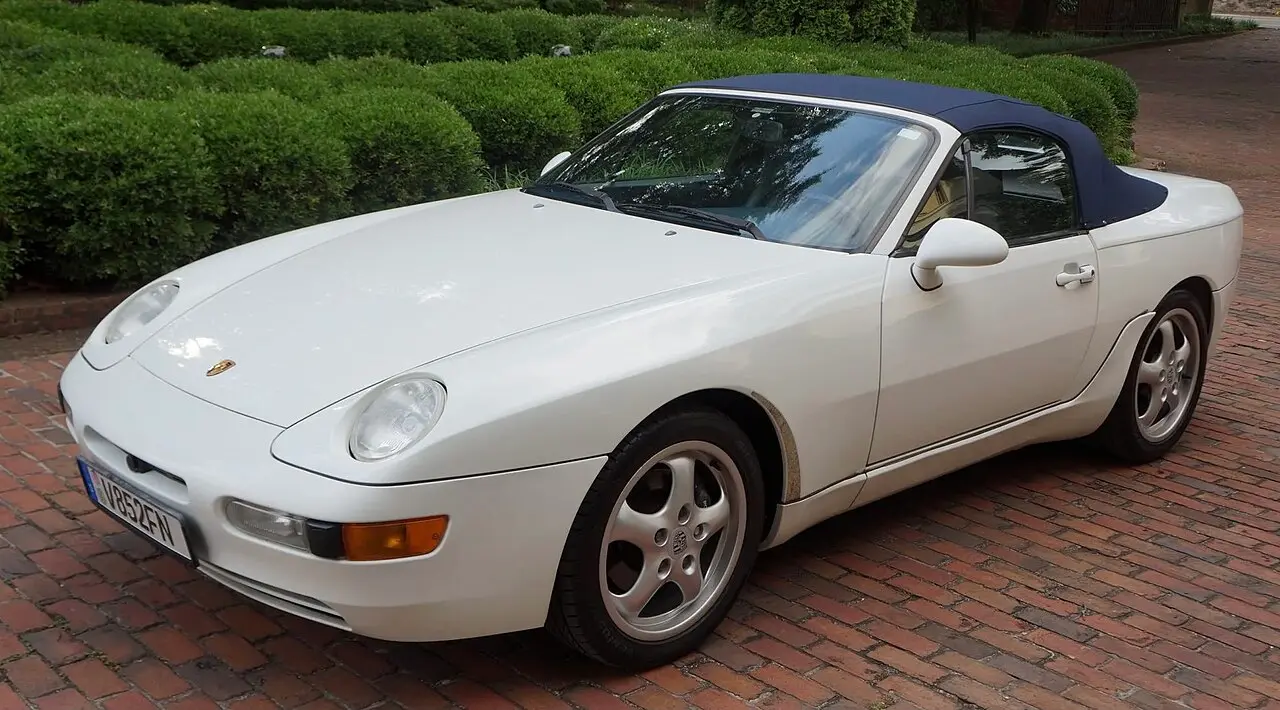
What is the Porsche 968?
The Porsche 968 is a front-engined sports car and the final model in Porsche’s four-cylinder transaxle line. It followed the 944 and came as a coupe or cabriolet. The engine sits at the front and the gearbox at the rear, a layout Porsche used across its transaxle models.
The 968 updated the 944’s styling, including its front end, while retaining much of the earlier car’s underlying body structure. Its engine technology also moved the line forward, giving the 968 a distinct place in Porsche’s model history.
Generation, engines and power
The 968 generation ran from 1992 to 1995. Its 3.0-litre petrol engine had four-valve cylinder heads, balance shafts and VarioCam variable intake valve timing. Porsche offered a six-speed manual gearbox and an automatic transmission.
As the successor to the 944, the 968 refined the front-engine, rear-gearbox concept. Its coupe and cabriolet body styles offered a choice of fixed roof or open-air driving.
How economical is the Porsche 968?
In the United States, the EPA lists three petrol versions for 1992–1995, with a best combined rating of 18 MPG and a low consumption figure of 13.1 L/100 km. For Canada, NRCan lists two petrol versions for 1995, with consumption as low as 13 L/100 km on the five-cycle test. EPA, Canadian five-cycle and European WLTP or NEDC tests use different procedures, so their results are not directly comparable.
Where was the Porsche 968 sold?
The EPA figures cover the United States for 1992–1995, while Canadian five-cycle figures cover 1995. The 968 continued Porsche’s front-engined sports-car line as a coupe and cabriolet.
Questions and answers
What body styles did the Porsche 968 have?
It was offered as a coupe and a cabriolet.
What engine was fitted to the 968?
It had a 3.0-litre petrol engine.
What is the Porsche 968’s best combined US EPA rating?
The best combined figure is 18 MPG, alongside a low consumption figure of 13.1 L/100 km.
How does the Canadian fuel figure compare?
NRCan lists 13 L/100 km on its five-cycle test for 1995. That procedure differs from the US EPA test.