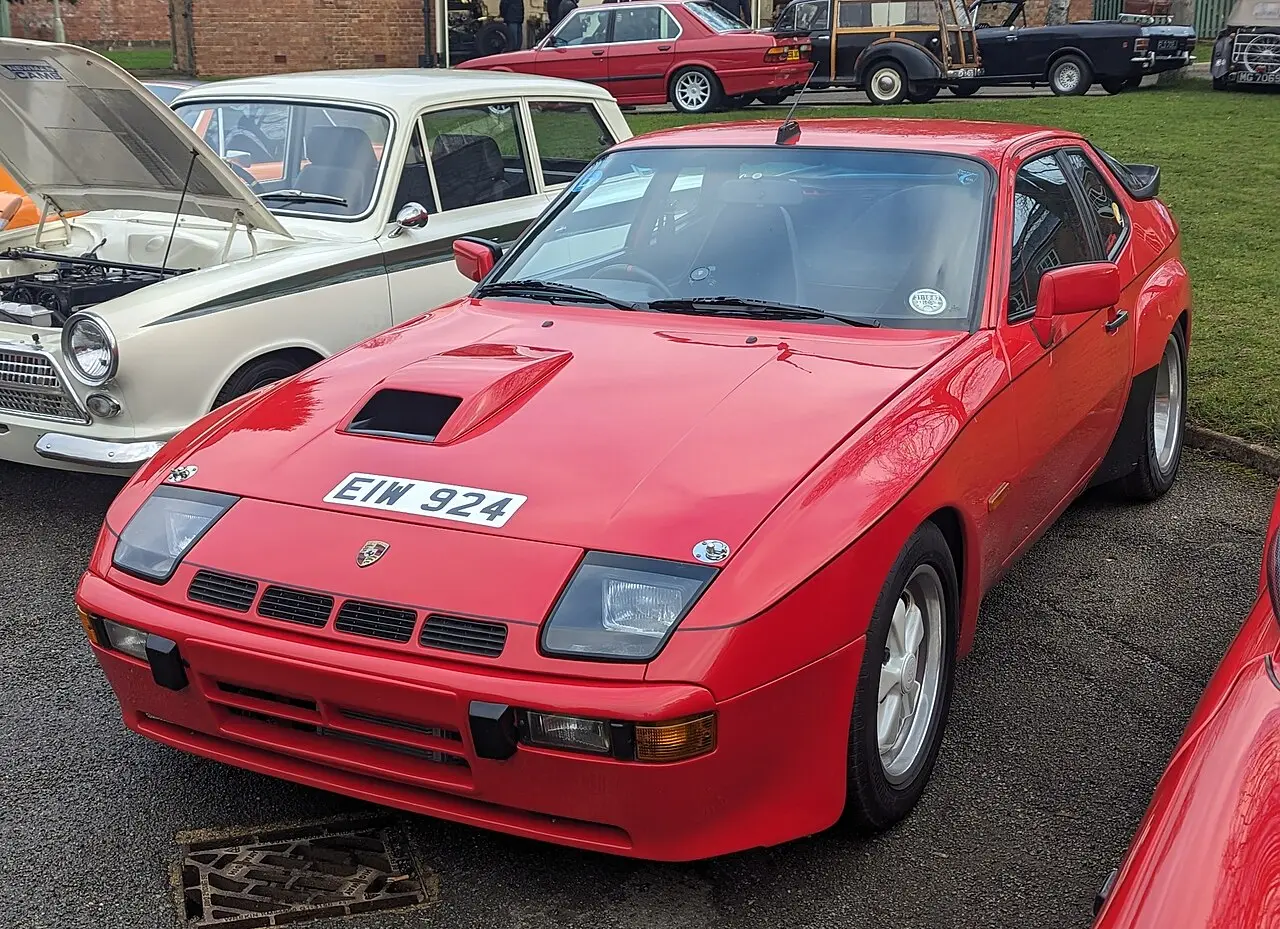
What is the Porsche 924?
The Porsche 924 is a front-engined sports coupe with a large glass rear hatch and a 2+2 cabin. It brought Porsche a more everyday-minded sports car alongside its established rear-engined models. Its engine sits at the front and its gearbox at the rear, linked by a rigid shaft in a layout called a transaxle. The clean shape and pop-up headlights give it a distinctive look.
The 924 began as a project for Volkswagen. When Volkswagen withdrew, Porsche took the design forward as its own model. It became the first in Porsche’s family of front-engined transaxle cars, adding a new kind of sports car to the range.
Generations, engines and power
The final US-market chapter was the 924S, produced from 1986 to 1988. The US EPA lists two petrol versions for 1987–1988, both with a 2.5-litre engine.
The 924S kept the original formula of a water-cooled engine at the front and gearbox at the rear. It retained the coupe’s straightforward shape while carrying forward the transaxle idea.
How economical is the Porsche 924?
For the United States, the EPA gives the 924 a best combined rating of 21 MPG for 1987–1988, alongside a low consumption figure of 11.2 L/100 km. EPA, European WLTP and NEDC tests use different procedures, so their results are not directly comparable.
Where was the Porsche 924 sold?
The EPA figures here are for the United States and cover 1987–1988. The 924’s wider story began earlier, when Porsche introduced it as a new front-engined sports car.
Questions and answers
What kind of car is the Porsche 924?
It is a front-engined sports coupe with a rear-mounted gearbox and a 2+2 cabin.
What engine did the US-market 924S have?
The US EPA lists a 2.5-litre petrol engine.
What is the 924’s official US fuel-economy figure?
The best combined EPA rating is 21 MPG, alongside a low consumption figure of 11.2 L/100 km.