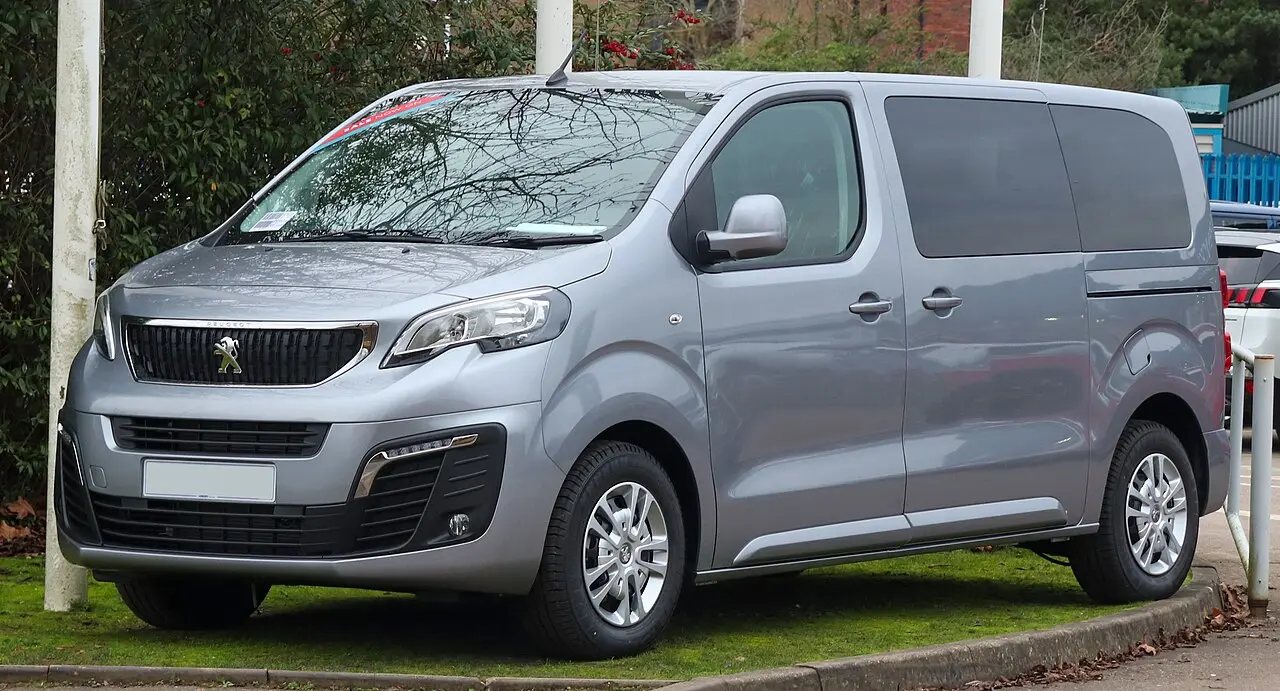
The official data lists 120 versions of the Peugeot Traveller (2016–2026), in the European Union, the United Kingdom, and France. Each market publishes its own figures, measured on its own test procedure.
At a glance
Years in the data
2016–2026
Markets
European Union, United Kingdom, France
Engines
1.5 L to 2.0 L
Power
57 kW (77 PS) to 165 kW (224 PS)
Fuels
Electric, Diesel
Lowest consumption (United Kingdom)
4.8 L/100 km (NEDC)
Lowest consumption (European Union)
6.3 L/100 km (WLTP)
New registrations in the EU
111,298
What is the Peugeot Traveller?
The Peugeot Traveller is a large passenger van designed for family journeys, group travel and shuttle work. Its tall cabin and sliding doors make it easy to get in and out, while its generous passenger space gives it a different feel from a conventional car. It sits in Peugeot’s passenger range alongside the brand’s cars and SUVs.
Introduced in 2016, the Traveller uses a passenger-car version of the modular EMP2 platform. Peugeot also offers the related Expert as a commercial van, while the Traveller focuses on carrying people.
Generations and engines
The first generation ran from 2016 to 2023. A facelifted version followed in 2024, with updated styling and a refreshed interior, while the Traveller kept its role as a passenger van.
Across the European Union, the range spans 1.5 to 2.2 litres and includes diesel, electric and other fuel types. Power runs from 57 kW (77 PS) to 195 kW (265 PS). UK listings cover 1.5 to 2.0 litre engines, with diesel and electric versions producing 88 kW (120 PS) to 136 kW (185 PS). France’s 2026 listings are electric, with 57 kW (77 PS).
Fuel consumption and registrations
The lowest listed consumption is 6.3 L/100 km for EU versions on the WLTP test. The UK figure is 4.8 L/100 km on the NEDC test. WLTP and NEDC use different procedures, so figures from these markets are not directly comparable.
The Traveller appears in EU registration figures from 2016 to 2025 and in UK VCA listings from 2017 to 2026. French ADEME listings cover electric versions in 2026. EU registrations total 111,298 over the period.
Questions and answers
When did the Peugeot Traveller first arrive?
The first generation began in 2016; a facelifted version followed in 2024.
Is the Traveller electric?
Yes. Electric versions appear in EU and UK listings, and France’s 2026 listings are electric.
What is the Traveller’s lowest listed fuel consumption?
The lowest listed figure is 6.3 L/100 km on the EU WLTP test. The UK listing gives 4.8 L/100 km on NEDC, a different procedure.
Model codes: K0, EMP2 · Sold in: European Union, United Kingdom, and France · References: peugeot.co.uk, adac.de
Show all 105 versions
Traveller First generation (facelift) (since 2024)
Model codes: K0, EMP2 · Sold in: European Union, United Kingdom, and France · References: adac.de, media.stellantis.com
European Union 7 versions
New cars registered in the EU (plus Norway and Iceland), from the European Environment Agency. Figures on the NEDC procedure until 2020 and on WLTP from 2021; versions are grouped by engine and power, with their number of registrations.
Years and version
Engine
Power
Fuel
Consumption (combined)
CO₂
Electric range
EU registrations
2025
2.0 L
130 kW (177 PS)
Diesel
7.4 L/100 km WLTP
193 g/km
–
5,005
2025
Electric motor
100 kW (136 PS)
Electric
24.5 kWh/100 km WLTP
0 g/km
316 km
565
2025
2.2 L
132 kW (179 PS)
Diesel
7.0 L/100 km WLTP
183 g/km
–
182
2025
Electric motor
62 kW (84 PS)
Electric
24.4 kWh/100 km WLTP
0 g/km
339 km
42
2024
2.0 L
130 kW (177 PS)
Diesel
7.3 L/100 km WLTP
192 g/km
–
1,473
2024
Electric motor
100 kW (136 PS)
Electric
25.8 kWh/100 km WLTP
0 g/km
313 km
453
2024
2.0 L
13 kW (18 PS)
Diesel
–
190 g/km
–
15
United Kingdom 6 versions
New cars on sale in the UK, from the Vehicle Certification Agency. NEDC figures until 2018 and WLTP figures after; years are the editions a version appeared in.
Years and version
Engine
Power
Fuel
Gearbox
Consumption (combined)
CO₂
Electric range
2025–2026Electric 50kWh
Electric motor
100 kW (136 PS)
Electric
Automatic
23.0 kWh/100 km WLTP
0 g/km
238 km
2025–2026Electric 50kWh
Electric motor
100 kW (136 PS)
Electric
Automatic
28.2 kWh/100 km WLTP
0 g/km
196 km
2026Electric 75kWh (VL)
Electric motor
100 kW (136 PS)
Electric
Automatic
22.4 kWh/100 km WLTP
0 g/km
370 km
2026Electric 75kWh (VH)
Electric motor
100 kW (136 PS)
Electric
Automatic
26.4 kWh/100 km WLTP
0 g/km
313 km
2024Electric 50kWh (VH)
Electric motor
136 kW (185 PS)
Electric
Automatic
28.2 kWh/100 km WLTP
0 g/km
196 km
2024Electric 50kWh (VL)
Electric motor
136 kW (185 PS)
Electric
Automatic
23.0 kWh/100 km WLTP
0 g/km
238 km
France 2 versions
New cars on sale in France, from ADEME Car Labelling. NEDC figures until 2015, WLTP figures in the current catalogue.
Years and version
Engine
Power
Fuel
Gearbox
Consumption (combined)
Electric range
2026e-TRAVELLER Long (57Kw)
Electric motor
57 kW (77 PS)
Electric
Continuously variable (CVT)
24.7 kWh/100 km WLTP
339 km
2026e-TRAVELLER Standard (57Kw)
Electric motor
57 kW (77 PS)
Electric
Continuously variable (CVT)
24.7 kWh/100 km WLTP
339 km
Official figures are measured on standard test procedures and differ between markets. Your consumption depends on how, where and in what conditions you drive.