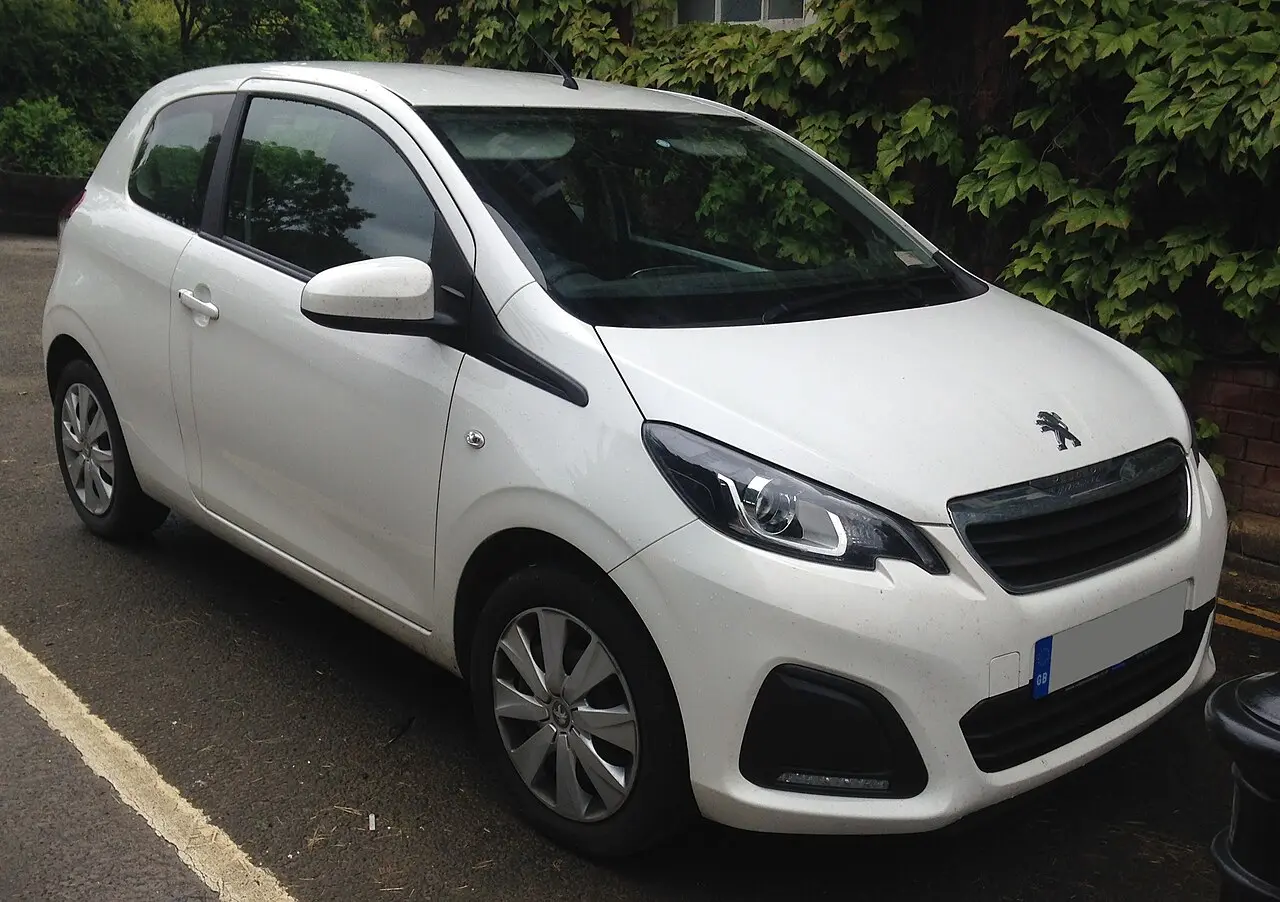
The official data lists 41 versions of the Peugeot 108 (2014–2023), in the European Union, the United Kingdom, and France. Each market publishes its own figures, measured on its own test procedure.
At a glance
Years in the data
2014–2023
Markets
European Union, United Kingdom, France
Engines
1.0 L to 1.2 L
Power
51 kW (69 PS) to 60 kW (82 PS)
Fuels
Petrol, Diesel
Lowest consumption (France)
3.8 L/100 km (NEDC)
Lowest consumption (United Kingdom)
3.8 L/100 km (NEDC)
Lowest consumption (European Union)
4.8 L/100 km (WLTP)
New registrations in the EU
807,616
What is the Peugeot 108?
The Peugeot 108 is a small city hatchback made for everyday urban driving. Peugeot also offered it with an openable fabric roof, bringing more light and air into the cabin. It sat at the small end of the brand’s range, with a compact shape suited to town trips.
Introduced as the 107’s successor, the 108 continued Peugeot’s shared small-car project with Citroën and Toyota. The models shared basic engineering but had distinct styling.
Generation and engines
The 108 had one generation, known as A9, spanning 2014–2021. It kept the 107’s city-car format while offering a more contemporary cabin and greater scope for personalisation.
EU figures span 1.0 L to 1.2 L engines and power from 51 kW (69 PS) to 60 kW (82 PS). UK figures list petrol engines in the same size range, producing 53 kW (72 PS).
Fuel consumption and markets
The lowest listed consumption is 4.8 L/100 km on WLTP in EU figures. UK and French figures give a low of 3.8 L/100 km on NEDC. WLTP and NEDC are different European test procedures, so their results are not directly comparable.
EU registrations cover 2014–2022 and total 807,616. UK figures cover 2014–2023, while French figures cover 2015.
Questions and answers
How many generations of Peugeot 108 were there?
One: generation A9, spanning 2014–2021.
What engines were available in the Peugeot 108?
EU figures span 1.0 L to 1.2 L engines and 51 kW (69 PS) to 60 kW (82 PS). UK figures list petrol versions at 53 kW (72 PS).
What is the Peugeot 108’s lowest listed fuel consumption?
The EU figure is 4.8 L/100 km on WLTP. UK and French NEDC figures give 3.8 L/100 km; the procedures differ.
Was the Peugeot 108 sold in the UK and France?
Yes. UK figures cover 2014–2023, and French figures cover 2015.
Model codes: A9 · Sold in: European Union, United Kingdom, and France · References: en.wikipedia.org
European Union 19 versions
New cars registered in the EU (plus Norway and Iceland), from the European Environment Agency. Figures on the NEDC procedure until 2020 and on WLTP from 2021; versions are grouped by engine and power, with their number of registrations.
Years and version
Engine
Power
Fuel
Consumption (combined)
CO₂
EU registrations
2021
1.0 L
53 kW (72 PS)
Petrol
4.8 L/100 km WLTP
110 g/km
63,232
2020
1.0 L
53 kW (72 PS)
Petrol
–
85 g/km
85,630
2019
1.0 L
53 kW (72 PS)
Petrol
–
89 g/km
101,038
2018–2019
1.2 L
60 kW (82 PS)
Petrol
–
99 g/km
18,356
2019
1.0 L
–
Petrol
–
93 g/km
7,262
2019
1.0 L
51 kW (69 PS)
Petrol
–
95 g/km
82
2018
1.0 L
53 kW (72 PS)
Petrol
–
92 g/km
57,843
2014–2018
1.2 L
–
Petrol
–
99 g/km
42,690
2018
1.0 L
51 kW (69 PS)
Petrol
–
94 g/km
32,190
2018
1.0 L
–
Petrol
–
93 g/km
7,112
2017
1.0 L
51 kW (69 PS)
Petrol
–
92 g/km
81,584
2017
1.2 L
60 kW (82 PS)
Petrol
–
99 g/km
21,422
2016
1.0 L
51 kW (69 PS)
Petrol
–
94 g/km
95,570
2016
1.2 L
60 kW (82 PS)
Petrol
–
99 g/km
19,274
2015
1.0 L
51 kW (69 PS)
Petrol
–
94 g/km
92,644
2015
1.2 L
60 kW (82 PS)
Petrol
–
99 g/km
23,058
2015
1.2 L
–
Diesel
–
99 g/km
18
2014
1.0 L
51 kW (69 PS)
Petrol
–
93 g/km
44,786
2014
1.2 L
60 kW (82 PS)
Petrol
–
99 g/km
10,552
United Kingdom 16 versions
New cars on sale in the UK, from the Vehicle Certification Agency. NEDC figures until 2018 and WLTP figures after; years are the editions a version appeared in.
Years and version
Engine
Power
Fuel
Gearbox
Consumption (combined)
CO₂
2020–20231.0L S&S 5-speed manual
1.0 L
53 kW (72 PS)
Petrol
5-speed manual
5.2 L/100 km WLTP
117 g/km
2020–20231.0L S&S 5-speed manual
1.0 L
53 kW (72 PS)
Petrol
5-speed manual
5.7 L/100 km WLTP
109 g/km
20191.0L 72
1.0 L
53 kW (72 PS)
Petrol
5-speed manual
4.9 L/100 km WLTP
–
20191.0L 72
1.0 L
53 kW (72 PS)
Petrol
5-speed manual
5.3 L/100 km WLTP
–
20191.0L 72 2-Tronic
1.0 L
53 kW (72 PS)
Petrol
5-speed automatic
5.1 L/100 km WLTP
–
20191.0L 72 2-Tronic
1.0 L
53 kW (72 PS)
Petrol
5-speed automatic
5.5 L/100 km WLTP
–
2015–20181.0i 68
1.0 L
–
Petrol
5-speed manual
4.1 L/100 km NEDC
95 g/km
20181.0i 72
1.0 L
–
Petrol
5-speed manual
4.1 L/100 km NEDC
93 g/km
20181.0i 72 2-Tronic
1.0 L
–
Petrol
5-speed automated manual
4.2 L/100 km NEDC
95 g/km
2015–2018PureTech VTi 1.2 82
1.2 L
–
Petrol
5-speed manual
4.3 L/100 km NEDC
99 g/km
2015–20171.0i 68 2-Tronic
1.0 L
–
Petrol
5-speed automated manual
4.2 L/100 km NEDC
97 g/km
20151.0i 68 Stop&Start · 1.0i 68 Stop-Start
1.0 L
–
Petrol
5-speed manual
3.8 L/100 km NEDC
88 g/km
20141.0i 68 Stop-Start
1.0 L
–
Petrol
Manual
3.8 L/100 km NEDC
88 g/km
20141.0i 68
1.0 L
–
Petrol
Manual
4.1 L/100 km NEDC
95 g/km
20141.0i 68 2-Tronic
1.0 L
–
Petrol
Automatic
4.2 L/100 km NEDC
97 g/km
2014VTi 1.2 82
1.2 L
–
Petrol
Manual
4.3 L/100 km NEDC
99 g/km
France 5 versions
New cars on sale in France, from ADEME Car Labelling. NEDC figures until 2015, WLTP figures in the current catalogue.
2015108 3P 1.2l VTi BVM5 · 108 5P 1.2l Vti BVM5 · 108 3P découvrable 1.2l Vti BVM5 and 1 more trim
–
60 kW (82 PS)
Petrol
5-speed manual
4.3 L/100 km NEDC
99 g/km
Versions outside these generations
European Union 1 version
New cars registered in the EU (plus Norway and Iceland), from the European Environment Agency. Figures on the NEDC procedure until 2020 and on WLTP from 2021; versions are grouped by engine and power, with their number of registrations.
Years and version
Engine
Power
Fuel
Consumption (combined)
CO₂
EU registrations
2022
1.0 L
53 kW (72 PS)
Petrol
4.8 L/100 km WLTP
111 g/km
3,273
Official figures are measured on standard test procedures and differ between markets. Your consumption depends on how, where and in what conditions you drive.