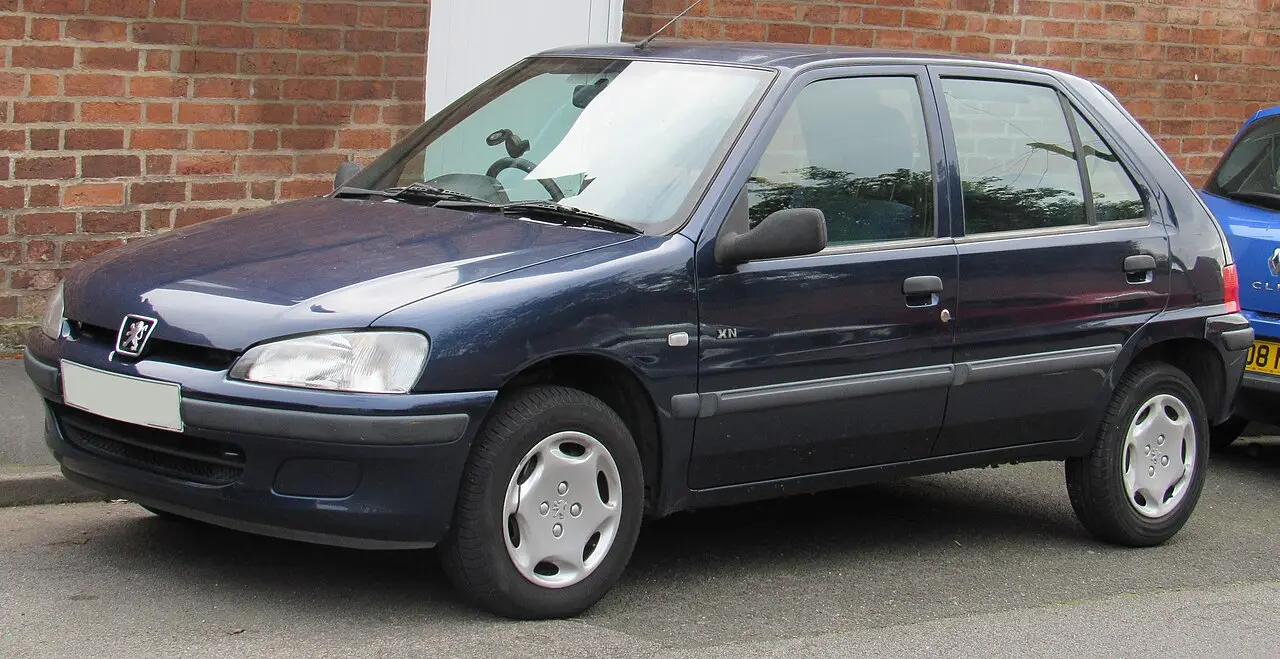
What is the Peugeot 106?
The Peugeot 106 is a small hatchback suited to everyday journeys around town and beyond. It brought a compact, practical option to the lower end of Peugeot’s passenger-car range. The model arrived in 1991 and remained in production until 2003.
Peugeot’s history began with tools and bicycles before the company moved into car making. The 106 carried that small-car tradition into the 1990s, with a straightforward hatchback design and a footprint that worked well in town.
What were the Peugeot 106 generations?
The later version, known as the 106 Phase II, ran from 1996 to 2003 and carries the code S2. It refreshed the styling while keeping the same compact hatchback character. The original 106 had arrived in 1991.
Engines, power and fuel consumption
UK VCA figures cover petrol and diesel engines from 1.1 L to 1.6 L, with power ranging from 43 kW (59 PS) to 90 kW (122 PS). The lowest listed consumption is 5.2 L/100 km on the NEDC test, an older European procedure.
EU registration figures show 12 petrol Peugeot 106s registered in 2014, with a 1.0 L engine.
Where was the Peugeot 106 sold?
The Peugeot 106 appears in UK VCA figures for 2000–2003 and in European Union (EEA) registration figures for 2014. The EU figures show 12 registrations in that year.
Questions and answers
What type of car is the Peugeot 106?
It is a small hatchback for everyday driving.
When was the Peugeot 106 Phase II made?
The Phase II ran from 1996 to 2003 and carries the code S2.
What engines were listed for the Peugeot 106 in the UK?
UK VCA figures list petrol and diesel engines from 1.1 L to 1.6 L.
What is the lowest listed fuel consumption?
The lowest UK figure is 5.2 L/100 km on the NEDC test.