Opel

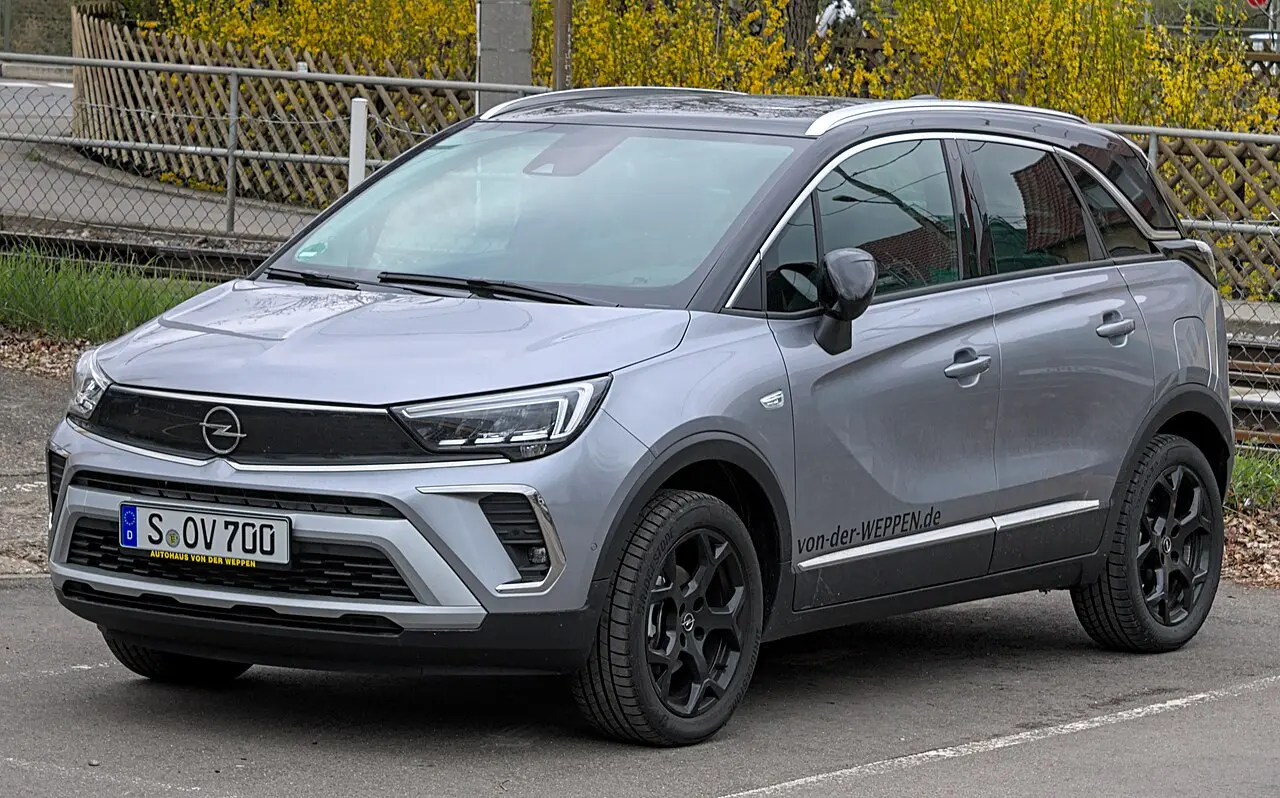
Opel Crossland

Opel Crossland
Photo: Alexander Migl / Wikimedia Commons · CC BY-SA 4.0

The official data lists 71 versions of the Opel Crossland (2017–2026), in the European Union and France. Each market publishes its own figures, measured on its own test procedure.

At a glance

Years in the data
2017–2026
Markets
European Union, France
Engines
1.2 L to 1.6 L
Power
60 kW (82 PS) to 122 kW (166 PS)
Fuels
Petrol, Diesel, Electric, LPG
Lowest consumption (France)
4.2 L/100 km (WLTP)
Lowest consumption (European Union)
4.4 L/100 km (WLTP)
New registrations in the EU
828,134

What is the Opel Crossland?

The Crossland is a compact crossover in Opel’s SUV range, with a raised seating position and a practical cabin. It took over the Meriva’s place in the range, shifting that family-car role from a compact MPV to a crossover.

The Crossland X arrived in 2017. After a facelift, Opel dropped the X from the name. EU registration figures cover 2017 to 2025, while the Crossland X generation is listed as running since 2017.

Engines and power

EU versions span engine sizes from 1.2 to 1.6 litres and power from 60 kW (82 PS) to 122 kW (166 PS). The listings include petrol and diesel, as well as electric, LPG and other fuel classifications. Among the leading EU registration entries are 1.2-litre petrol versions rated at 81 kW (110 PS), recorded in 2018, 2019 and 2020.

France’s ADEME listings cover petrol and diesel versions with engines from 1.2 to 1.5 litres and power from 81 kW (110 PS) to 96 kW (131 PS).

How economical is the Opel Crossland?

The lowest listed EU consumption is 4.4 L/100 km on WLTP. France’s ADEME figure is 4.2 L/100 km, also on WLTP. European figures may use WLTP or NEDC; the USA uses EPA testing, and Canada uses a five-cycle procedure, so results from different markets are not directly equivalent.

EU registration figures record 828,134 Crosslands from 2017 to 2025. The Crossland X generation is listed since 2017.

Questions and answers

When was the Opel Crossland X sold?

The listed Crossland X generation has run since 2017. After a facelift, Opel used the Crossland name.

What is the lowest listed fuel consumption for the Crossland?

The EU low is 4.4 L/100 km on WLTP; France’s ADEME low is 4.2 L/100 km on WLTP.

What power range does the Crossland have?

EU versions range from 60 kW (82 PS) to 122 kW (166 PS).

Crossland Crossland X (since 2017)

Opel Crossland Crossland X
Photo: Alexander Migl / Wikimedia Commons · CC BY-SA 4.0

References: en.wikipedia.org, opel-team-niedersachsen.de

European Union 69 versions

New cars registered in the EU (plus Norway and Iceland), from the European Environment Agency. Figures on the NEDC procedure until 2020 and on WLTP from 2021; versions are grouped by engine and power, with their number of registrations.

Years and versionEnginePowerFuelConsumption (combined)CO₂Electric rangeEU registrations
2024–20251.2 L96 kW (131 PS)Petrol6.3 L/100 km WLTP142 g/km–10,110
20251.2 L81 kW (110 PS)Petrol5.9 L/100 km WLTP132 g/km–403
20251.5 L81 kW (110 PS)Diesel4.8 L/100 km WLTP127 g/km–69
20241.2 L81 kW (110 PS)Petrol5.9 L/100 km WLTP132 g/km–18,166
20241.5 L81 kW (110 PS)Diesel4.9 L/100 km WLTP127 g/km–2,603
20231.2 L81 kW (110 PS)Petrol5.9 L/100 km WLTP132 g/km–20,990
20231.2 L96 kW (131 PS)Petrol6.3 L/100 km WLTP142 g/km–11,467
20231.5 L81 kW (110 PS)Diesel4.9 L/100 km WLTP127 g/km–5,421
2022–20231.5 L88 kW (120 PS)Diesel5.0 L/100 km WLTP131 g/km–2,251
20231.2 L61 kW (83 PS)Petrol5.9 L/100 km WLTP134 g/km–516
20231.2 L67 kW (91 PS)Petrol5.9 L/100 km WLTP133 g/km–60
20231.2 L110 kW (150 PS)Petrol5.9 L/100 km WLTP133 g/km–20
20231.2 L84 kW (114 PS)Petrol5.9 L/100 km WLTP134 g/km–11
20221.2 L96 kW (131 PS)Petrol6.0 L/100 km WLTP136 g/km–17,875
20221.2 L81 kW (110 PS)Petrol5.7 L/100 km WLTP132 g/km–16,773
20221.2 L61 kW (83 PS)Petrol5.9 L/100 km WLTP134 g/km–8,273
20221.5 L81 kW (110 PS)Diesel4.6 L/100 km WLTP121 g/km–5,999
20211.2 L81 kW (110 PS)Petrol5.6 L/100 km WLTP131 g/km–42,900
20211.2 L96 kW (131 PS)Petrol5.9 L/100 km WLTP135 g/km–39,960
20211.2 L61 kW (83 PS)Petrol5.5 L/100 km WLTP134 g/km–23,124
20211.5 L81 kW (110 PS)Diesel4.4 L/100 km WLTP121 g/km–13,652
20211.5 L88 kW (120 PS)Diesel4.9 L/100 km WLTP131 g/km–5,450
20211.5 L75 kW (102 PS)Diesel4.7 L/100 km WLTP125 g/km–785
20211.2 L–Diesel4.8 L/100 km WLTP125 g/km–96
2021Electric motor–Electric17.0 kWh/100 km WLTP0 g/km329 km12
20201.2 L81 kW (110 PS)Petrol–109 g/km–48,728
20201.2 L96 kW (131 PS)Petrol–111 g/km–45,140
20201.2 L61 kW (83 PS)Petrol–106 g/km–26,658
20201.5 L75 kW (102 PS)Diesel–105 g/km–19,594
20201.5 L88 kW (120 PS)Diesel–103 g/km–6,840
20201.5 L81 kW (110 PS)Diesel–93 g/km–1,378
20191.2 L81 kW (110 PS)Petrol–115 g/km–94,236
20191.2 L96 kW (131 PS)Petrol–115 g/km–36,522
20191.2 L61 kW (83 PS)Petrol–115 g/km–32,966
20191.5 L75 kW (102 PS)Diesel–106 g/km–24,696
20191.5 L88 kW (120 PS)Diesel–104 g/km–9,162
20191.2 L60 kW (82 PS)LPG–111 g/km–174
20191.6 L73 kW (99 PS)Diesel–95 g/km–164
20191.2 L60 kW (82 PS)Petrol–116 g/km–150
20191.6 L88 kW (120 PS)Diesel–105 g/km–94
20191.2 L66 kW (90 PS)Petrol–117 g/km–22
20181.2 L81 kW (110 PS)Petrol–117 g/km–75,853
20181.2 L96 kW (131 PS)Petrol–116 g/km–26,942
20181.2 L60 kW (82 PS)Petrol–116 g/km–18,376
20181.6 L73 kW (99 PS)Diesel–96 g/km–16,146
20181.2 L61 kW (83 PS)Petrol–117 g/km–6,594
20181.6 L88 kW (120 PS)Diesel–105 g/km–6,393
20181.2 L60 kW (82 PS)LPG–121 g/km–6,188
20181.5 L75 kW (102 PS)Diesel–105 g/km–5,458
20181.5 L88 kW (120 PS)Diesel–106 g/km–878
20181.6 L85 kW (116 PS)Diesel–105 g/km–378
20171.2 L81 kW (110 PS)Petrol–114 g/km–29,518
20171.2 L96 kW (131 PS)Petrol–116 g/km–9,794
20171.2 L60 kW (82 PS)Petrol–115 g/km–9,574
20171.6 L88 kW (120 PS)Diesel–105 g/km–6,486
20171.6 L73 kW (99 PS)Other fuel–94 g/km–6,348
20171.6 L73 kW (99 PS)Diesel–94 g/km–3,772
20171.2 L60 kW (82 PS)Other fuel–117 g/km–2,400
20171.2 L81 kW (110 PS)Other fuel–115 g/km–1,456
20171.6 L88 kW (120 PS)Other fuel–105 g/km–1,064
20171.2 L122 kW (166 PS)Petrol–111 g/km–414
20171.2 L144 kW (196 PS)Petrol–116 g/km–146
20171.6 L85 kW (116 PS)Diesel–105 g/km–130
20171.2 L90 kW (122 PS)Diesel–116 g/km–116
20171.2 L60 kW (82 PS)LPG–112 g/km–90
20171.2 L96 kW (131 PS)Other fuel–116 g/km–68
20171.2 L90 kW (122 PS)LPG–123 g/km–20
20171.2 L90 kW (122 PS)Petrol–116 g/km–12
20171.6 L110 kW (150 PS)Diesel–102 g/km–10

France 2 versions

New cars on sale in France, from ADEME Car Labelling. NEDC figures until 2015, WLTP figures in the current catalogue.

Years and versionEnginePowerFuelGearboxConsumption (combined)CO₂
2026CROSSLAND X (130ch)1.2 L96 kW (131 PS)Petrol6-speed manual5.6 L/100 km WLTP126 g/km
2026CROSSLAND X (110ch)1.5 L81 kW (110 PS)Diesel6-speed manual4.2 L/100 km WLTP110 g/km

Official figures are measured on standard test procedures and differ between markets. Your consumption depends on how, where and in what conditions you drive.