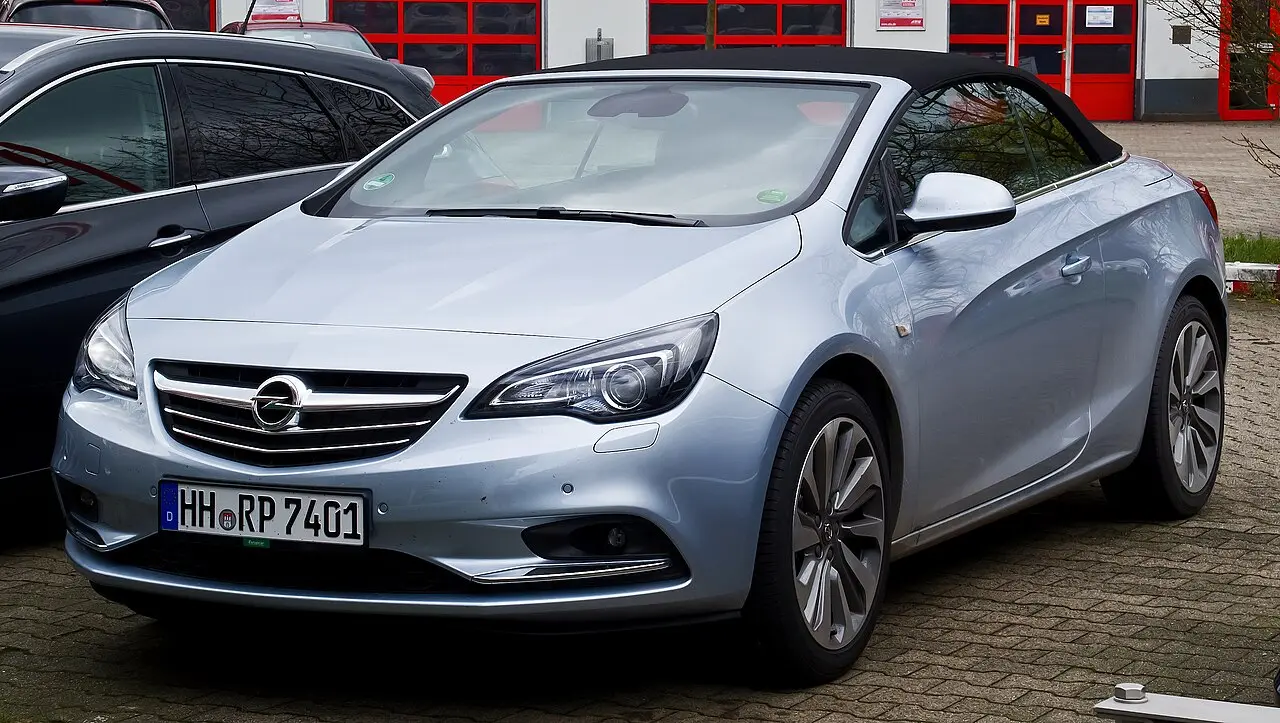
What is the Opel Cascada?
The Opel Cascada is a four-seat convertible with a fabric roof. Its open cabin suits relaxed drives, while the roof closes to make it a conventional enclosed car. Opel positioned it as a mid-size convertible, with a longer, flowing shape in place of the compact proportions of its earlier Kadett and Astra convertibles.
Sold in Europe from 2013 to 2019, the Cascada brought together a soft-top layout and sculpted Opel styling. Its single generation carried the model through its time in the range.
Generation and design
The Cascada had one generation, designated W13, running from 2013 to 2019. Its identity centred on a four-seat cabin and fabric roof, which opens the car to the air and closes to shelter its occupants.
Opel’s design paired the soft top with a flowing body shape. With the roof raised or lowered, the Cascada kept the character of a conventional four-seat car.
Engines and power
EU versions from 2013–2019 have engines from 1.4 L to 2.0 L, with power from 88 kW (120 PS) to 147 kW (200 PS). Listed fuels include petrol, diesel and other. Among the most registered configurations were the 1.4 L petrol with 103 kW (140 PS) and the 1.6 L petrol with 125 kW (170 PS).
France’s ADEME figures cover 2013–2015. They list petrol and diesel versions producing 103 kW (140 PS) to 147 kW (200 PS). The lowest listed French consumption is 5.2 L/100 km on NEDC.
Where was the Cascada sold?
Official EU registration figures cover 2013–2019 and total 46,066 registrations. France’s ADEME figures cover 2013–2015. The French consumption figure is on NEDC, a European test procedure.
Questions and answers
What body style is the Opel Cascada?
It is a four-seat convertible with a fabric roof.
Did the Cascada have multiple generations?
The Cascada is a single generation, W13, from 2013 to 2019.
What engines and power are listed for the Cascada?
EU versions range from 1.4 L to 2.0 L and from 88 kW (120 PS) to 147 kW (200 PS).
What is the lowest listed French fuel consumption?
The lowest listed French figure is 5.2 L/100 km on the NEDC test.