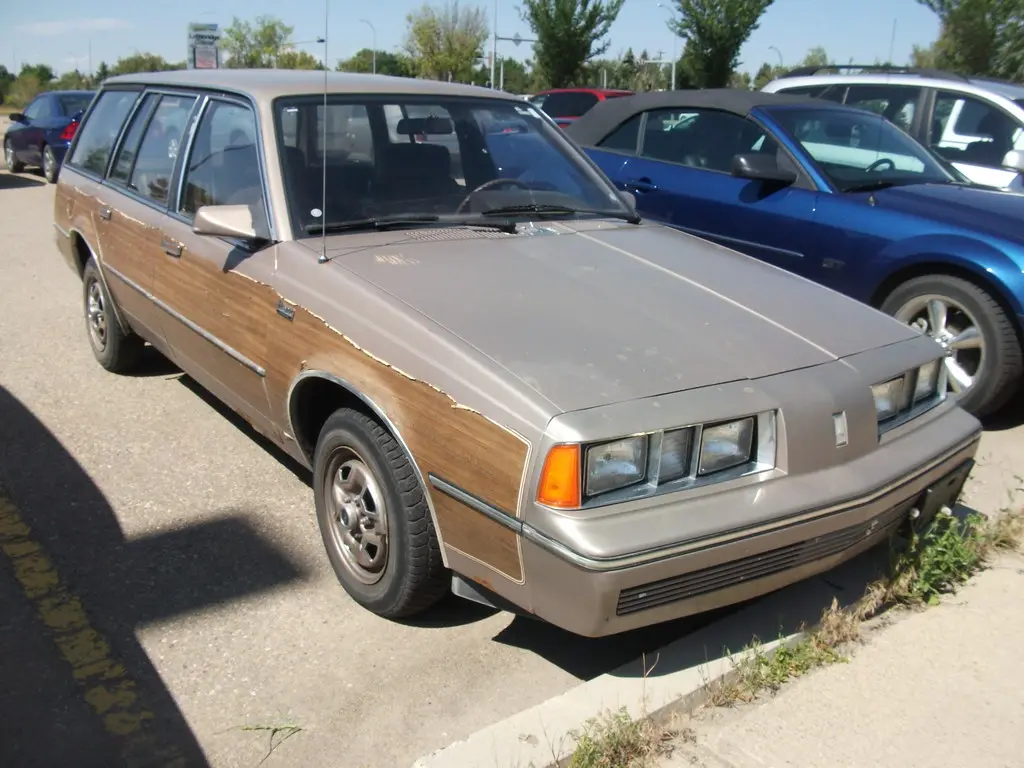
Oldsmobile

Oldsmobile Firenza Cruiser

Oldsmobile Firenza Cruiser
Photo: dave_7 / Wikimedia Commons · CC BY 2.0

The official data lists 28 versions of the Oldsmobile Firenza Cruiser (1984–1988), in the United States. Each market publishes its own figures, measured on its own test procedure.

At a glance

Years in the data
1984–1988
Markets
United States
Engines
1.8 L to 2.8 L
Fuels
Petrol
Lowest consumption (United States)
8.7 L/100 km (EPA)

What is the Oldsmobile Firenza Cruiser?

The Firenza Cruiser was the station wagon in Oldsmobile’s compact Firenza range. Its long roof and cargo area suited everyday trips and carrying luggage, while the wider Firenza family also included other body styles.

The Firenza used GM’s J-body platform, shared across several divisions. Oldsmobile gave it distinctive exterior details, and used the Cruiser name for the wagon.

Generation and engines

The Firenza’s first generation ran from 1982 to 1988 on the J-body platform. The Cruiser wagon joined the range during that run, giving the compact Firenza a more cargo-focused body style.

The US EPA listings span petrol engines from 1.8 L to 2.8 L, including four-cylinder and V6 choices. The Cruiser’s role remained that of a compact wagon for daily travel and carrying belongings.

Fuel consumption and where it was sold

In the United States, the Firenza Cruiser was listed from 1984 to 1988. Its best combined EPA rating is 27 MPG, and its lowest listed consumption is 8.7 L/100 km. EPA testing differs from Europe’s WLTP and NEDC procedures and Canada’s 5-cycle test.

The US EPA listings include 28 versions, all with petrol engines.

Questions and answers

What kind of car was the Firenza Cruiser?

It was the station-wagon version of Oldsmobile’s compact Firenza.

What years was the Firenza generation sold?

The first generation ran from 1982 to 1988. The Firenza Cruiser was listed in the United States from 1984 to 1988.

What engines did the Cruiser have?

The US EPA listings span petrol engines from 1.8 L to 2.8 L.

What is its best official fuel economy?

Its best combined EPA rating is 27 MPG, and its lowest listed consumption is 8.7 L/100 km.

Firenza Cruiser first generation (1982–1988)

Model codes: J-body · References: en.wikipedia.org

United States 28 versions

Model years sold in the USA, from the EPA and the Department of Energy (fueleconomy.gov). MPG on the EPA test; litres per 100 km = 235.215 ÷ MPG.

Years and versionEngineFuelGearboxDriveConsumption (combined)CO₂
1987–1988(122) (FFS) · (121) (FFS), CLKUP2.0 LPetrol3-speed automaticFront-wheel drive25 MPG (9.4 L/100 km) EPA221 g/km
1988(121) (FFS), SIL2.0 LPetrol5-speed manualFront-wheel drive26 MPG (9.0 L/100 km) EPA212 g/km
1988(FFS), CLKUP2.0 LPetrol3-speed automaticFront-wheel drive25 MPG (9.4 L/100 km) EPA221 g/km
1988(FFS), SIL2.0 LPetrol5-speed manualFront-wheel drive27 MPG (8.7 L/100 km) EPA205 g/km
1987(FFS)2.0 LPetrol3-speed automaticFront-wheel drive24 MPG (9.8 L/100 km) EPA230 g/km
1987(FFS), SIL2.0 LPetrol4-speed manualFront-wheel drive25 MPG (9.4 L/100 km) EPA221 g/km
1987(122) (FFS), SIL2.0 LPetrol5-speed manualFront-wheel drive26 MPG (9.0 L/100 km) EPA212 g/km
1986(FFS)1.8 LPetrol3-speed automaticFront-wheel drive24 MPG (9.8 L/100 km) EPA230 g/km
1986(FFS), SIL1.8 LPetrol5-speed manualFront-wheel drive27 MPG (8.7 L/100 km) EPA205 g/km
1985–1986(FFS) CA model, SIL · (FFS), SIL2.0 LPetrol4-speed manualFront-wheel drive25 MPG (9.4 L/100 km) EPA221 g/km
1986(FFS)2.0 LPetrol3-speed automaticFront-wheel drive22 MPG (10.7 L/100 km) EPA251 g/km
1986(FFS)2.8 LPetrol3-speed automaticFront-wheel drive19 MPG (12.4 L/100 km) EPA291 g/km
1986(FFS)2.8 LPetrol4-speed manualFront-wheel drive19 MPG (12.4 L/100 km) EPA291 g/km
1985(CAL)(FFS)1.8 LPetrol3-speed automaticFront-wheel drive24 MPG (9.8 L/100 km) EPA230 g/km
1985(CAL)(FFS), SIL1.8 LPetrol5-speed manualFront-wheel drive26 MPG (9.0 L/100 km) EPA212 g/km
1985(FFS) CA model2.0 LPetrol3-speed automaticFront-wheel drive22 MPG (10.7 L/100 km) EPA251 g/km
1985(FFS)2.0 LPetrol3-speed automaticFront-wheel drive24 MPG (9.8 L/100 km) EPA230 g/km
1985(FFS), SIL2.0 LPetrol4-speed manualFront-wheel drive26 MPG (9.0 L/100 km) EPA212 g/km
1985(FFS) CA model · (FFS)2.8 LPetrol3-speed automaticFront-wheel drive19 MPG (12.4 L/100 km) EPA291 g/km
1985(FFS) CA model2.8 LPetrol4-speed manualFront-wheel drive18 MPG (13.1 L/100 km) EPA307 g/km
1985(FFS)2.8 LPetrol4-speed manualFront-wheel drive18 MPG (13.1 L/100 km) EPA307 g/km
1984(CAL)(FFS) · (FFS) CA model1.8 LPetrol3-speed automatic–24 MPG (9.8 L/100 km) EPA230 g/km
1984(CAL)(FFS)1.8 LPetrol5-speed manual–26 MPG (9.0 L/100 km) EPA212 g/km
1984(FFS) CA model1.8 LPetrol5-speed manual–26 MPG (9.0 L/100 km) EPA212 g/km
1984(FFS) · (FFS) CA model2.0 LPetrol3-speed automatic–21 MPG (11.2 L/100 km) EPA263 g/km
1984(FFS)2.0 LPetrol4-speed manual–25 MPG (9.4 L/100 km) EPA221 g/km
1984(FFS) · (FFS) CA model2.0 LPetrol5-speed manual–25 MPG (9.4 L/100 km) EPA221 g/km
1984(FFS) CA model2.0 LPetrol4-speed manual–24 MPG (9.8 L/100 km) EPA230 g/km

Official figures are measured on standard test procedures and differ between markets. Your consumption depends on how, where and in what conditions you drive.