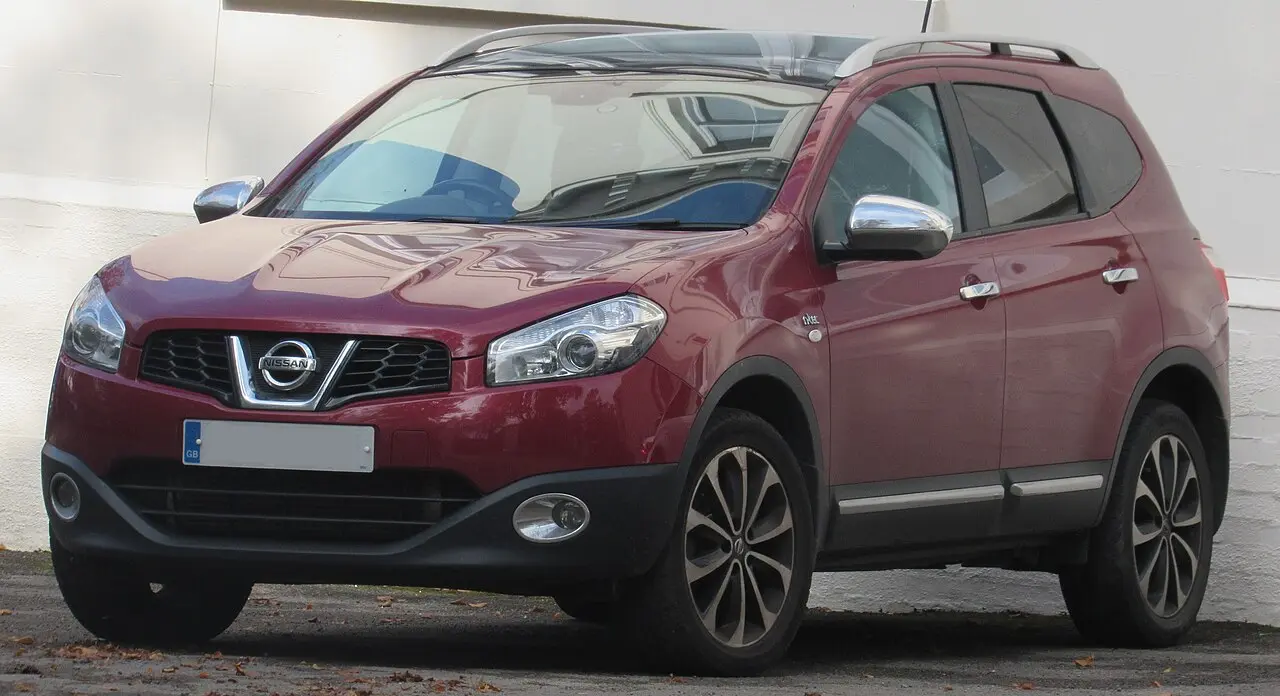
The official data lists 106 versions of the Nissan Qashqai+2 (2009–2020), in the European Union and the United Kingdom. Each market publishes its own figures, measured on its own test procedure.
At a glance
Years in the data
2009–2020
Markets
European Union, United Kingdom
Engines
1.2 L to 2.0 L
Power
76 kW (103 PS) to 110 kW (150 PS)
Fuels
Diesel, Petrol
Lowest consumption (United Kingdom)
3.8 L/100 km (NEDC)
New registrations in the EU
255,631
What is the Nissan Qashqai+2?
The Qashqai+2 is a longer version of the first-generation Qashqai, with a fold-flat third row for occasional extra passengers. The Qashqai helped establish Nissan’s European crossover range, pairing an upright shape and raised seating position with the everyday feel of a passenger car.
The extra length gave the Qashqai+2 more flexibility for family journeys. It offered an alternative to a conventional people carrier while keeping the Qashqai’s crossover layout.
Generations and engines
The Qashqai+2 belongs to the J10 generation, listed for 2009–2014. Nissan extended the original Qashqai with a longer body and a third row, keeping the same basic design and character.
EU registration figures span 1.5 L to 2.0 L engines, with power from 76 kW (103 PS) to 110 kW (150 PS). The recorded fuels include diesel, petrol and other. UK figures list 1.2 L to 2.0 L engines and diesel and petrol versions.
Fuel consumption and markets
The lowest UK VCA figure is 3.8 L/100 km on the NEDC test. NEDC was the European test procedure used for these figures; results can differ from those measured under other procedures. EU registrations cover 2010–2015 and total 255,631. UK VCA figures span 2009–2020.
The Qashqai+2 brought extra passenger space to Nissan’s European crossover range. Its longer body and fold-flat third row set it apart from the standard Qashqai.
Questions and answers
How many seats does the Qashqai+2 have?
It has a fold-flat third row for extra passengers.
What generation is the Qashqai+2?
It is part of the J10 generation, listed for 2009–2014.
What is its lowest official fuel-consumption figure?
The UK VCA figure is 3.8 L/100 km on the NEDC test.
New cars registered in the EU (plus Norway and Iceland), from the European Environment Agency. Figures on the NEDC procedure until 2020 and on WLTP from 2021; versions are grouped by engine and power, with their number of registrations.
Years and version
Engine
Power
Fuel
CO₂
EU registrations
2014
1.6 L
96 kW (131 PS)
Diesel
129 g/km
6,830
2014
1.5 L
81 kW (110 PS)
Diesel
135 g/km
3,638
2014
1.6 L
86 kW (117 PS)
Petrol
151 g/km
968
2014
2.0 L
104 kW (141 PS)
Petrol
188 g/km
598
2014
2.0 L
110 kW (150 PS)
Diesel
180 g/km
270
2013
1.6 L
96 kW (131 PS)
Diesel
130 g/km
30,790
2013
1.5 L
81 kW (110 PS)
Diesel
137 g/km
16,810
2013
1.6 L
86 kW (117 PS)
Petrol
152 g/km
7,330
2013
2.0 L
104 kW (141 PS)
Petrol
189 g/km
6,288
2013
2.0 L
110 kW (150 PS)
Diesel
181 g/km
3,748
2013
–
–
Diesel
153 g/km
14
2013
–
–
Petrol
154 g/km
10
2012
1.6 L
96 kW (131 PS)
Diesel
135 g/km
22,781
2012
1.5 L
81 kW (110 PS)
Diesel
139 g/km
14,867
2012
2.0 L
104 kW (141 PS)
Petrol
193 g/km
5,708
2012
1.6 L
86 kW (117 PS)
Petrol
152 g/km
5,648
2012
2.0 L
110 kW (150 PS)
Diesel
179 g/km
4,799
2012
–
–
Diesel
143 g/km
356
2012
–
–
Petrol
166 g/km
168
2011
2.0 L
110 kW (150 PS)
Diesel
173 g/km
18,518
2011
1.5 L
81 kW (110 PS)
Diesel
140 g/km
17,972
2011
2.0 L
104 kW (141 PS)
Petrol
194 g/km
9,784
2011
1.6 L
86 kW (117 PS)
Petrol
151 g/km
5,118
2011
1.6 L
96 kW (131 PS)
Diesel
140 g/km
2,524
2011
–
–
Petrol
167 g/km
642
2011
1.5 L
78 kW (106 PS)
Diesel
138 g/km
482
2011
1.6 L
84 kW (114 PS)
Petrol
159 g/km
282
2011
–
–
Diesel
161 g/km
142
2011
1.5 L
76 kW (103 PS)
Diesel
142 g/km
76
2010
2.0 L
–
Diesel
178 g/km
26,008
2010
1.5 L
–
Diesel
141 g/km
22,040
2010
2.0 L
–
Petrol
194 g/km
11,728
2010
1.6 L
–
Petrol
158 g/km
6,726
2010
–
–
Petrol
171 g/km
1,764
2010
–
–
Diesel
168 g/km
48
2010
–
–
Other fuel
171 g/km
42
United Kingdom 36 versions
New cars on sale in the UK, from the Vehicle Certification Agency. NEDC figures until 2018 and WLTP figures after; years are the editions a version appeared in.
Years and version
Engine
Fuel
Gearbox
Consumption (combined)
CO₂
20141.2 2WD
1.2 L
Petrol
Manual
5.6 L/100 km NEDC
129 g/km
2013–20141.5 dCi
1.5 L
Diesel
Manual
5.0 L/100 km NEDC
132 g/km
20141.5 dCi
1.5 L
Diesel
Manual
3.8 L/100 km NEDC
99 g/km
2013–20141.6
1.6 L
Petrol
Manual
6.6 L/100 km NEDC
154 g/km
2013–20141.6 dCi DPF Stop Start
1.6 L
Diesel
Manual
4.7 L/100 km NEDC
123 g/km
2013–20141.6 dCi DPF Stop Start 4WD
1.6 L
Diesel
Manual
5.3 L/100 km NEDC
139 g/km
2013–20141.6 Stop Start
1.6 L
Petrol
Manual
6.4 L/100 km NEDC
149 g/km
20141.6 Diesel 2WD manual
1.6 L
Diesel
Manual
4.4 L/100 km NEDC
115 g/km
20141.6 Diesel 2WD CVT
1.6 L
Diesel
Automatic
4.6 L/100 km NEDC
119 g/km
20141.6 Diesel 4WD
1.6 L
Diesel
Manual
4.9 L/100 km NEDC
129 g/km
2013–20142.0 4WD Auto
2.0 L
Diesel
Automatic
6.9 L/100 km NEDC
180 g/km
2013–20142.0 dCi 2WD
2.0 L
Diesel
Manual
6.0 L/100 km NEDC
159 g/km
2013–20142 · 2.0
2.0 L
Petrol
Manual
4.9 L/100 km NEDC
183 g/km
2013–20142.0 4WD CVT
2.0 L
Petrol
Automatic
8.1 L/100 km NEDC
187 g/km
20121.5 dCi
1.5 L
Diesel
6-speed manual
5.3 L/100 km NEDC
139 g/km
20121.6
1.6 L
Petrol
5-speed manual
6.6 L/100 km NEDC
154 g/km
20121.6 dCi DPF Stop Start
1.6 L
Diesel
6-speed manual
4.7 L/100 km NEDC
123 g/km
20121.6 dCi DPF Stop Start 4WD
1.6 L
Diesel
6-speed manual
5.3 L/100 km NEDC
139 g/km
20121.6 Stop Start
1.6 L
Petrol
5-speed manual
6.4 L/100 km NEDC
149 g/km
20122.0 dCi 2WD
2.0 L
Diesel
6-speed manual
6.0 L/100 km NEDC
159 g/km
20122.0 4WD CVT
2.0 L
Petrol
Continuously variable (CVT)
8.2 L/100 km NEDC
194 g/km
20101.5 dCi 4x2
1.5 L
Diesel
6-speed manual
5.2 L/100 km NEDC
138 g/km
20101.6 4x2
1.6 L
Petrol
5-speed manual
6.8 L/100 km NEDC
159 g/km
20102.0 dCi 4x2
2.0 L
Diesel
6-speed manual
6.5 L/100 km NEDC
169 g/km
20102.0 dCi 4X4
2.0 L
Diesel
6-speed manual
6.8 L/100 km NEDC
179 g/km
20102.0 dCi 4X4
2.0 L
Diesel
6-speed automatic
7.6 L/100 km NEDC
199 g/km
20102.0 4X4
2.0 L
Petrol
Continuously variable (CVT)
8.2 L/100 km NEDC
194 g/km
20102.0 4x2
2.0 L
Petrol
6-speed manual
8.0 L/100 km NEDC
189 g/km
20091.5 dCi 4x2
1.5 L
Diesel
6-speed manual
5.7 L/100 km NEDC
149 g/km
20091.6 4x2
1.6 L
Petrol
5-speed manual
7.0 L/100 km NEDC
165 g/km
20092.0 4x2
2.0 L
Diesel
6-speed manual
6.7 L/100 km NEDC
177 g/km
20092.0 4x4
2.0 L
Diesel
6-speed manual
7.0 L/100 km NEDC
188 g/km
20092.0 4x4
2.0 L
Diesel
6-speed automatic
7.9 L/100 km NEDC
209 g/km
20092.0 4x2
2.0 L
Petrol
6-speed manual
8.4 L/100 km NEDC
197 g/km
20092.0 4x4
2.0 L
Petrol
Continuously variable (CVT)
8.5 L/100 km NEDC
199 g/km
20092.0 4x4
2.0 L
Petrol
6-speed manual
8.6 L/100 km NEDC
205 g/km
Versions outside these generations
European Union 2 versions
New cars registered in the EU (plus Norway and Iceland), from the European Environment Agency. Figures on the NEDC procedure until 2020 and on WLTP from 2021; versions are grouped by engine and power, with their number of registrations.
Years and version
Engine
Power
Fuel
CO₂
EU registrations
2015
1.5 L
81 kW (110 PS)
Diesel
132 g/km
60
2015
1.6 L
96 kW (131 PS)
Diesel
128 g/km
54
United Kingdom 32 versions
New cars on sale in the UK, from the Vehicle Certification Agency. NEDC figures until 2018 and WLTP figures after; years are the editions a version appeared in.
Official figures are measured on standard test procedures and differ between markets. Your consumption depends on how, where and in what conditions you drive.