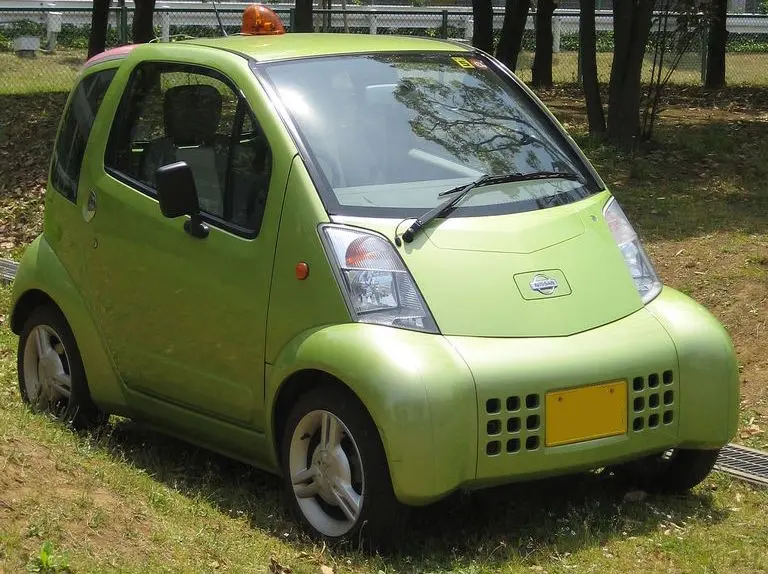
What is the Nissan Hypermini?
The Nissan Hypermini is a compact, two-seat electric city car. Its small size and tight turning circle were designed to make it easy to manoeuvre through urban streets. Nissan first showed it at the Tokyo Motor Show, then released the production model in 2000.
Nissan also explored shared use: the Hypermini had an IC-card keyless entry system, and the company took part in car-sharing trials in Japan.
Generations, engines and power
The Hypermini was a single design, with no separate generations listed. It was powered by an electric motor and lithium-ion battery, with no petrol or diesel engine. Nissan describes the motor as a neodymium-magnet synchronous type.
The IC-card keyless entry system suited the car’s role in shared-use trials, allowing access without a conventional key.
How economical is the Nissan Hypermini?
The Hypermini runs on electricity, so petrol or diesel consumption figures do not apply. The EPA listing includes one electric version for 2001, but gives no consumption or CO₂ figure. Test procedures differ between regions: Europe uses WLTP or NEDC, the USA uses EPA testing, and Canada uses a five-cycle test.
Where was the Nissan Hypermini sold?
The US EPA listing includes the Hypermini for 2001. Nissan released the production car in Japan, where it was also used in car-sharing trials.
Questions and answers
Was the Nissan Hypermini electric?
Yes. It was a battery-electric two-seat city car with a lithium-ion battery and electric motor.
How many Hypermini versions are listed for the United States?
One electric version is listed for the United States in 2001.
Did the Hypermini have different generations?
It was a single design.
Where was the Hypermini used?
Nissan released it in Japan and used it in car-sharing trials there. The US EPA listing includes it for 2001.