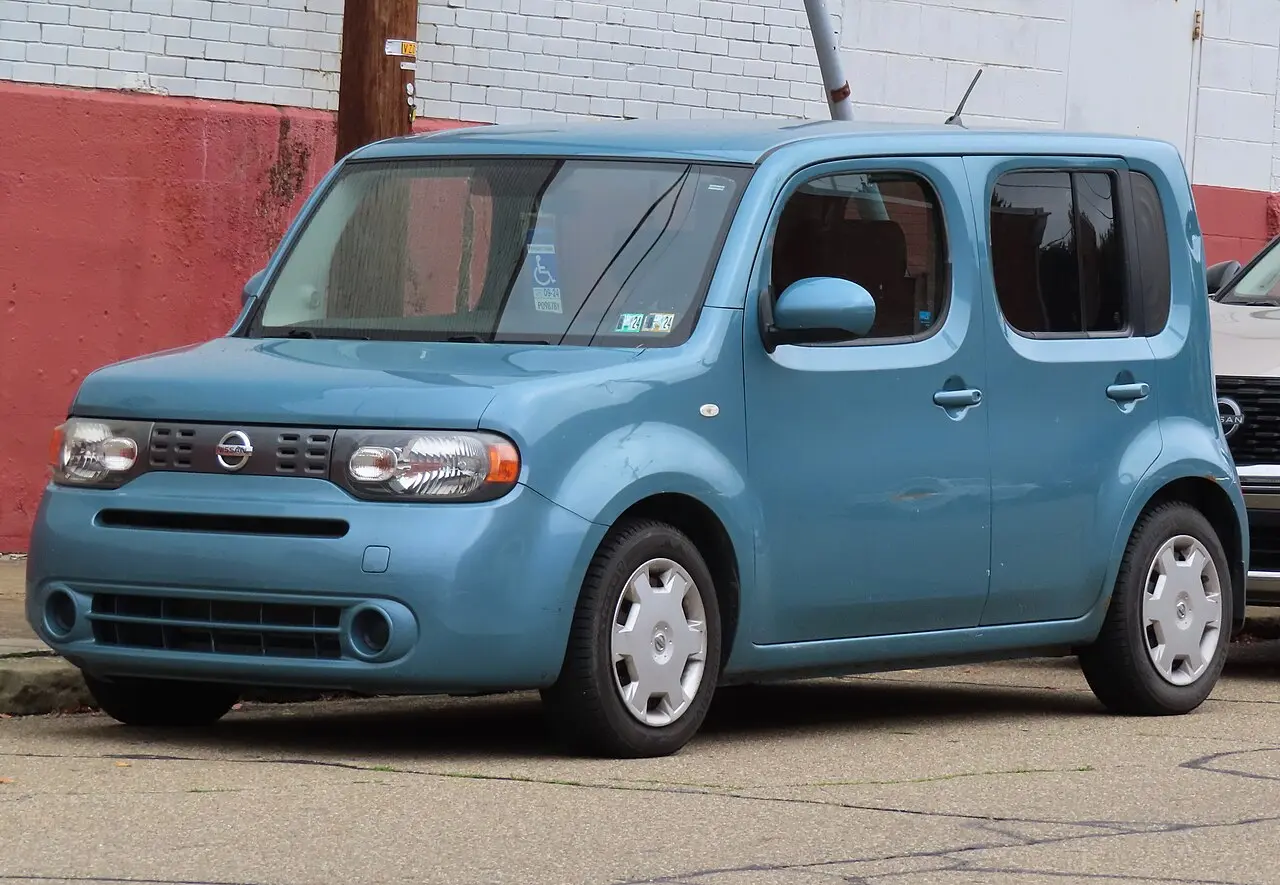
The official data lists 25 versions of the Nissan Cube (2009–2014), in the European Union, the United Kingdom, France, the United States, and Canada. Each market publishes its own figures, measured on its own test procedure.
At a glance
Years in the data
2009–2014
Markets
European Union, United Kingdom, France, United States, Canada
Engines
1.5 L to 1.8 L
Power
81 kW (110 PS)
Fuels
Petrol, Diesel
Lowest consumption (United Kingdom)
5.2 L/100 km (NEDC)
Lowest consumption (France)
6.6 L/100 km (NEDC)
Lowest consumption (United States)
8.1 L/100 km (EPA)
New registrations in the EU
10,648
What is the Nissan Cube?
The Cube is a small, box-shaped hatchback with an upright body and a cabin-focused layout. Its compact shape lends itself to city driving and everyday errands. The third generation, code Z12, is the version represented in the market figures.
The third-generation Cube stands out for its asymmetrical rear window and side-opening rear door. Nissan also gave the cabin distinctive touches, including a wraparound rear window and changeable footwell lighting on the US model.
Generation and engines
The third generation ran from 2009 to 2014. Listed years are 2010 to 2012 in the EU and UK, 2009 to 2014 in the US, and 2010 to 2013 in Canada.
EU and UK listings include 1.5-litre and 1.6-litre petrol or diesel versions, with a listed output of 81 kW (110 PS). France’s ADEME entry lists petrol versions at that output. US and Canadian versions used a 1.8-litre petrol engine.
Fuel consumption and CO₂
The lowest listed consumption is 5.2 L/100 km in the UK VCA figures, measured under NEDC. France’s ADEME listing gives 6.6 L/100 km, also on NEDC. The US EPA figure is 8.1 L/100 km, with a best combined rating of 29 MPG; Canada’s NRCan 5-cycle figure is also 8.1 L/100 km. Test procedures differ, so results are best read within their own markets.
EU registration figures total 10,648 Cubes. The largest listed annual entry is the 1.6-litre petrol version in 2010, with 6,726 registrations.
Where was the Cube sold?
The third-generation Cube appears in figures for the EU, the UK, France, the United States and Canada. Its upright shape, asymmetrical rear window and side-opening door give it a distinctive place in Nissan’s small-car range.
Questions and answers
What engine did the European Nissan Cube use?
Listed European versions include 1.5-litre and 1.6-litre petrol or diesel engines.
What was the lowest listed fuel consumption?
The UK VCA figures list 5.2 L/100 km on the NEDC test.
What was distinctive about the Cube’s design?
The third-generation model had an asymmetrical rear window and a side-opening rear door.
How economical was the US Cube according to the EPA?
Its best combined EPA rating was 29 MPG, with a listed consumption of 8.1 L/100 km.
Model codes: Z12 · Sold in: France, European Union, United States, Canada, and United Kingdom · References: en.wikipedia.org, goodcarbadcar.net
European Union 5 versions
New cars registered in the EU (plus Norway and Iceland), from the European Environment Agency. Figures on the NEDC procedure until 2020 and on WLTP from 2021; versions are grouped by engine and power, with their number of registrations.
Years and version
Engine
Power
Fuel
CO₂
EU registrations
2012
1.6 L
81 kW (110 PS)
Petrol
151 g/km
120
2011
1.6 L
81 kW (110 PS)
Petrol
152 g/km
1,616
2011
1.5 L
81 kW (110 PS)
Diesel
135 g/km
854
2010
1.6 L
–
Petrol
155 g/km
6,726
2010
1.5 L
–
Diesel
135 g/km
1,332
United Kingdom 5 versions
New cars on sale in the UK, from the Vehicle Certification Agency. NEDC figures until 2018 and WLTP figures after; years are the editions a version appeared in.
Years and version
Engine
Power
Fuel
Gearbox
Consumption (combined)
CO₂
20121.6
1.6 L
–
Petrol
5-speed manual
6.6 L/100 km NEDC
151 g/km
20121.6
1.6 L
–
Petrol
Continuously variable (CVT)
7.0 L/100 km NEDC
159 g/km
20101.5 dCi 81kW
1.5 L
81 kW (110 PS)
Diesel
6-speed manual
5.2 L/100 km NEDC
135 g/km
20101.6
1.6 L
–
Petrol
5-speed manual
6.6 L/100 km NEDC
151 g/km
20101.6
1.6 L
–
Petrol
Continuously variable (CVT)
7.0 L/100 km NEDC
159 g/km
France 2 versions
New cars on sale in France, from ADEME Car Labelling. NEDC figures until 2015, WLTP figures in the current catalogue.
Years and version
Engine
Power
Fuel
Gearbox
Consumption (combined)
CO₂
2012CUBE 1.6 CVT
–
81 kW (110 PS)
Petrol
Continuously variable (CVT)
7.0 L/100 km NEDC
159 g/km
2012CUBE 1.6
–
81 kW (110 PS)
Petrol
5-speed manual
6.6 L/100 km NEDC
151 g/km
United States 9 versions
Model years sold in the USA, from the EPA and the Department of Energy (fueleconomy.gov). MPG on the EPA test; litres per 100 km = 235.215 ÷ MPG.
Years and version
Engine
Fuel
Gearbox
Drive
Consumption (combined)
CO₂
2013–2014
1.8 L
Petrol
6-speed manual
Front-wheel drive
27 MPG (8.7 L/100 km) EPA
208 g/km
2014
1.8 L
Petrol
Continuously variable (CVT)
Front-wheel drive
28 MPG (8.4 L/100 km) EPA
196 g/km
2013
1.8 L
Petrol
Continuously variable (CVT)
Front-wheel drive
28 MPG (8.4 L/100 km) EPA
195 g/km
2011–2012
1.8 L
Petrol
Continuously variable (CVT)
Front-wheel drive
28 MPG (8.4 L/100 km) EPA
197 g/km
2011–2012
1.8 L
Petrol
6-speed manual
Front-wheel drive
27 MPG (8.7 L/100 km) EPA
205 g/km
2010
1.8 L
Petrol
6-speed manual
Front-wheel drive
27 MPG (8.7 L/100 km) EPA
205 g/km
2010
1.8 L
Petrol
Continuously variable (CVT)
Front-wheel drive
29 MPG (8.1 L/100 km) EPA
190 g/km
2009
1.8 L
Petrol
Continuously variable (CVT)
Front-wheel drive
29 MPG (8.1 L/100 km) EPA
190 g/km
2009
1.8 L
Petrol
6-speed manual
Front-wheel drive
26 MPG (9.0 L/100 km) EPA
212 g/km
Canada 4 versions
Model years sold in Canada, from Natural Resources Canada fuel consumption ratings (5-cycle test).
Years and version
Engine
Fuel
Gearbox
Consumption (combined)
CO₂
2011–2013Station wagon: Small
1.8 L
Petrol
Continuously variable (CVT)
8.2 L/100 km 5-cycle
189 g/km
2011–2013Station wagon: Small
1.8 L
Petrol
6-speed manual
8.8 L/100 km 5-cycle
202 g/km
2010Station wagon: Small
1.8 L
Petrol
Continuously variable (CVT)
8.1 L/100 km 5-cycle
186 g/km
2010Station wagon: Small
1.8 L
Petrol
6-speed manual
8.7 L/100 km 5-cycle
200 g/km
Official figures are measured on standard test procedures and differ between markets. Your consumption depends on how, where and in what conditions you drive.