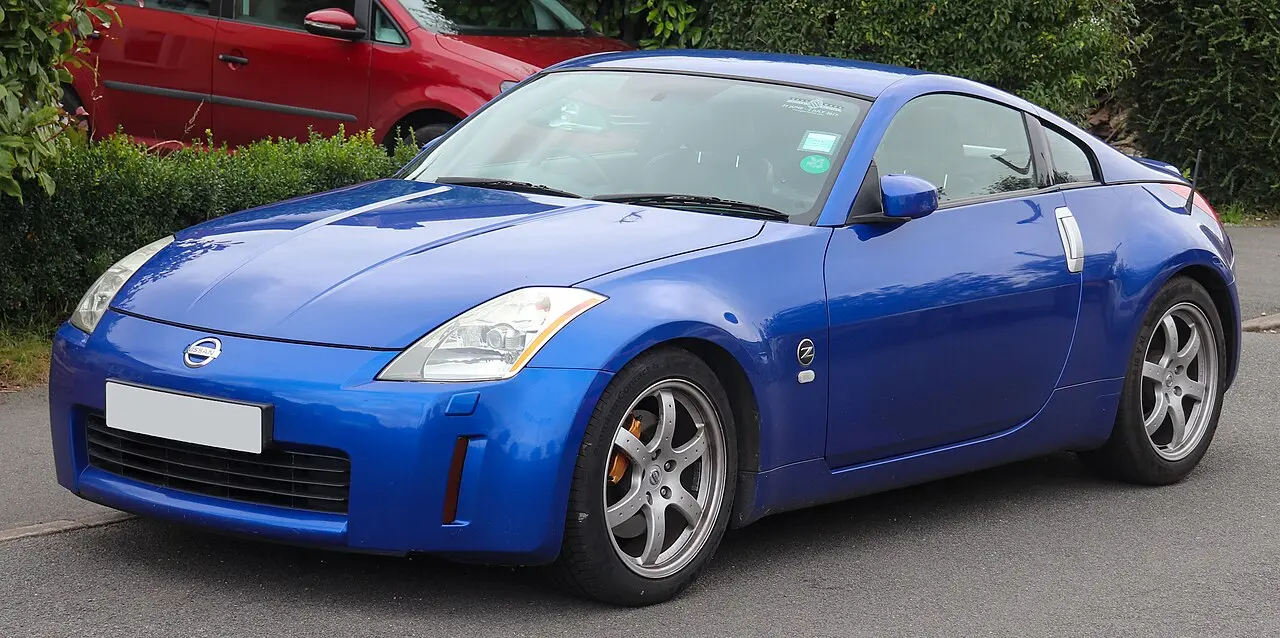
The official data lists 32 versions of the Nissan 350Z (2003–2010), in the European Union, the United Kingdom, the United States, and Canada. Each market publishes its own figures, measured on its own test procedure.
At a glance
Years in the data
2003–2010
Markets
European Union, United Kingdom, United States, Canada
Engines
3.5 L to 3.5 L
Fuels
Petrol
Lowest consumption (United Kingdom)
11.4 L/100 km (NEDC)
Lowest consumption (Canada)
11.7 L/100 km (5-cycle)
Lowest consumption (United States)
11.8 L/100 km (EPA)
New registrations in the EU
56
What is the Nissan 350Z?
The 350Z is a two-seat sports car in Nissan’s Z-car line. Its coupé body and sporting character gave it a focused role in the range. The Z33 generation, sold from 2003 to 2009, brought a rounded shape with a long bonnet and compact cabin.
Engine and power
The 350Z was listed with a 3.5 L petrol engine in the UK, USA, Canada and European Union.
How economical is the Nissan 350Z?
The lowest listed consumption is 11.4 L/100 km in the UK on NEDC, 11.8 L/100 km in the USA on the EPA test and 11.7 L/100 km in Canada on the 5-cycle test. These procedures differ, so the figures are best read as market-specific ratings. European ratings use NEDC or WLTP, the USA uses EPA testing and Canada uses the 5-cycle test.
The USA’s best listed combined rating is 20 MPG. EU registration figures show 56 registrations of the 3.5 L petrol 350Z in 2010.
Where was the 350Z sold?
The 350Z was listed in the UK from 2004 to 2009, in the USA and Canada from 2003 to 2009, and in the European Union in 2010. The Z33 generation ran from 2003 to 2009.
Questions and answers
What engine does the 350Z use?
The listed versions use a 3.5 L petrol engine.
What is the lowest official consumption figure listed?
The lowest is the UK figure of 11.4 L/100 km on NEDC.
Which markets have figures for the 350Z?
The 350Z is listed in the UK, USA, Canada and European Union.
Model codes: Z33 · Sold in: United States, Canada, and United Kingdom · References: en.wikipedia.org
United Kingdom 6 versions
New cars on sale in the UK, from the Vehicle Certification Agency. NEDC figures until 2018 and WLTP figures after; years are the editions a version appeared in.
Years and version
Engine
Fuel
Gearbox
Consumption (combined)
CO₂
2007–2009Coupé
3.5 L
Petrol
6-speed manual
11.7 L/100 km NEDC
280 g/km
2007–2009Convertible
3.5 L
Petrol
6-speed manual
12.0 L/100 km NEDC
288 g/km
20063.5 Coupé
3.5 L
Petrol
6-speed manual
11.4 L/100 km NEDC
273 g/km
2006Coupé
3.5 L
Petrol
6-speed manual
11.7 L/100 km NEDC
280 g/km
2006Convertible
3.5 L
Petrol
6-speed manual
12.0 L/100 km NEDC
288 g/km
20043.5 Coupé
3.5 L
Petrol
6-speed manual
11.4 L/100 km NEDC
273 g/km
United States 10 versions
Model years sold in the USA, from the EPA and the Department of Energy (fueleconomy.gov). MPG on the EPA test; litres per 100 km = 235.215 ÷ MPG.
Years and version
Engine
Fuel
Gearbox
Drive
Consumption (combined)
CO₂
2007–2009
3.5 L
Petrol
6-speed manual
Rear-wheel drive
20 MPG (11.8 L/100 km) EPA
276 g/km
2005–2009CLKUP
3.5 L
Petrol
5-speed automatic
Rear-wheel drive
19 MPG (12.4 L/100 km) EPA
291 g/km
2007–2008
3.5 L
Petrol
6-speed manual
Rear-wheel drive
20 MPG (11.8 L/100 km) EPA
276 g/km
2007–2008CLKUP
3.5 L
Petrol
5-speed automatic
Rear-wheel drive
20 MPG (11.8 L/100 km) EPA
276 g/km
2004–2006CLKUP
3.5 L
Petrol
5-speed automatic
Rear-wheel drive
19 MPG (12.4 L/100 km) EPA
291 g/km
2006
3.5 L
Petrol
6-speed manual
Rear-wheel drive
19 MPG (12.4 L/100 km) EPA
291 g/km
2004–2005
3.5 L
Petrol
6-speed manual
Rear-wheel drive
20 MPG (11.8 L/100 km) EPA
276 g/km
2005DVVT
3.5 L
Petrol
6-speed manual
Rear-wheel drive
20 MPG (11.8 L/100 km) EPA
276 g/km
2003–2004
3.5 L
Petrol
6-speed manual
Rear-wheel drive
20 MPG (11.8 L/100 km) EPA
276 g/km
2003–2004CLKUP
3.5 L
Petrol
5-speed automatic
Rear-wheel drive
19 MPG (12.4 L/100 km) EPA
291 g/km
Canada 15 versions
Model years sold in Canada, from Natural Resources Canada fuel consumption ratings (5-cycle test).
Years and version
Engine
Fuel
Gearbox
Consumption (combined)
CO₂
2008–2009Two-seater
3.5 L
Petrol
5-speed automatic
12.2 L/100 km 5-cycle
281 g/km
2008–2009Two-seater
3.5 L
Petrol
6-speed manual
11.9 L/100 km 5-cycle
274 g/km
2008Two-seater
3.5 L
Petrol
5-speed automatic
12.0 L/100 km 5-cycle
276 g/km
2008Two-seater
3.5 L
Petrol
6-speed manual
11.8 L/100 km 5-cycle
271 g/km
2006Two-seater
3.5 L
Petrol
5-speed automatic
12.5 L/100 km 5-cycle
288 g/km
2006Two-seater
3.5 L
Petrol
6-speed manual
12.2 L/100 km 5-cycle
281 g/km
2006Two-seater
3.5 L
Petrol
5-speed automatic
12.6 L/100 km 5-cycle
290 g/km
2006Two-seater
3.5 L
Petrol
6-speed manual
12.4 L/100 km 5-cycle
285 g/km
2003–2005Two-seater
3.5 L
Petrol
6-speed manual
11.7 L/100 km 5-cycle
269 g/km
2004–2005Two-seater
3.5 L
Petrol
6-speed manual
11.9 L/100 km 5-cycle
274 g/km
2005Two-seater
3.5 L
Petrol
5-speed automatic
12.2 L/100 km 5-cycle
281 g/km
2005Two-seater
3.5 L
Petrol
6-speed manual
12.0 L/100 km 5-cycle
276 g/km
2005Two-seater
3.5 L
Petrol
5-speed automatic
12.5 L/100 km 5-cycle
288 g/km
2003–2004Two-seater
3.5 L
Petrol
5-speed automatic
12.4 L/100 km 5-cycle
285 g/km
2004Two-seater
3.5 L
Petrol
5-speed automatic
12.8 L/100 km 5-cycle
294 g/km
Versions outside these generations
European Union 1 version
New cars registered in the EU (plus Norway and Iceland), from the European Environment Agency. Figures on the NEDC procedure until 2020 and on WLTP from 2021; versions are grouped by engine and power, with their number of registrations.
Years and version
Engine
Fuel
CO₂
EU registrations
2010
3.5 L
Petrol
284 g/km
56
Official figures are measured on standard test procedures and differ between markets. Your consumption depends on how, where and in what conditions you drive.