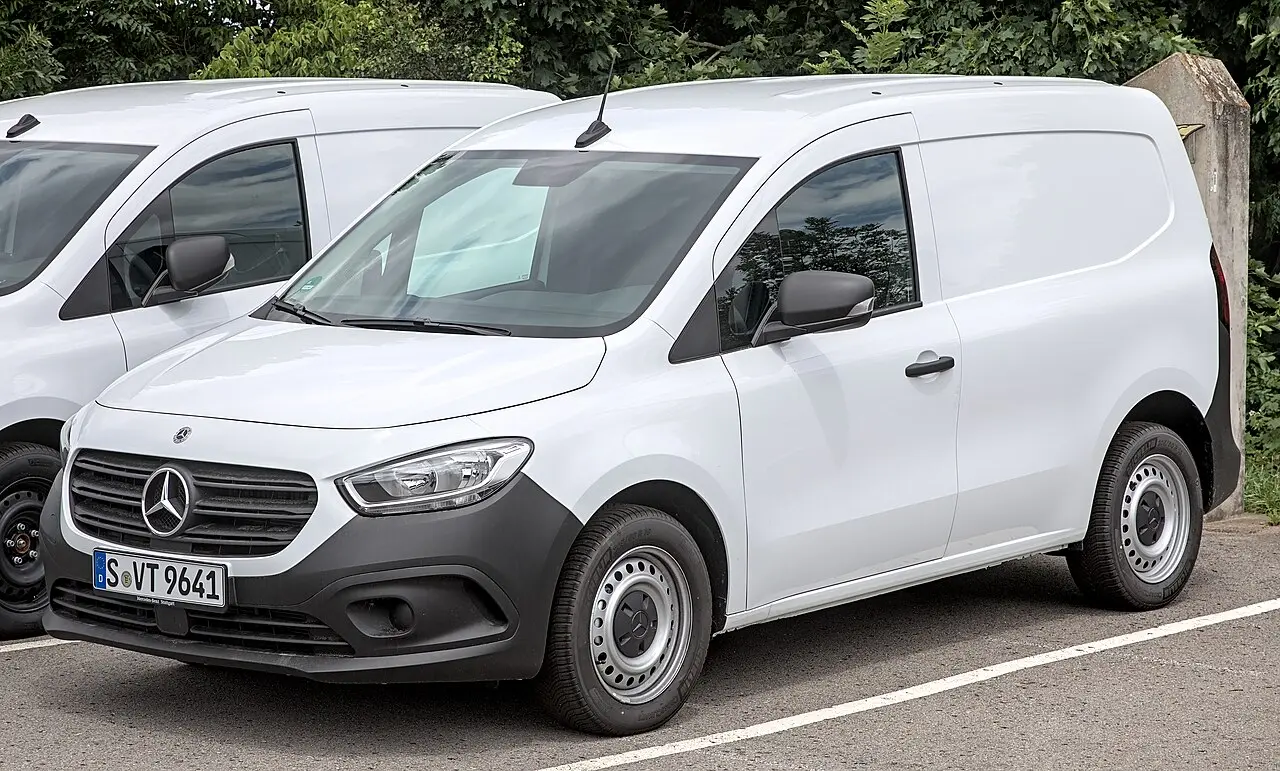
What is the Mercedes-Benz T-Class?
The T-Class is Mercedes-Benz’s small passenger van, designed for families and people who want flexible room for everyday life and leisure. Its upright body and van layout make space for passengers and luggage. Mercedes-Benz positioned it as the private-customer counterpart to the more work-focused Citan.
The first generation, W420, began in 2022. It launched as a five-seat model, with a long-wheelbase version later adding room for up to seven. The T-Class brings passenger-car comfort and equipment to Mercedes-Benz’s small-van range.
Engines and power
EU versions from 2022 to 2025 include petrol, diesel and electric power. The combustion engines range from 1.3 to 1.5 litres, while power across the versions runs from 51 kW (69 PS) to 96 kW (131 PS). The electric version is rated at 90 kW (122 PS).
The range offers petrol and diesel engines alongside a battery-electric version. Output depends on the version and model year.
How economical is the Mercedes-Benz T-Class?
The lowest listed EU fuel-consumption figure is 5.3 L/100 km on WLTP. The electric version uses electricity rather than fuel measured in litres.
The T-Class recorded 6,967 EU registrations from 2022 to 2025. Among the listed entries, the 1.3-litre petrol version rated at 96 kW (131 PS) and the 1.5-litre diesel rated at 85 kW (116 PS) had the most registrations in 2025, with 2,887 and 2,471 respectively. The electric 90 kW (122 PS) version recorded 889.
Where was the T-Class sold?
The T-Class is a small van for private customers, complementing the work-focused Citan in Mercedes-Benz’s van range. Its tall body and flexible cabin suit households that need room for passengers and everyday luggage.
Questions and answers
When did the Mercedes-Benz T-Class arrive?
The first generation, W420, began in 2022.
What engines are available?
EU versions include 1.3-litre petrol, 1.5-litre diesel and electric power. Power ranges from 51 kW (69 PS) to 96 kW (131 PS), with the electric version rated at 90 kW (122 PS).
How many seats does the T-Class have?
It launched as a five-seat model, and a long-wheelbase version can seat up to seven.
What is its lowest listed fuel consumption?
The lowest listed EU figure is 5.3 L/100 km on the WLTP test.