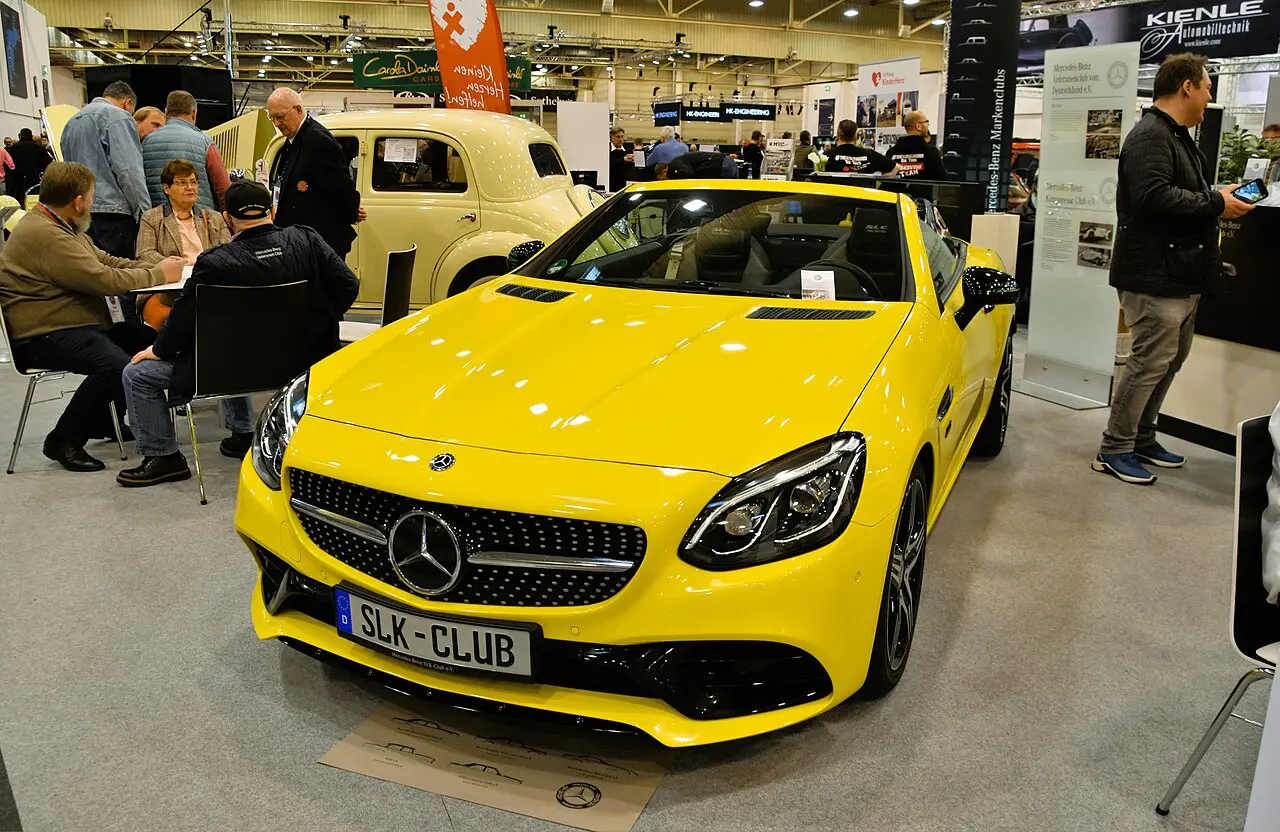
The official data lists 57 versions of the Mercedes-Benz SLC (2016–2021), in the European Union, the United Kingdom, the United States, and Canada. Each market publishes its own figures, measured on its own test procedure.
At a glance
Years in the data
2016–2021
Markets
European Union, United Kingdom, United States, Canada
Engines
1.6 L to 3.0 L
Power
115 kW (156 PS) to 287 kW (390 PS)
Fuels
Petrol, Diesel
Lowest consumption (United Kingdom)
4.4 L/100 km (NEDC)
Lowest consumption (European Union)
6.9 L/100 km (WLTP)
Lowest consumption (Canada)
8.5 L/100 km (5-cycle)
New registrations in the EU
50,199
What is the Mercedes-Benz SLC?
The SLC is a two-seat roadster with a retractable hardtop. With the roof closed it has the look and feel of a coupe; lower it and the cabin opens to the sky. It sat below the larger SL in Mercedes-Benz’s range and carried on the compact roadster tradition begun by the SLK.
Mercedes-Benz introduced the SLK in 1996. In 2016, the third-generation SLK was updated and renamed SLC, a nod to its close technical ties with the C-Class. The R172 kept the familiar two-seat, folding-hardtop format while gaining revised styling and technology.
Generations and engines
The SLC was sold from 2016 to 2021 as the R172, an updated version of the third-generation SLK. The new name and refreshed styling marked the change, while the compact roadster layout remained.
In the EU, engines ranged from 1.6 to 3.0 litres, with power from 115 kW (156 PS) to 287 kW (390 PS). Petrol and diesel versions were available, along with versions classified as other fuel types in EU registration figures. UK versions ranged from 135 kW (184 PS) to 287 kW (390 PS). US and Canadian versions were petrol-powered, with engines from 2.0 to 3.0 litres.
How economical is the Mercedes-Benz SLC?
The lowest listed EU figure is 6.9 L/100 km on WLTP. In the UK, the lowest is 4.4 L/100 km on NEDC. In the US, the EPA figure is 8.7 L/100 km, or 27 MPG combined; Canada’s lowest listed result is 8.5 L/100 km on the NRCan 5-cycle test. WLTP and NEDC are European procedures, while the US EPA and Canadian 5-cycle tests use different methods, so figures across markets are not directly comparable.
Where was the SLC sold?
The SLC appears in EU registration figures from 2016 to 2021 and UK figures over the same period. US and Canadian figures cover 2017 to 2020. EU registrations total 50,199. The leading EU versions included the 2.1-litre diesel rated at 150 kW (204 PS), the 2.0-litre petrol at 135 kW (184 PS), and the 1.6-litre petrol at 115 kW (156 PS).
Questions and answers
Was the SLC a convertible or a coupe?
It was a two-seat roadster with a retractable hardtop, so it could be driven with the roof open or closed.
How many SLC generations were there?
The SLC was the R172, sold from 2016 to 2021 as an updated version of the third-generation SLK.
What was the most powerful SLC listed in the EU?
The top of the EU power range was 287 kW (390 PS).
Which SLC fuel economy figure should I use?
Use the figure for your market and test procedure: EU WLTP starts at 6.9 L/100 km, UK NEDC at 4.4, US EPA at 8.7, and Canada’s 5-cycle result at 8.5. The procedures differ.
New cars registered in the EU (plus Norway and Iceland), from the European Environment Agency. Figures on the NEDC procedure until 2020 and on WLTP from 2021; versions are grouped by engine and power, with their number of registrations.
Years and version
Engine
Power
Fuel
Consumption (combined)
CO₂
EU registrations
2021
2.0 L
135 kW (184 PS)
Petrol
6.9 L/100 km WLTP
174 g/km
56
2021
2.0 L
180 kW (245 PS)
Petrol
7.5 L/100 km WLTP
179 g/km
10
2020
2.0 L
135 kW (184 PS)
Petrol
–
155 g/km
2,645
2019–2020
3.0 L
287 kW (390 PS)
Petrol
–
185 g/km
899
2020
2.0 L
180 kW (245 PS)
Petrol
–
161 g/km
820
2020
1.6 L
115 kW (156 PS)
Petrol
–
145 g/km
53
2019
2.0 L
135 kW (184 PS)
Petrol
–
154 g/km
3,804
2016–2019
3.0 L
270 kW (367 PS)
Petrol
–
178 g/km
3,326
2019
1.6 L
115 kW (156 PS)
Petrol
–
144 g/km
2,372
2019
2.0 L
180 kW (245 PS)
Petrol
–
159 g/km
1,128
2016–2018
2.1 L
150 kW (204 PS)
Diesel
–
114 g/km
8,456
2018
2.0 L
135 kW (184 PS)
Petrol
–
142 g/km
4,732
2018
1.6 L
115 kW (156 PS)
Petrol
–
136 g/km
3,180
2018
2.0 L
180 kW (245 PS)
Petrol
–
148 g/km
970
2018
3.0 L
287 kW (390 PS)
Petrol
–
186 g/km
146
2017
2.0 L
135 kW (184 PS)
Petrol
–
139 g/km
6,026
2016–2017
1.6 L
115 kW (156 PS)
Petrol
–
132 g/km
4,890
2017
2.0 L
180 kW (245 PS)
Petrol
–
138 g/km
834
2017
2.0 L
135 kW (184 PS)
Other fuel
–
141 g/km
174
2017
2.0 L
180 kW (245 PS)
Other fuel
–
138 g/km
72
2017
2.0 L
203 kW (276 PS)
Petrol
–
137 g/km
30
2017
2.0 L
270 kW (367 PS)
Petrol
–
138 g/km
24
2016
2.0 L
135 kW (184 PS)
Petrol
–
141 g/km
4,682
2016
2.0 L
180 kW (245 PS)
Petrol
–
139 g/km
870
United Kingdom 21 versions
New cars on sale in the UK, from the Vehicle Certification Agency. NEDC figures until 2018 and WLTP figures after; years are the editions a version appeared in.
Years and version
Engine
Power
Fuel
Gearbox
Consumption (combined)
CO₂
2020–2021SLC 200
2.0 L
135 kW (184 PS)
Petrol
9-speed automatic
7.3 L/100 km WLTP
166 g/km
2020–2021SLC 200
2.0 L
135 kW (184 PS)
Petrol
9-speed automatic
7.8 L/100 km WLTP
178 g/km
2020–2021SLC 200
2.0 L
135 kW (184 PS)
Petrol
6-speed manual
7.0 L/100 km WLTP
159 g/km
2020–2021SLC 200
2.0 L
135 kW (184 PS)
Petrol
6-speed manual
7.6 L/100 km WLTP
171 g/km
2020–2021SLC 300
2.0 L
180 kW (245 PS)
Petrol
9-speed automatic
7.6 L/100 km WLTP
171 g/km
2020–2021SLC 300
2.0 L
180 kW (245 PS)
Petrol
9-speed automatic
8.0 L/100 km WLTP
182 g/km
2020–2021AMG SLC 43
3.0 L
287 kW (390 PS)
Petrol
9-speed automatic
8.7 L/100 km WLTP
197 g/km
2020–2021AMG SLC 43
3.0 L
287 kW (390 PS)
Petrol
9-speed automatic
8.9 L/100 km WLTP
201 g/km
2018SLC 180 with 17'' rear wheels · SLC 180 with 18'' rear wheels
1.6 L
–
Petrol
6-speed manual
5.8 L/100 km NEDC
132 g/km
2018SLC 180 with 17'' rear wheels · SLC 180 with 18'' rear wheels
1.6 L
–
Petrol
9-speed automatic
5.8 L/100 km NEDC
133 g/km
2018SLC 180 with 18'' rear wheels
1.6 L
–
Petrol
9-speed automatic
6.3 L/100 km NEDC
144 g/km
2016–2018SLC 200 with 17'' rear wheels · SLC 200 with 18'' rear wheels
2.0 L
–
Petrol
9-speed automatic
5.9 L/100 km NEDC
137 g/km
2016–2018SLC 200 with 17'' rear wheels · SLC 200 with 18'' rear wheels
2.0 L
–
Petrol
6-speed manual
6.5 L/100 km NEDC
150 g/km
2016–2018SLC 300 with 18'' rear wheels · SLC 300 with 17'' rear wheels
2.0 L
–
Petrol
9-speed automatic
6.0 L/100 km NEDC
138 g/km
2018SLC 200 with 18'' rear wheels
2.0 L
–
Petrol
8-speed automatic
7.0 L/100 km NEDC
160 g/km
2018SLC 300 with 18'' rear wheels
2.0 L
–
Petrol
9-speed automatic
7.0 L/100 km NEDC
161 g/km
2016–2018SLC 250 d with 17'' rear wheels · SLC 250 d with 18'' rear wheels
2.1 L
–
Diesel
9-speed automatic
4.4 L/100 km NEDC
114 g/km
2016–2018AMG SLC 43 with 18'' rear wheels
3.0 L
–
Petrol
9-speed automatic
7.8 L/100 km NEDC
178 g/km
2018AMG SLC 43 with 18'' rear wheels
3.0 L
–
Petrol
9-speed automatic
8.2 L/100 km NEDC
186 g/km
2016–2017SLC 180 with 18'' rear wheels
1.6 L
–
Petrol
6-speed manual
5.8 L/100 km NEDC
134 g/km
2017SLC 180 with 18'' rear wheels
1.6 L
–
Petrol
9-speed automatic
6.1 L/100 km NEDC
139 g/km
United States 5 versions
Model years sold in the USA, from the EPA and the Department of Energy (fueleconomy.gov). MPG on the EPA test; litres per 100 km = 235.215 ÷ MPG.
Years and version
Engine
Fuel
Gearbox
Drive
Consumption (combined)
CO₂
2020SIDI
2.0 L
Petrol
9-speed automatic
Rear-wheel drive
27 MPG (8.7 L/100 km) EPA
206 g/km
2019–2020SIDI
3.0 L
Petrol
9-speed automatic
Rear-wheel drive
23 MPG (10.2 L/100 km) EPA
238 g/km
2019SIDI
2.0 L
Petrol
9-speed automatic
Rear-wheel drive
27 MPG (8.7 L/100 km) EPA
205 g/km
2017–2018SIDI
2.0 L
Petrol
9-speed automatic
Rear-wheel drive
27 MPG (8.7 L/100 km) EPA
201 g/km
2017–2018SIDI
3.0 L
Petrol
9-speed automatic
Rear-wheel drive
23 MPG (10.2 L/100 km) EPA
235 g/km
Canada 7 versions
Model years sold in Canada, from Natural Resources Canada fuel consumption ratings (5-cycle test).
Years and version
Engine
Fuel
Gearbox
Consumption (combined)
CO₂
2020Two-seater
2.0 L
Petrol
9-speed automatic
8.8 L/100 km 5-cycle
206 g/km
2019–2020Two-seater
3.0 L
Petrol
9-speed automatic
10.2 L/100 km 5-cycle
238 g/km
2019Two-seater
2.0 L
Petrol
9-speed automatic
8.8 L/100 km 5-cycle
205 g/km
2018Two-seater
2.0 L
Petrol
9-speed automatic
8.6 L/100 km 5-cycle
202 g/km
2018Two-seater
3.0 L
Petrol
9-speed automatic
10.1 L/100 km 5-cycle
236 g/km
2017Two-seater
2.0 L
Petrol
9-speed automatic
8.5 L/100 km 5-cycle
200 g/km
2017Two-seater
3.0 L
Petrol
9-speed automatic
10.1 L/100 km 5-cycle
234 g/km
Official figures are measured on standard test procedures and differ between markets. Your consumption depends on how, where and in what conditions you drive.