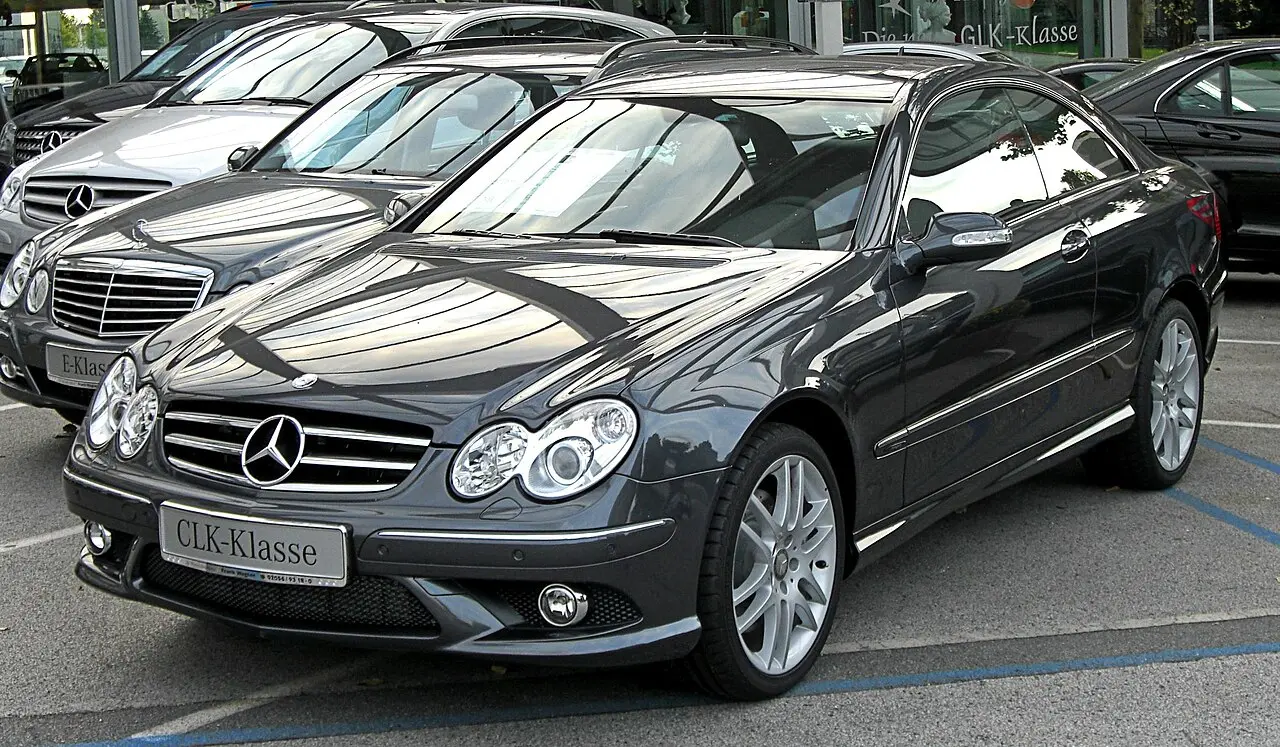
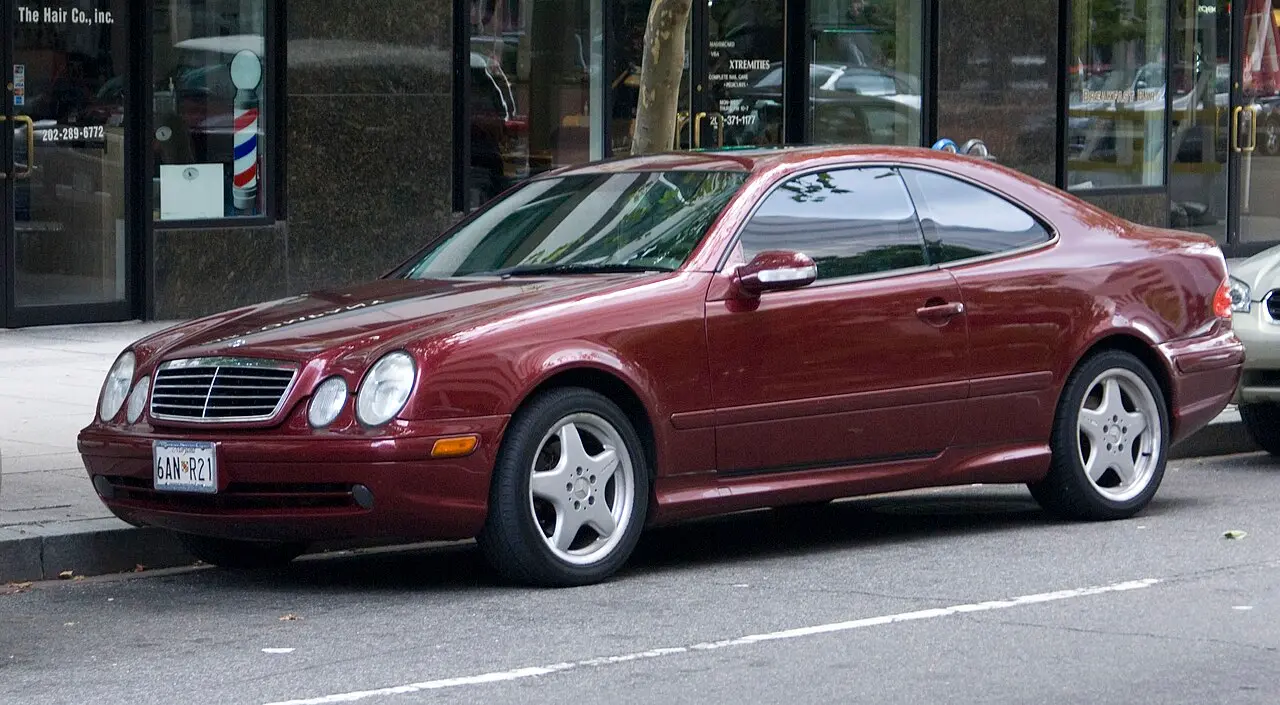
The official data lists 246 versions of the Mercedes-Benz CLK (1998–2015), in the European Union, the United Kingdom, the United States, and Canada. Each market publishes its own figures, measured on its own test procedure.
At a glance
Years in the data
1998–2015
Markets
European Union, United Kingdom, United States, Canada
Engines
1.8 L to 6.2 L
Fuels
Petrol, Diesel
Lowest consumption (United Kingdom)
6.3 L/100 km (NEDC)
Lowest consumption (United States)
10.7 L/100 km (EPA)
Lowest consumption (Canada)
10.9 L/100 km (5-cycle)
New registrations in the EU
386
What is the Mercedes-Benz CLK?
The CLK is a two-door Mercedes-Benz offered as a coupé and a cabriolet. It added a more personal shape to the range while keeping room for passengers. The cabriolet has a folding soft top, giving the model an open-air option.
The CLK was a distinct model in the Mercedes-Benz range. Its design included a twin-headlamp front and frameless side windows.
CLK generations
The first generation, the C208 coupé and A208 cabriolet, ran from 1998 to 2003. The second, the C209 coupé and A209 cabriolet, followed from 2003 to 2009. Both generations were offered as coupés and cabriolets.
Engines and fuel consumption
Engine choice varied by market. EU registration figures from 2010 to 2015 include petrol and diesel engines from 1.8 L to 3.0 L. UK VCA figures cover petrol and diesel versions from 1.8 L to 6.2 L between 2000 and 2010. US EPA and Canadian NRCan listings cover petrol engines from 3.2 L to 6.2 L between 1998 and 2009.
The lowest listed UK consumption is 6.3 L/100 km on the NEDC test. The best combined US EPA figure is 22 MPG, with a listed low of 10.7 L/100 km. Canada’s lowest listed figure is 10.9 L/100 km on the 5-cycle test. These results use different procedures: NEDC in Europe, EPA in the United States and 5-cycle in Canada.
Where was the CLK sold?
The CLK appears in figures for the European Union, the UK, the United States and Canada. The periods vary by market: EU registration figures run from 2010 to 2015, UK VCA figures from 2000 to 2010, and US and Canadian figures from 1998 to 2009.
Questions and answers
Was the CLK available as a convertible?
Yes. Both generations came as a coupé and as a cabriolet with a folding soft top.
What engine sizes are listed for the CLK in Europe?
EU registration figures include petrol and diesel engines from 1.8 L to 3.0 L.
What is the lowest listed CLK fuel consumption?
The lowest listed figure is 6.3 L/100 km on the UK NEDC test. US EPA and Canadian 5-cycle results use different procedures.
New cars on sale in the UK, from the Vehicle Certification Agency. NEDC figures until 2018 and WLTP figures after; years are the editions a version appeared in.
Model years sold in Canada, from Natural Resources Canada fuel consumption ratings (5-cycle test).
Years and version
Engine
Fuel
Gearbox
Consumption (combined)
CO₂
2007–2009Subcompact
3.5 L
Petrol
7-speed automatic
11.8 L/100 km 5-cycle
271 g/km
2008–2009Subcompact
5.5 L
Petrol
7-speed automatic
13.9 L/100 km 5-cycle
320 g/km
2008–2009Subcompact
5.5 L
Petrol
7-speed automatic
13.7 L/100 km 5-cycle
315 g/km
2009Subcompact
6.2 L
Petrol
7-speed automatic
16.5 L/100 km 5-cycle
380 g/km
2007–2008Subcompact
6.2 L
Petrol
7-speed automatic
17.0 L/100 km 5-cycle
391 g/km
2007Subcompact
5.5 L
Petrol
7-speed automatic
13.8 L/100 km 5-cycle
317 g/km
2007Subcompact
5.5 L
Petrol
7-speed automatic
13.7 L/100 km 5-cycle
315 g/km
2006Subcompact
3.5 L
Petrol
7-speed automatic
11.7 L/100 km 5-cycle
269 g/km
2006Subcompact
3.5 L
Petrol
7-speed automatic
12.3 L/100 km 5-cycle
283 g/km
2005–2006Subcompact
5.0 L
Petrol
7-speed automatic
13.2 L/100 km 5-cycle
304 g/km
2006Subcompact
5.4 L
Petrol
5-speed automatic
14.0 L/100 km 5-cycle
322 g/km
2004–2005Subcompact
3.2 L
Petrol
5-speed automatic
11.7 L/100 km 5-cycle
269 g/km
2005Subcompact
3.2 L
Petrol
5-speed automatic
11.5 L/100 km 5-cycle
265 g/km
2005Subcompact
5.4 L
Petrol
7-speed automatic
13.2 L/100 km 5-cycle
304 g/km
2005Subcompact
5.4 L
Petrol
5-speed automatic
14.4 L/100 km 5-cycle
331 g/km
2005Subcompact
5.4 L
Petrol
5-speed automatic
14.2 L/100 km 5-cycle
327 g/km
2004Subcompact
5.0 L
Petrol
5-speed automatic
13.8 L/100 km 5-cycle
317 g/km
2004Subcompact
5.4 L
Petrol
5-speed automatic
14.6 L/100 km 5-cycle
336 g/km
2003Subcompact
3.2 L
Petrol
5-speed automatic
11.9 L/100 km 5-cycle
274 g/km
2003Subcompact
3.2 L
Petrol
5-speed automatic
11.8 L/100 km 5-cycle
271 g/km
2003Subcompact
4.3 L
Petrol
5-speed automatic
13.0 L/100 km 5-cycle
299 g/km
2003Subcompact
5.0 L
Petrol
5-speed automatic
13.9 L/100 km 5-cycle
320 g/km
Versions outside these generations
European Union 12 versions
New cars registered in the EU (plus Norway and Iceland), from the European Environment Agency. Figures on the NEDC procedure until 2020 and on WLTP from 2021; versions are grouped by engine and power, with their number of registrations.
Years and version
Engine
Power
Fuel
CO₂
EU registrations
2015
1.8 L
120 kW (163 PS)
Petrol
208 g/km
10
2014
2.1 L
–
Diesel
156 g/km
10
2011
3.0 L
165 kW (224 PS)
Diesel
199 g/km
14
2011
2.1 L
110 kW (150 PS)
Diesel
179 g/km
12
2010
1.8 L
–
Petrol
211 g/km
106
2010
2.1 L
–
Diesel
177 g/km
68
2010
3.0 L
–
Diesel
200 g/km
64
2010
–
–
Petrol
207 g/km
46
2010
2.1 L
–
Diesel
175 g/km
16
2010
2.7 L
–
Diesel
184 g/km
14
2010
3.2 L
–
Petrol
229 g/km
14
2010
6.2 L
–
Petrol
352 g/km
12
Official figures are measured on standard test procedures and differ between markets. Your consumption depends on how, where and in what conditions you drive.